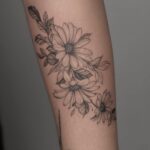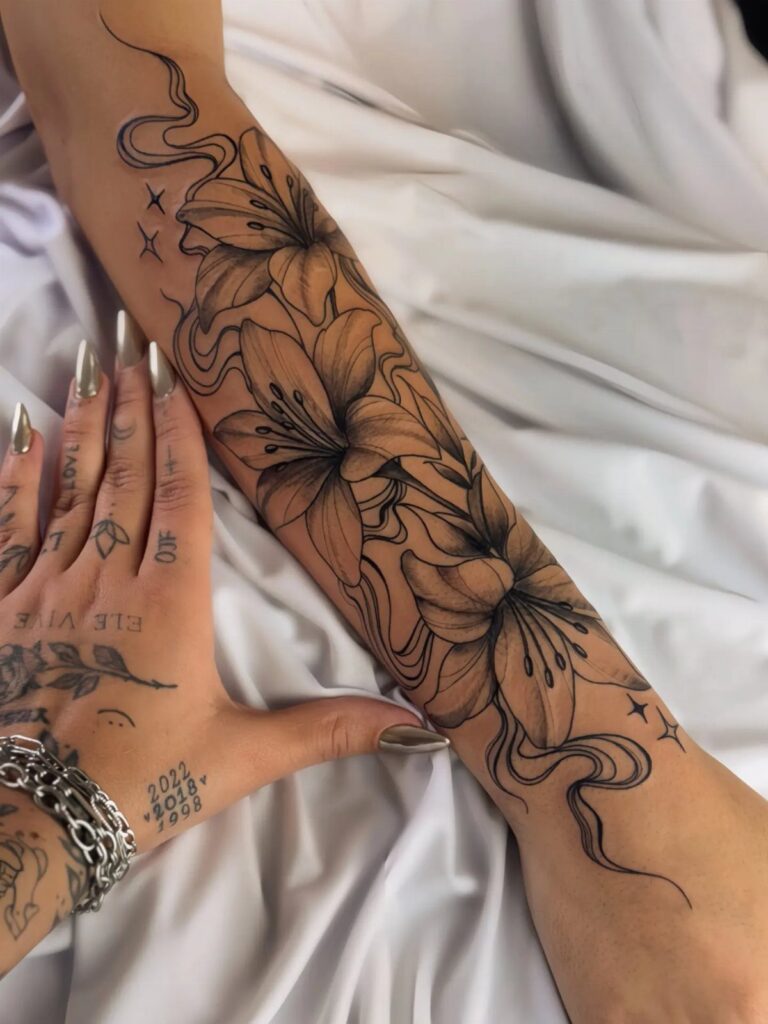
Flower tattoos on the arm range from a fine-line cluster on the forearm that takes one session to a full sleeve requiring multiple sittings spread across months.
1. Fine-line Flower Cluster Forearm Tattoo
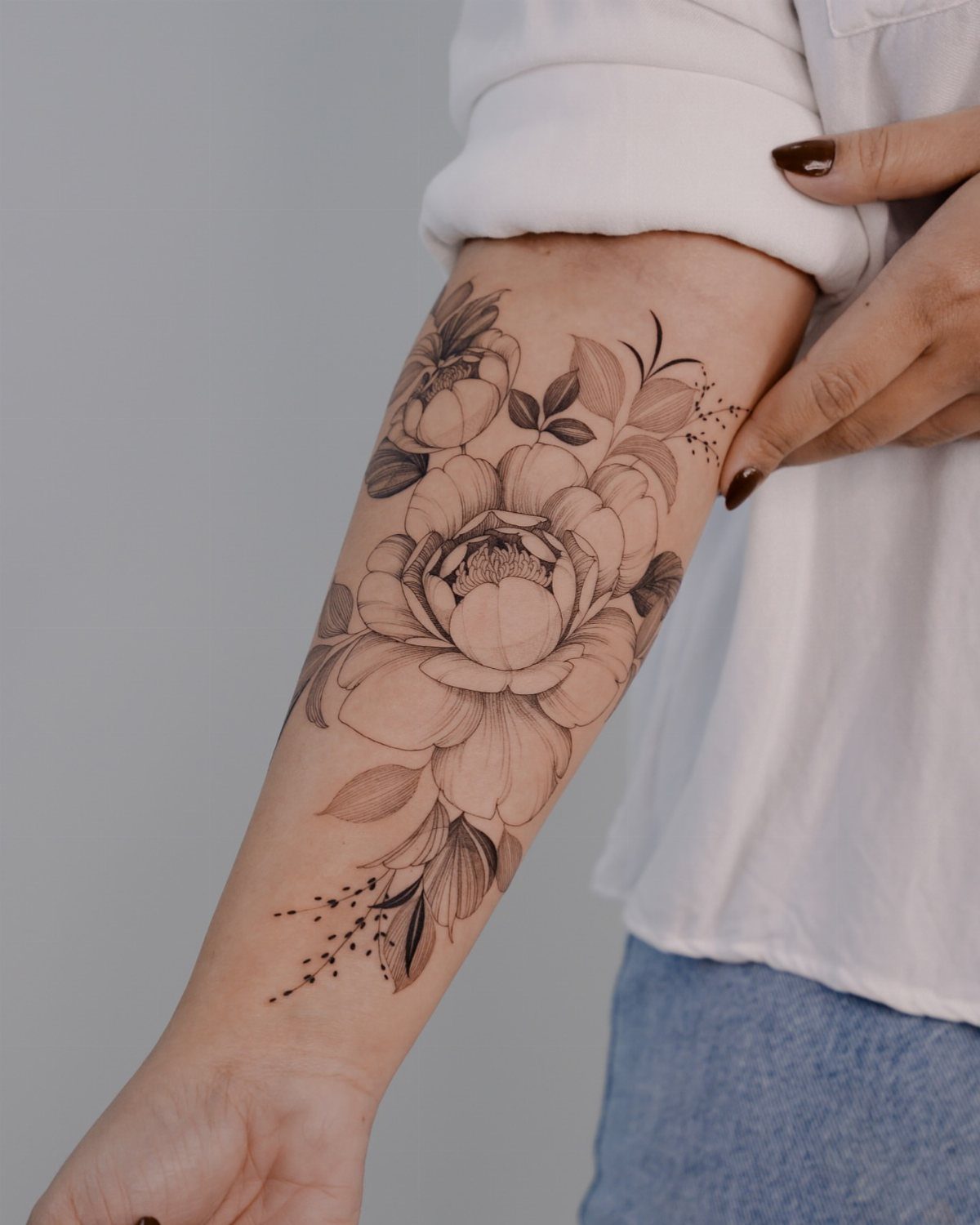
A cluster of fine-line flowers on the forearm gives you detail without weight.
The petals and leaves sit close together but stay legible because the lines are thin and evenly spaced, so the design reads clearly from a distance and holds up as the ink settles.
Forearm placement keeps the tattoo visible without committing to a full sleeve. The relatively flat surface means the artist can work with fewer contour adjustments, and healing is straightforward since the skin moves less here than at joints.
If you want florals that feel modern and understated, fine line does that better than bold traditional work.
2. Vertical Flower Arrangement
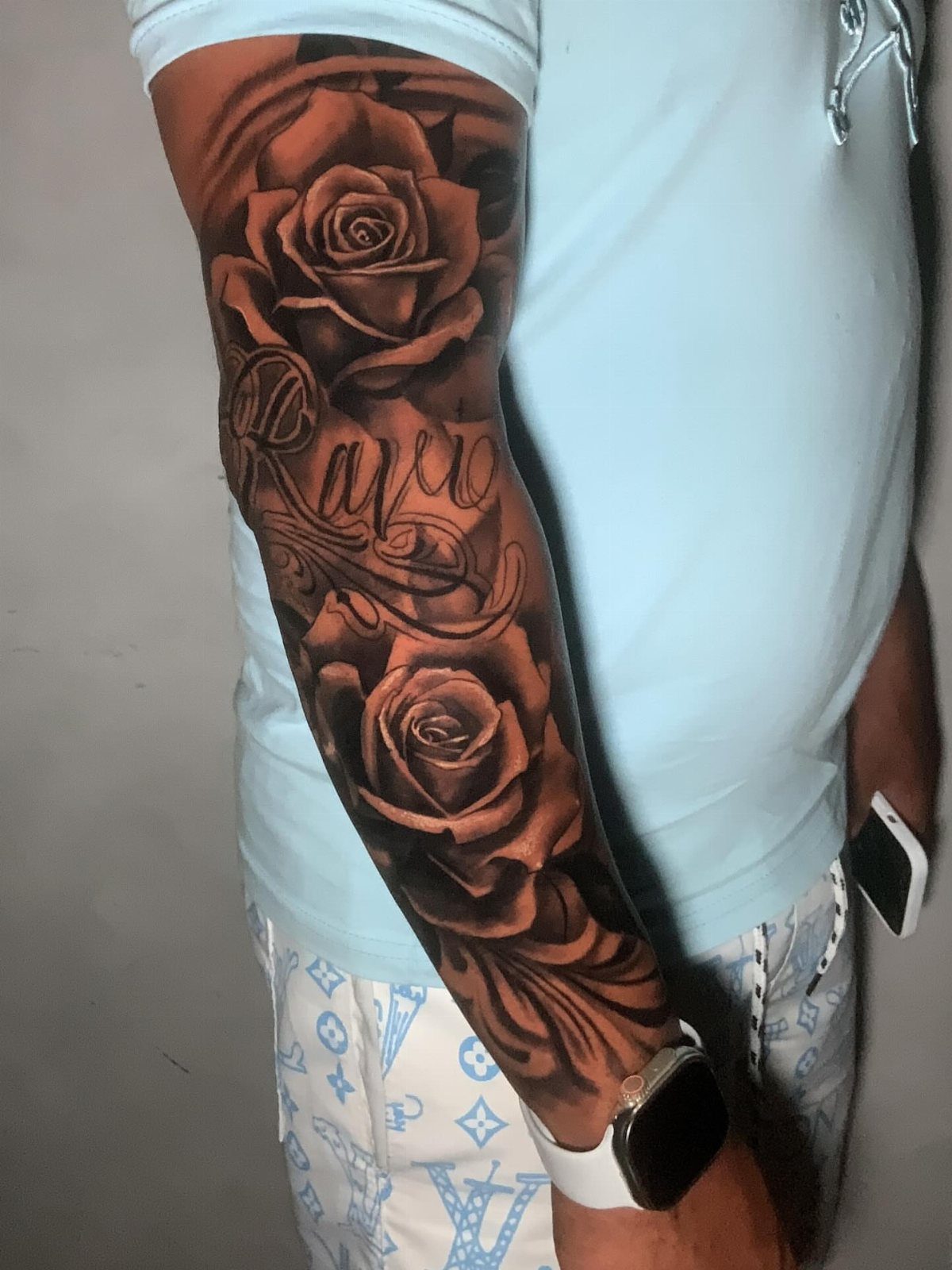
Arranging flowers vertically lets you follow the length of the forearm rather than fighting it. Roses stacked with script or other elements create a clear focal line, and the composition stays readable whether your arm is bent or straight.
Black and grey shading gives the roses dimension without color, which ages more predictably. The technique relies on contrast, so darker petals sit against lighter backgrounds and the design doesn’t flatten out over time.
Vertical flow works especially well if you’re adding to the piece later, since you can extend upward toward the elbow or down toward the wrist without reworking the original layout.
3. Botanical Vine Tattoo
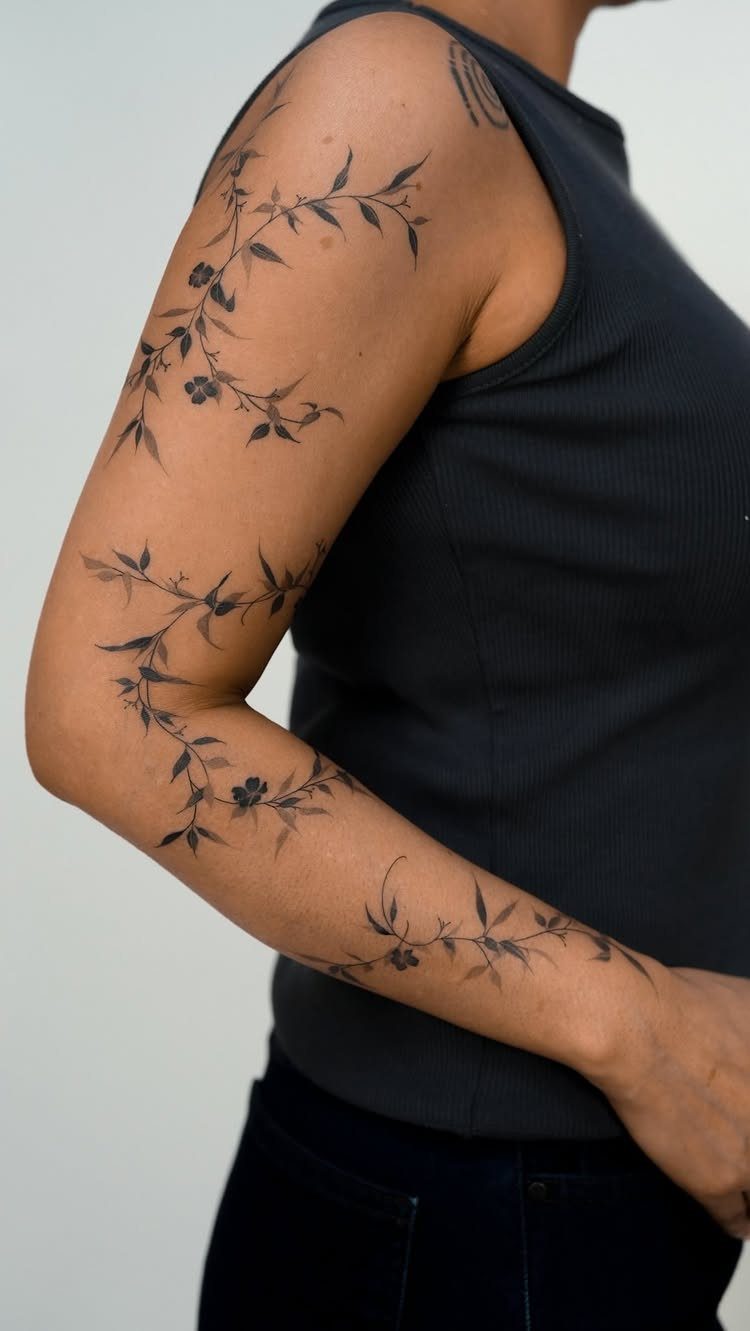
Vines wrap the natural curve of the arm instead of sitting flat on one side. Leaves and small flowers follow the contour, so the tattoo moves with you and reads differently depending on how you hold your arm.
Black ink keeps the botanical look clean and lets the line weight carry the design. Thicker lines for the main vine and finer ones for leaves create depth without shading, which means faster healing and less touch-up down the line.
This style suits people who want coverage without committing to a solid sleeve, since the negative space between elements keeps the skin visible.
4. Lotus Flower Tattoo
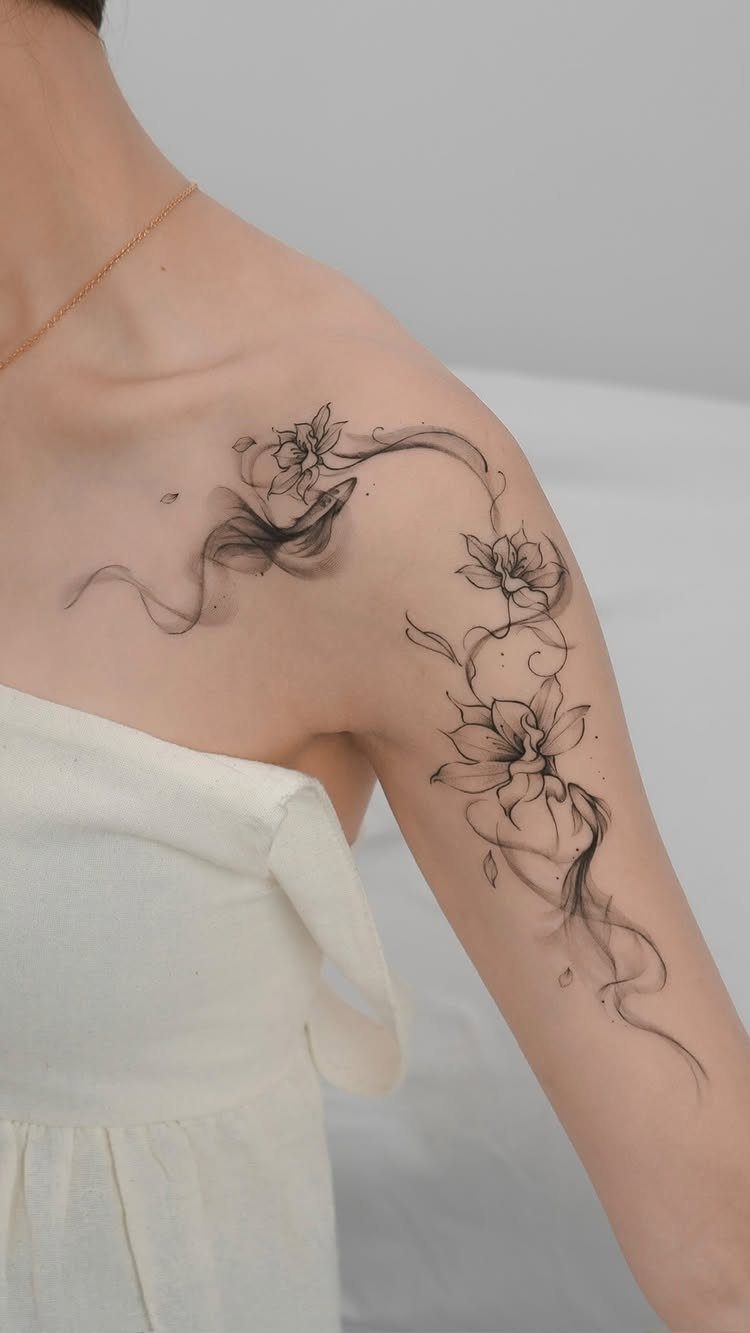
Lotus flowers on the shoulder and upper arm give you a design that flows across 2 surfaces, so the composition feels larger than the actual inked area.
The petals sit on the shoulder while decorative lines extend down the arm, connecting the two without filling everything in between.
The upper arm and shoulder heal well because clothing rarely rubs directly on them, and the placement stays easy to cover when you need to.
Lotus works particularly well in black ink because the petal structure is recognizable even without shading, and the decorative swirls add movement without requiring color to make them read.
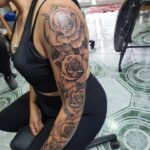
5. Floral Sleeve Tattoo
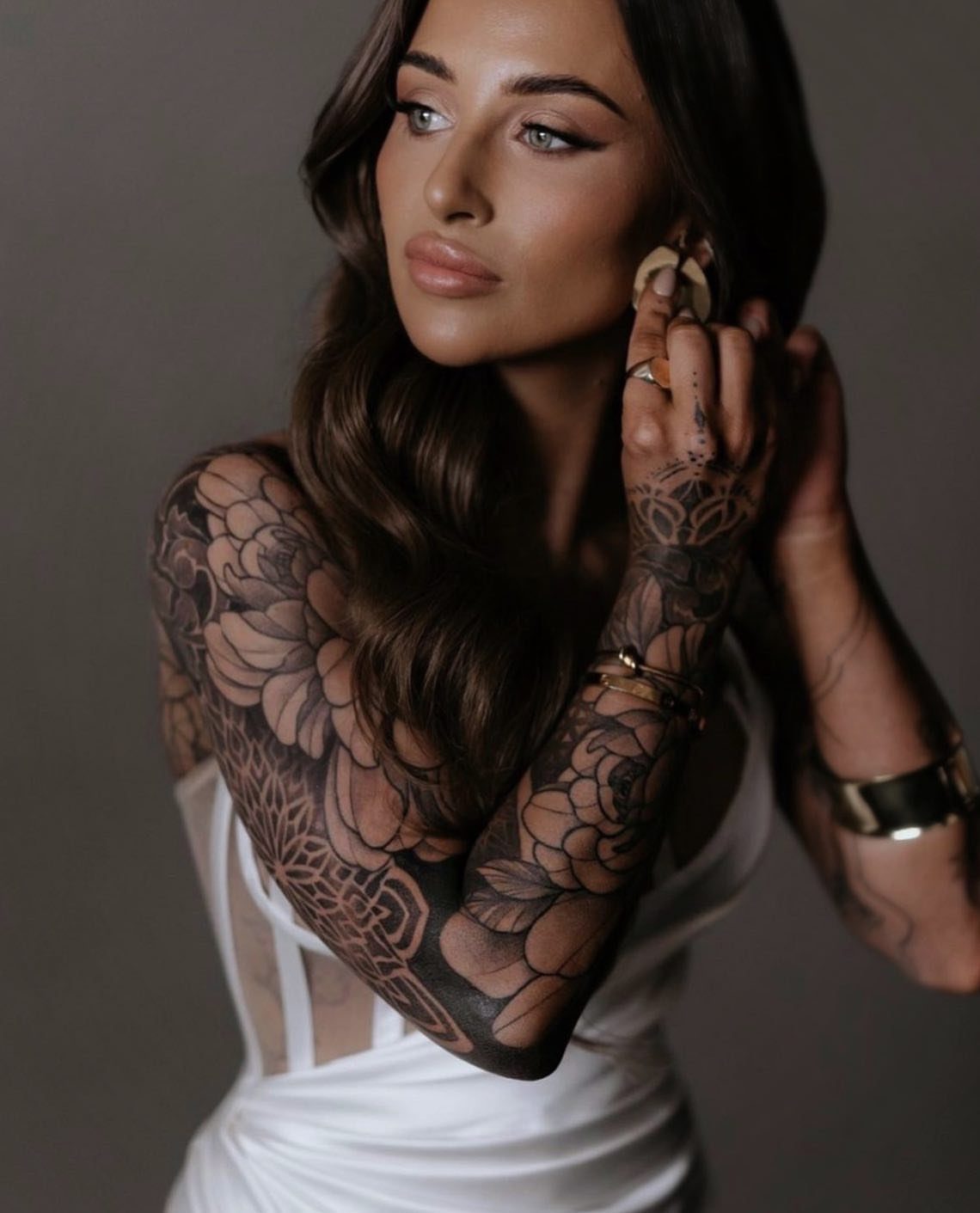
A full sleeve commits the entire arm to one cohesive floral design, and that means planning the layout so flowers of different sizes fill the space without leaving awkward gaps.
Larger blooms anchor the composition at the shoulder or forearm, while smaller flowers and leaves fill the transitions.
Black ink across a full sleeve takes multiple sessions, and each one is long enough that you’ll want breaks. Healing happens in stages, so you’ll finish one section before starting the next.
Sleeves suit people who already know they want extensive work and don’t mind the time or the visibility, since covering a full sleeve requires long sleeves year-round.
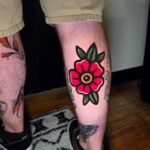
6. Colorful Flower Tattoo
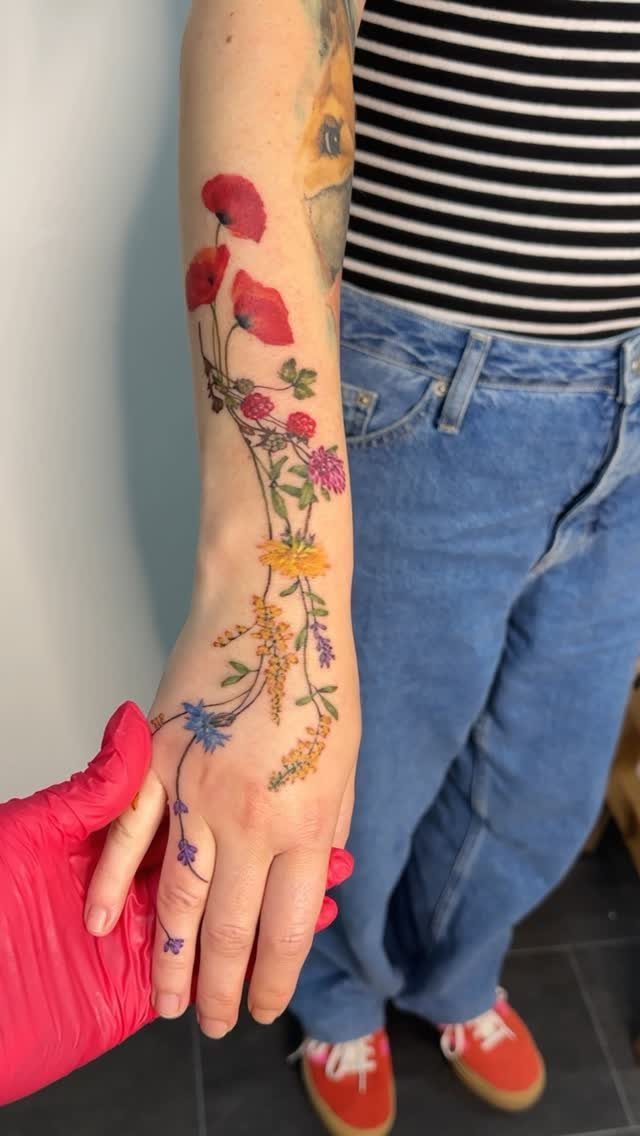
Color brings florals to life in a way black ink can’t match, but it also fades faster and requires more frequent touch-ups to stay saturated.
Reds, yellows and purples age at different rates, so expect the yellow to lighten first while the red holds longer.
Placement on the forearm and hand means the tattoo gets constant sun exposure, which accelerates fading. Sunscreen becomes part of the maintenance, not optional, if you want the colors to last more than a few years without a refresh.
If you’re drawn to bright, garden-style florals and don’t mind the upkeep, color delivers impact that monochrome can’t.
7. Single Line Flower Upper Arm Tattoo
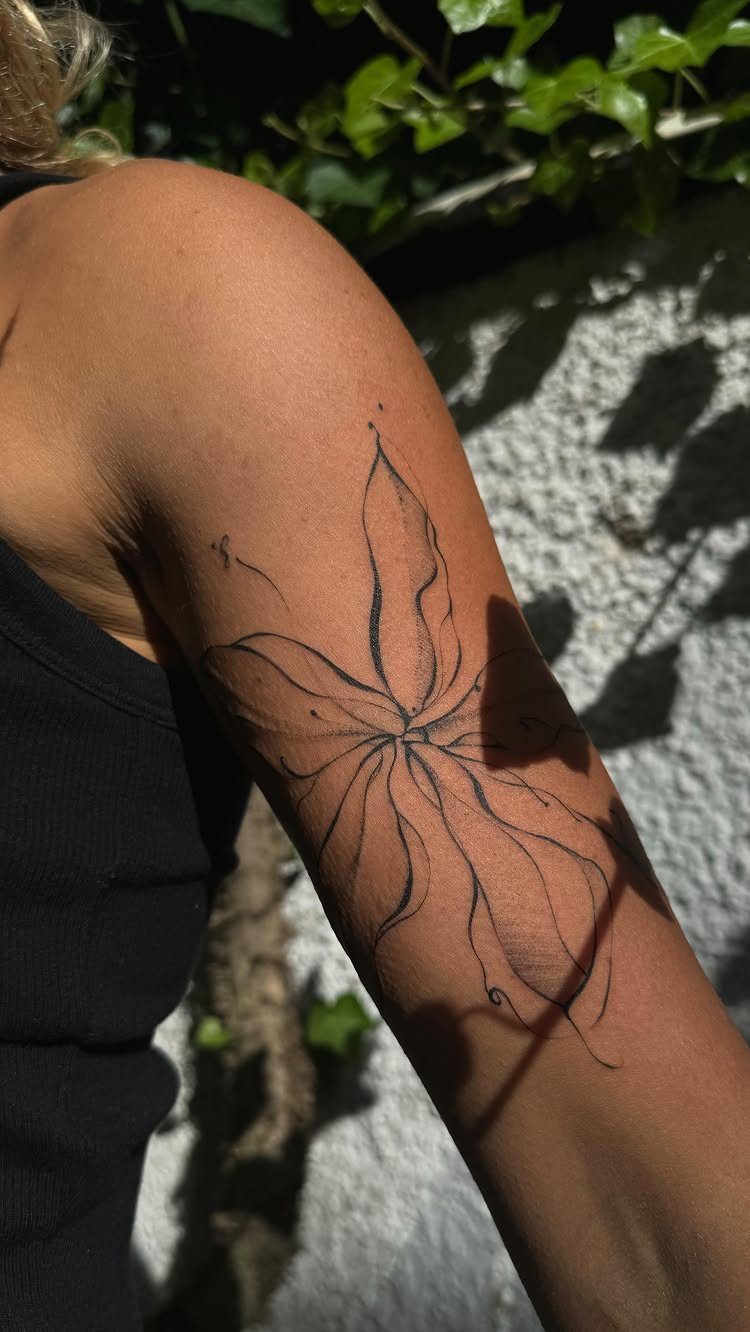
A single unbroken line tracing the shape of a flower keeps the design minimal and readable. The artist draws petals, stem and leaves in a way that makes the whole piece read as one continuous mark.
Upper arm placement works because the surface curves gently, letting the line follow the natural shape of the muscle.
The area heals quickly since fabric doesn’t rub it constantly, and you can hide it under a sleeve or show it in a tank top.
Single-line work relies entirely on the artist’s steadiness. One wobble shows, so choose someone whose portfolio proves they can hold a clean line from start to finish.
Advice on Choosing Designs
Start by deciding what the flower means to you, not just what it means in general.
A peony because you like how the petals stack carries as much weight as one chosen for prosperity symbolism, and you’ll wear it longer if the design itself matters to you.
Placement changes how much arm the tattoo takes. A vertical arrangement from shoulder to wrist uses the full length and reads as one piece.
A cluster on the forearm or a single bloom on the upper arm keeps the rest of the skin open, so you can add more later without boxing yourself in.
Size follows placement. Fine-line work on the forearm stays legible at a smaller scale, while a shoulder piece needs more room to show the same level of detail.
Smaller flowers work better as part of a larger composition than as standalone pieces, since petals lose definition when they’re packed into an inch.
Popular Flower Choices
Roses give you the most flexibility in style. Stacked vertically or arranged in a cluster, roses fill space without looking repetitive because you can vary the bloom size and the degree of opening.
Peonies rely on volume. The layered petals need enough room to show their structure, so they work best at 4 inches or larger.
Lotus flowers carry symmetry that other florals don’t. The petal arrangement radiates from the center, so the design holds up even when it’s simplified to an outline.
Tattoo Care Tips
Wash the tattoo 2–3 times a day with unscented soap, pat it dry and apply a thin layer of unscented lotion.
Thick ointment clogs the pores and slows healing, so less is better. The arm gets fabric contact all day, so avoid tight sleeves that rub the fresh ink, especially across the forearm where cuffs sit.
Sun exposure fades color faster than anything else, so apply sunscreen every time the tattoo is uncovered once it’s healed.
Black ink holds longer, but even monochrome work lightens after years of direct sun. If you’re getting color, expect to book a touch-up eventually to bring the saturation back.
Peeling and light scabbing are normal.
Don’t pick at it. The ink sits below the surface, and pulling off a scab early can lift pigment with it, leaving gaps that need a second pass.
Frequently Asked Questions
What are pretty flowers to get tattooed?
Roses, peonies and lotus flowers are the most common choices for arm tattoos.
Roses give you flexibility in style and size, peonies need at least 4 inches to show their layered petals, and lotus flowers hold symmetry even when simplified to an outline.
Each works in black ink or color depending on the look you want.
What is an arm sleeve tattoo?
The design wraps from shoulder to wrist as a single continuous piece, built from flowers in varying scales to cover the arm completely.
Big focal flowers sit at the shoulder or forearm, and filler flowers plus foliage bridge the gaps. You finish one section, let it heal, then come back for the next until the arm is done.
What should I fill my tattoo sleeve with?
Use a mix of scales: anchor pieces at the shoulder or forearm, then pack filler blooms and leaves into the remaining areas.
Sketch the full arm layout first so you know what sits where, then build it out in sessions. Black ink works best across a full sleeve because it ages more predictably than color through multiple sessions.