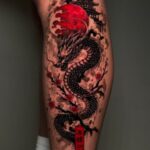
Dragon tattoos scale from a small head on the forearm to a full back piece that runs shoulder to lower spine, and the size you pick changes how the design reads from across a room or only up close.
A Japanese dragon wraps the arm in scales and clouds, a Celtic dragon weaves into knotwork on the shoulder, and a Quetzalcoatl serpent runs feathers down the leg where Western designs would use spines.
1. Japanese Dragon Tattoo
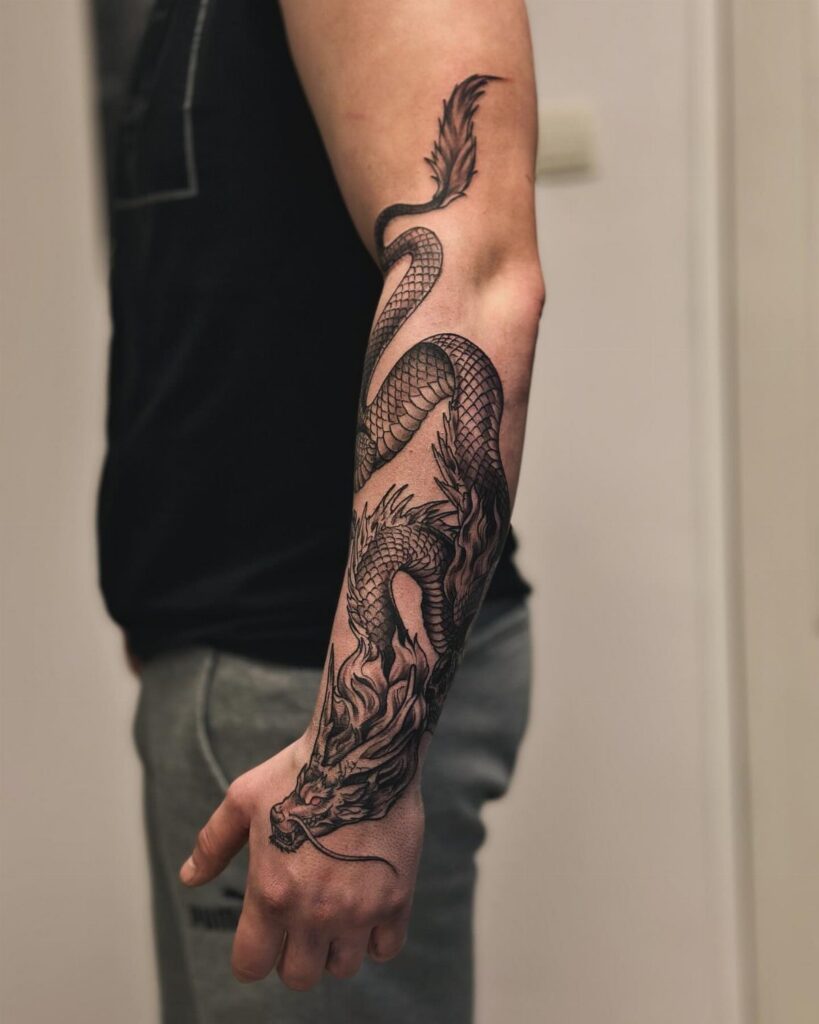
Japanese dragons coil along the arm in scales and clouds, bodies twisting in motion even when the skin is still. You can run the design from shoulder to forearm in blue ink, black, red or green.
Forearm and upper arm suit this design because the shape follows muscle. The dragon wraps the curve and keeps reading from any angle.
If you want a dragon that carries meaning beyond the look, Japanese dragons represent wisdom and strength in the mythology they come from.
That history makes them popular for sleeves and half-sleeves where there is room for the full body and detail.
2. Celtic Dragon Tattoo
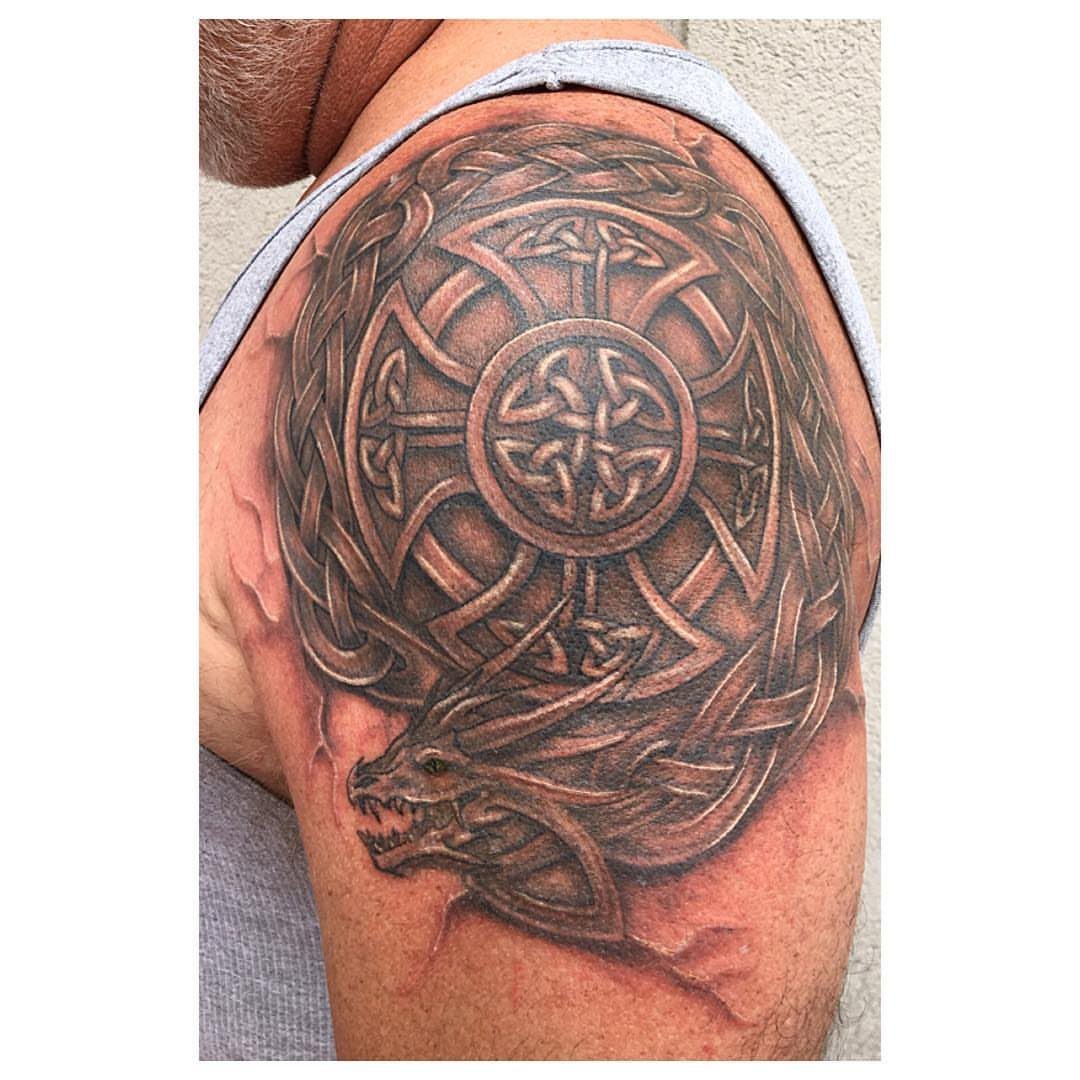
Celtic dragons weave into knotwork, the body forming the loops and crossings instead of sitting on top of them.
Centering the dragon’s head in a circular knot on the shoulder gives the piece a focal point and keeps the lines clear.
Knotwork reads best when it’s large enough to show each crossing without the lines blurring together. Shoulder, upper back and chest work well because the muscle underneath is relatively flat and the skin doesn’t shift much.
If you like the look but want more coverage, the same knot can expand outward into a half-sleeve or chest piece. Just keep the line weight consistent so the weaving stays readable.
3. Blackwork Dragon Tattoo
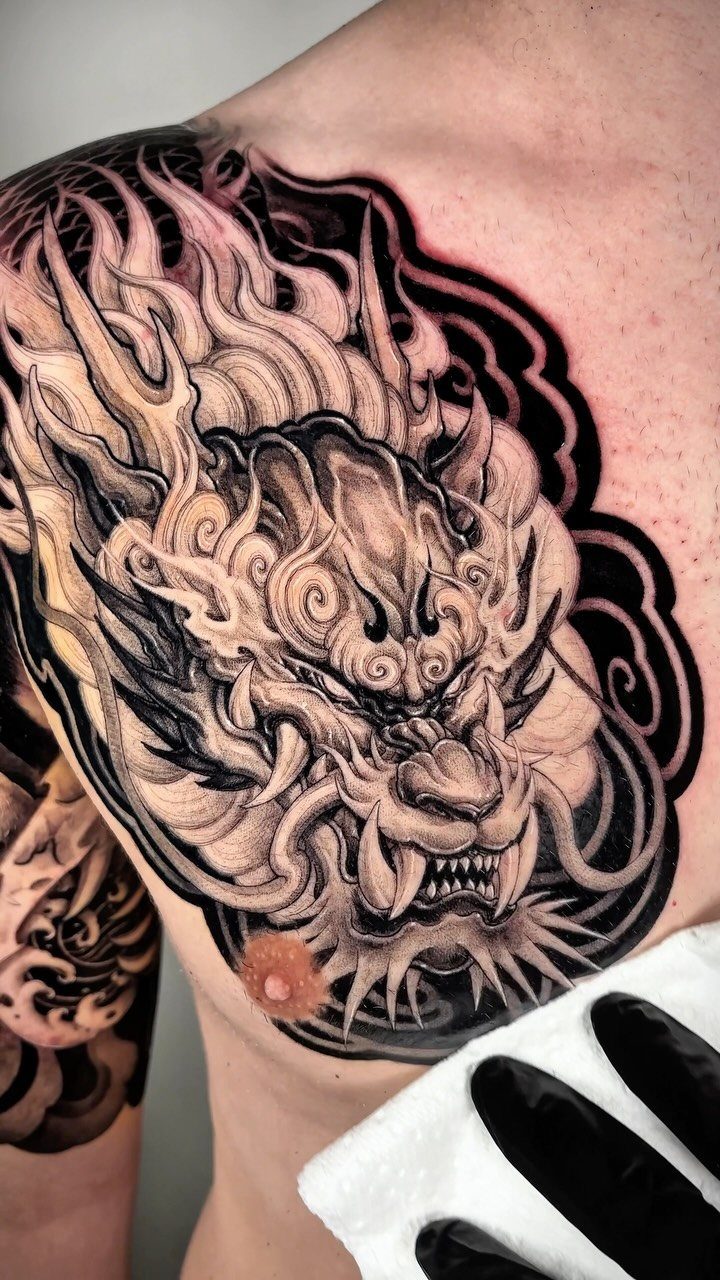
You can cover the chest and shoulder with scales, horns and texture worked in close, or scale the same concept down to a forearm or calf.
Mythical creatures give you room to decide what the dragon looks like: Eastern, Western, somewhere in between. The artist can shape the jaw, add or drop wings, and adjust the expression to match what you’re after.
Chest and shoulder give enough space for a head this size. Smaller placements work if you simplify the shading and focus on outline and basic shape.
4. Dragon Tribal Tattoo
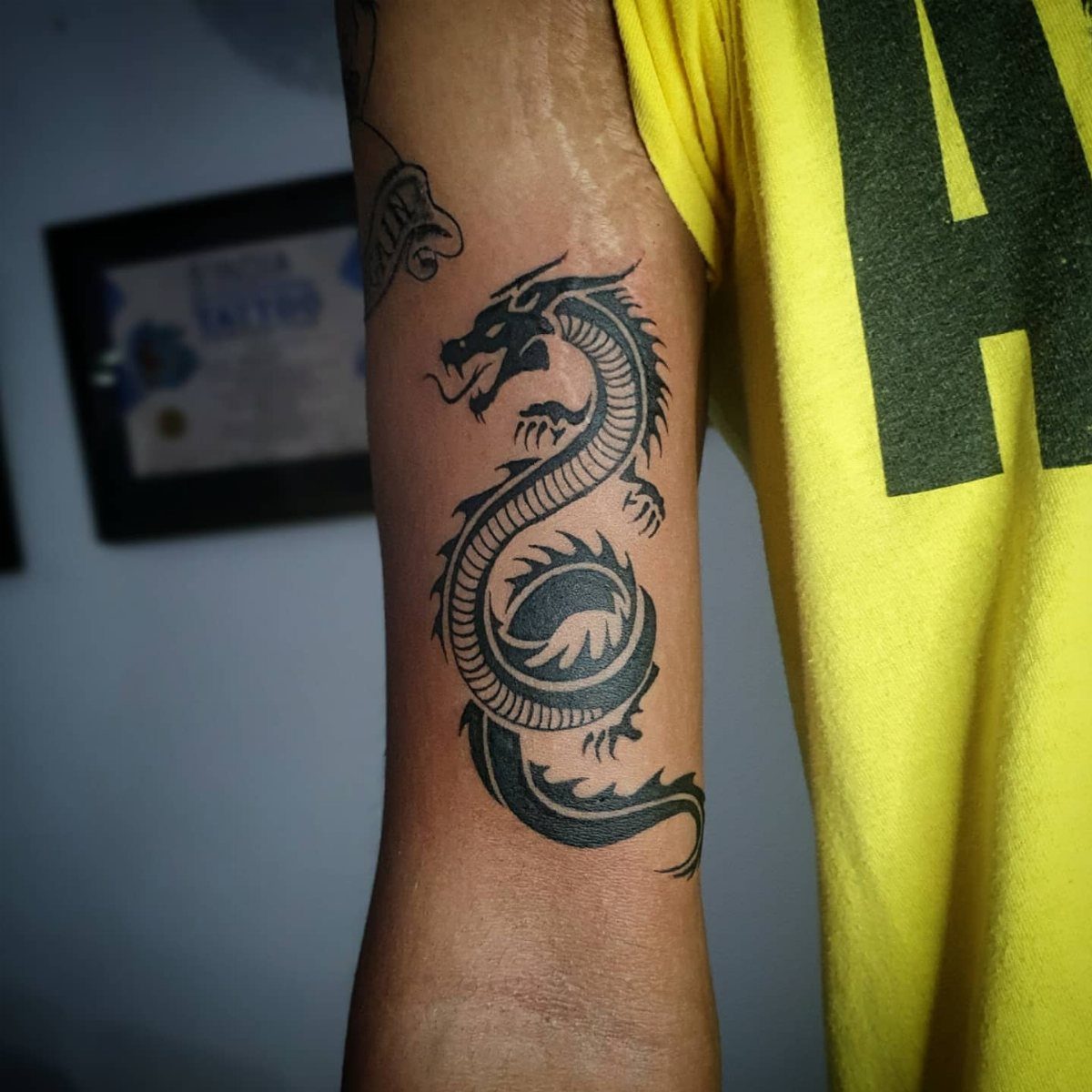
Tribal dragons strip the design down to bold black lines and negative space, no shading or color. The pattern sits on the upper arm and forearm with sharp angles and thick strokes that follow the muscle.
This style reads from a distance better than fine detail does, which makes it a good fit for arms and calves where the tattoo will be seen at arm’s length most of the time.
Tribal works best when the design is large enough to show the weight of the lines.
If you go too small, the bold sections can bleed together over time and lose definition. Keep it at least 4 inches across.
5. Small Dragon Tattoo
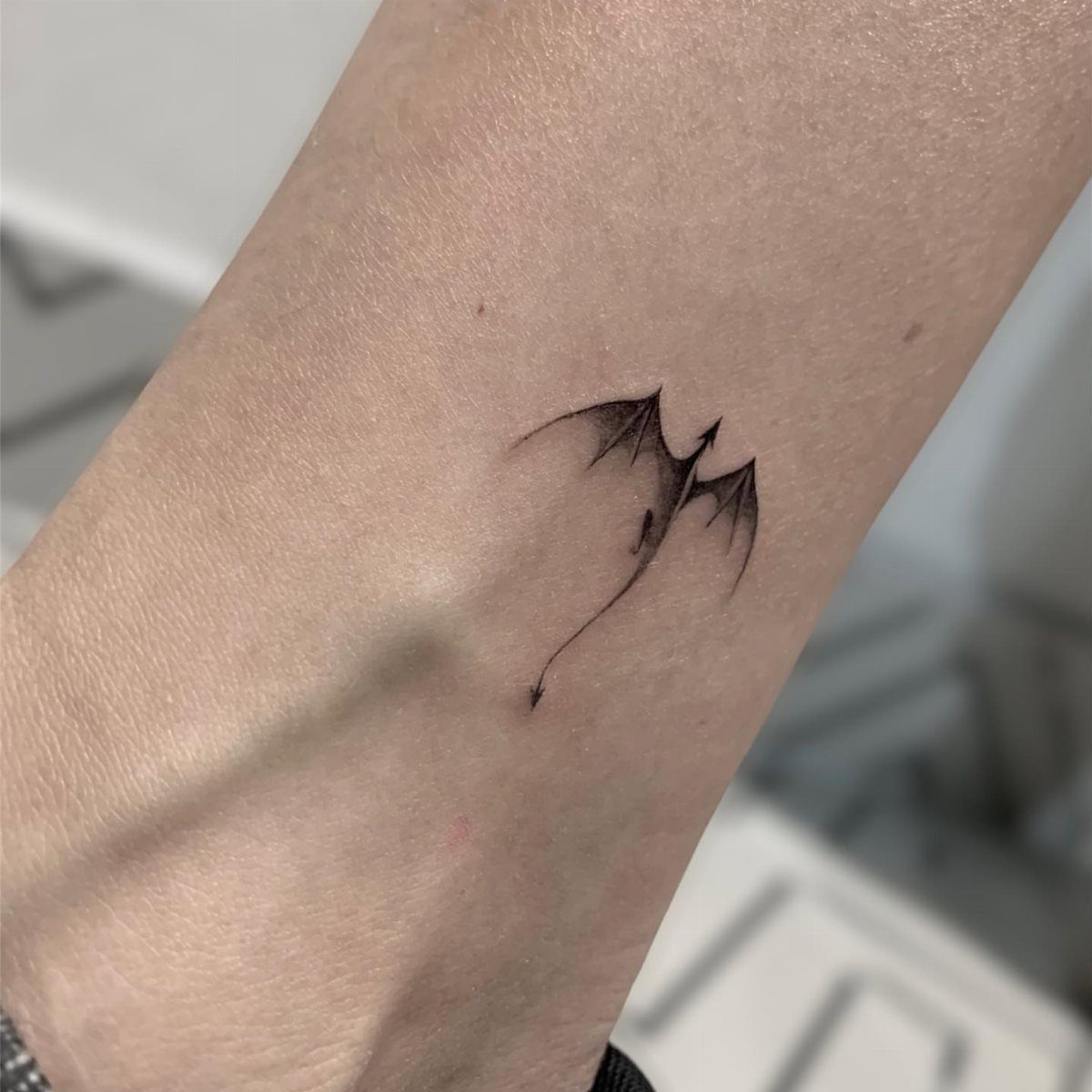
A small dragon silhouette fits the forearm, wrist, ankle or behind the ear when you want the idea without committing to a large piece.
A small flying dragon in black ink, just the outline, reads clearly at any size you can fit on the wrist or ankle.
Small tattoos work best with simple shapes. Too much detail in a small space will blur as the ink settles, so stick to a clean silhouette or basic line drawing.
Forearm and ankle are the most common placements for small dragons because the skin is tight and the tattoo stays visible.
If you want it more hidden, the upper ribcage or behind the shoulder blade gives you the option to cover it when needed.
6. Dragon Head Tattoo
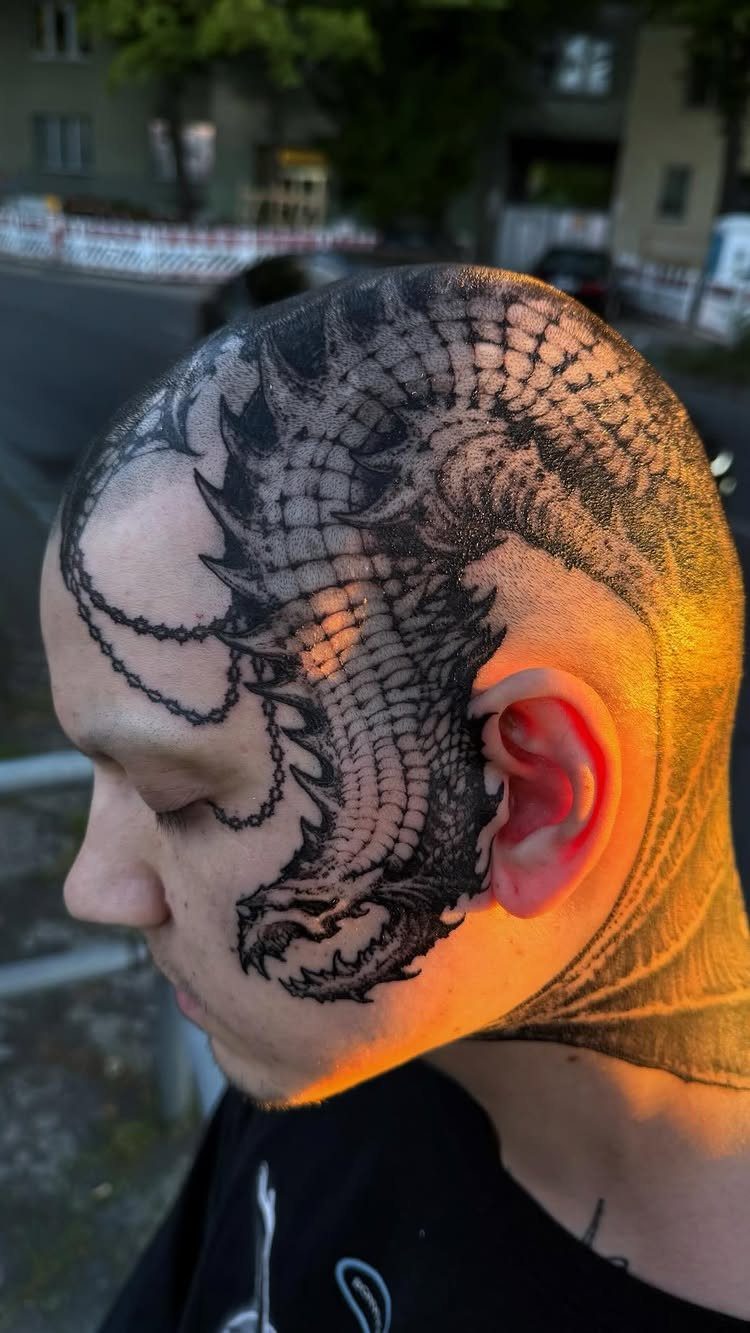
A dragon head covering the scalp and temple is about as bold as placement gets. A dragon head can wrap the side of the head with scales and horns detailed in black ink, following the curve of the skull.
Head tattoos hurt more than most other spots because there’s little fat between the skin and bone, and they take longer to heal because the area moves every time you talk or eat.
You’ll also need to keep the area shaved if you want the tattoo to stay visible.
If you’re considering this, go with an artist who has experience with head tattoos. The skin is thinner and the ink can spread if it’s not applied at the right depth.
7. Koi Dragon Tattoo
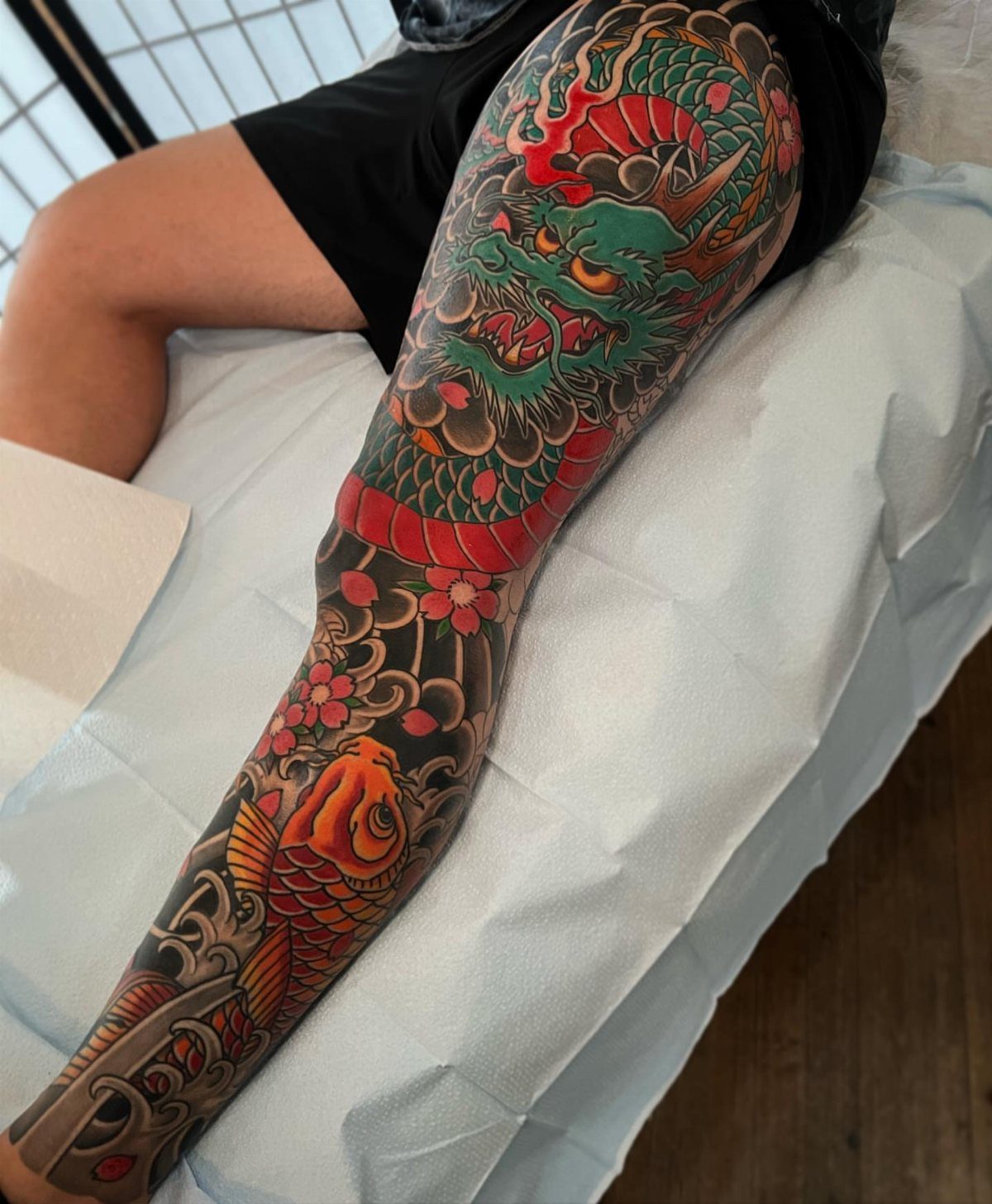
A koi transforming into a dragon is a classic image in Japanese tattooing, and the leg gives you room to show the fish rising from water and the dragon emerging above it.
The koi represents perseverance, the dragon is the reward once the climb is done.
Color pulls this design together.
Orange or red koi against a green or blue dragon creates separation and keeps both halves readable. If you skip color, contrast the scales with different line weights.
Thigh and calf work because the tattoo can run vertically, following the natural flow of the transformation.
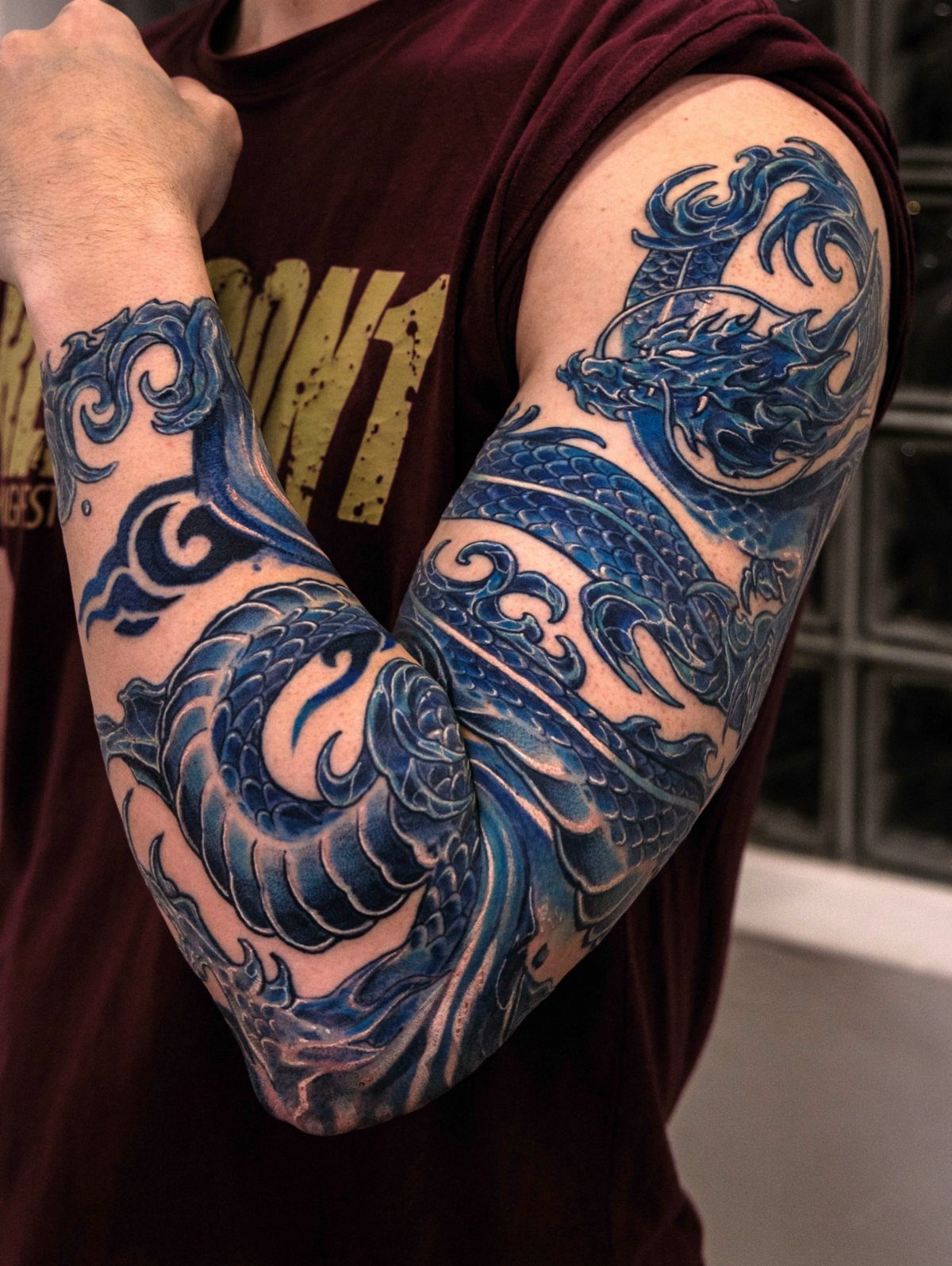
8. Blue Dragon Tattoo
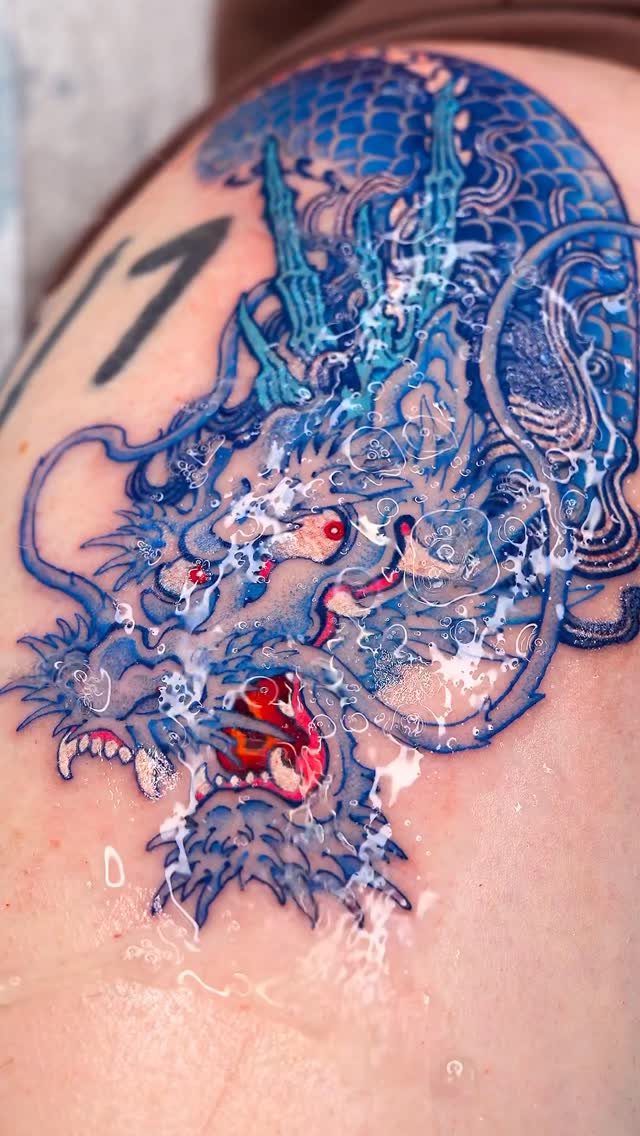
Blue ink shifts the mood.
Where red or black dragons lean aggressive, blue reads calmer, though the design itself can still be fierce. The color comes from Eastern traditions where blue dragons connect to water and sky.
Shoulder and upper arm suit this because the dragon head can sit high and the color stays visible in short sleeves.
Blue holds better in larger designs where there’s space for clean gradients and shading, so I’d keep this on the bigger side.
If you’re going for blue, commit to it. A half-saturated blue can look faded before it’s even healed.
9. Haku Dragon Tattoo
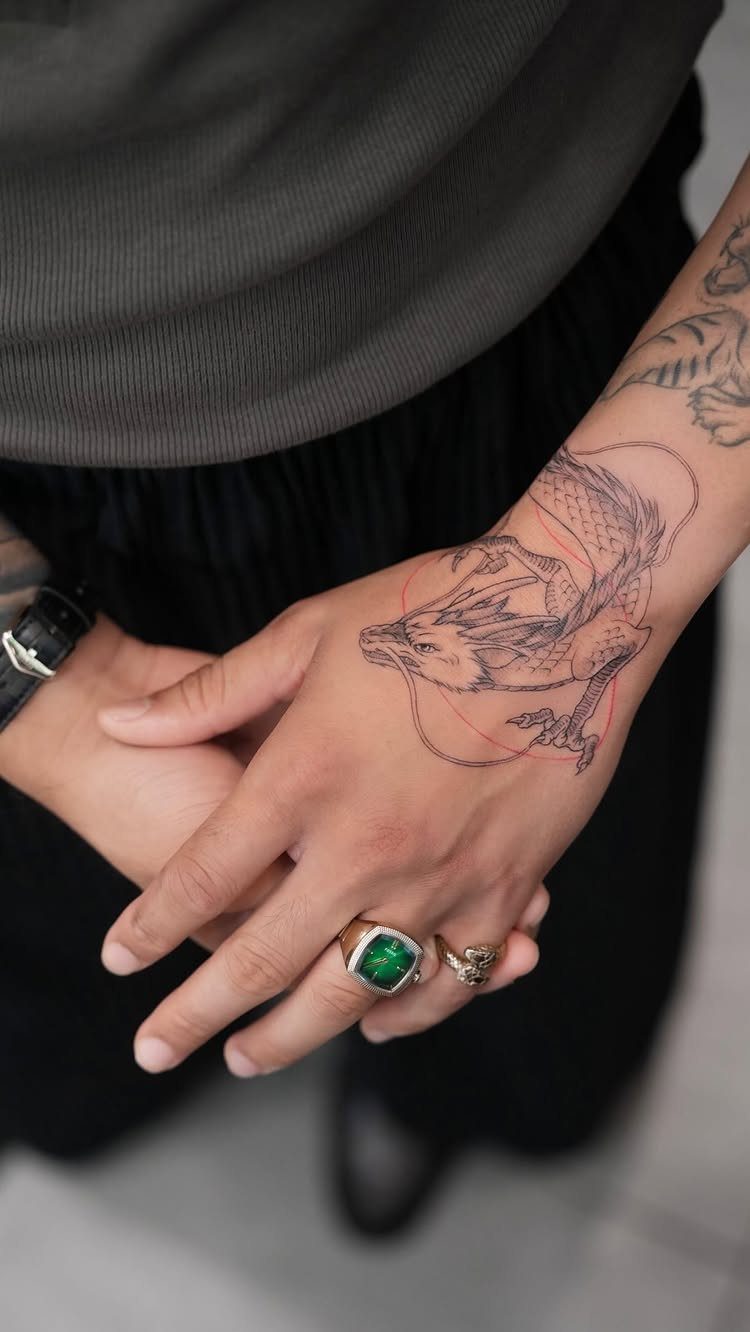
Haku from Spirited Away is a long, serpentine dragon with a white body and green mane, and the design translates well to forearm or hand placement where the body can follow the length of the limb.
The hand and wrist let the dragon wrap the fingers or run along the back of the hand.
Hand tattoos fade faster than most other placements because the skin sheds constantly and takes more friction. You’ll need touch-ups every few years to keep the lines crisp.
If you want a recognizable character, find an artist who works in anime style. The proportions and expression matter more here than in a generic dragon.
10. Dragon and Rose Tattoo
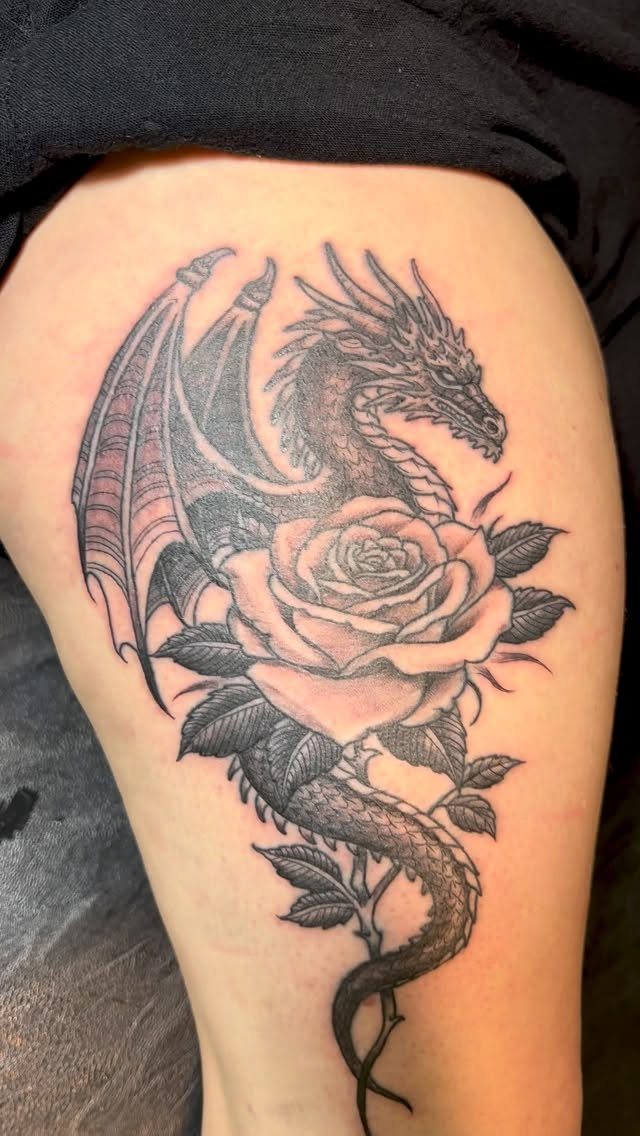
A dragon coiled around a rose balances aggression with softness, and the thigh gives you space to fit both without cramping either one.
The dragon can wrap the stem or sit behind the petals, whichever reads better for the shape you’re working with.
Black and grey keeps the 2 elements unified. If you add color, pick one or the other to highlight so the design doesn’t split in half visually.
Thigh and upper arm work because there’s enough flat surface for the rose to sit fully open and the dragon to coil without excessive wrapping.
11. Yin and Yang Dragon Tattoo
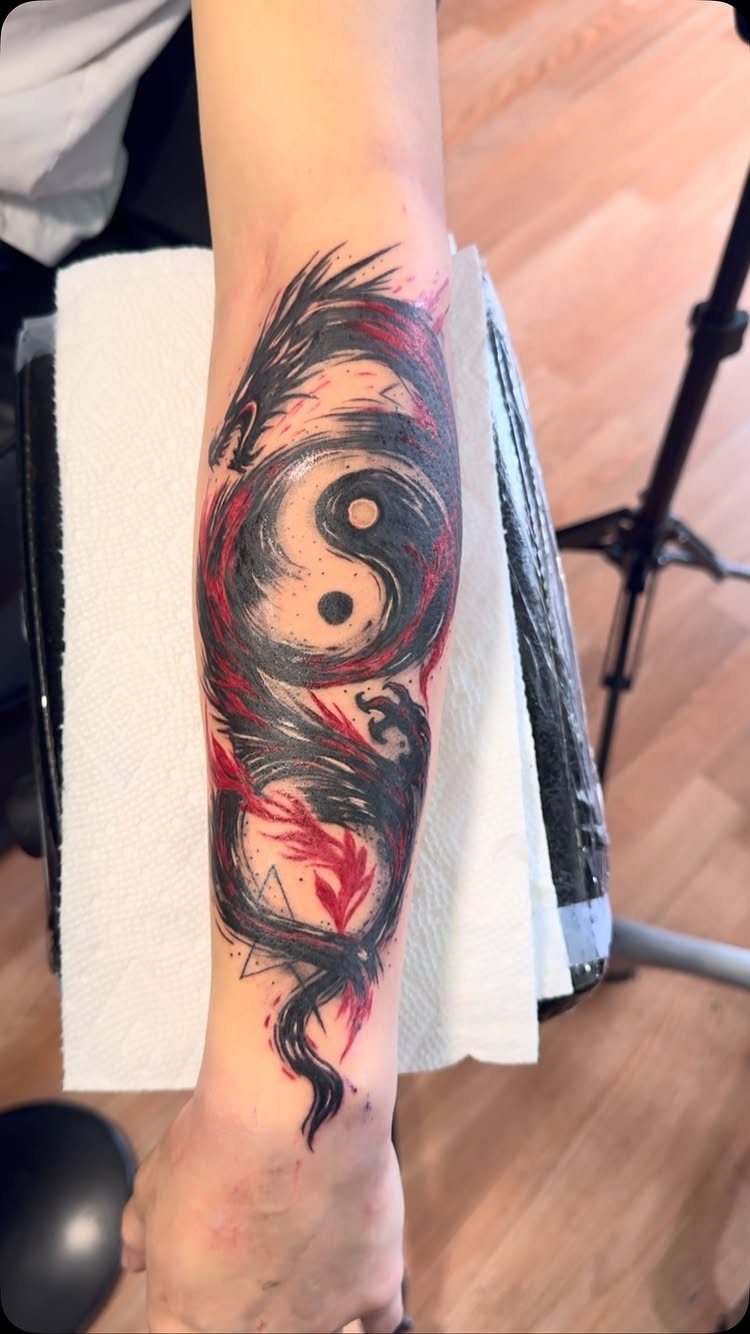
Two dragons circling a yin-yang symbol, one light and one dark, is about balance. The design works on the forearm or calf where the circle can sit centered and the dragons can mirror each other without distortion.
Forearm and calf are both cylindrical, which helps the symmetry stay intact as the skin curves. If you place this on the shoulder or chest, the muscle will shift the circle and throw off the balance.
Red and black is the most common color pair, but you can use any 2 contrasting tones. Just make sure the contrast is strong enough that the dragons stay separate.
12. Jade Dragon Tattoo
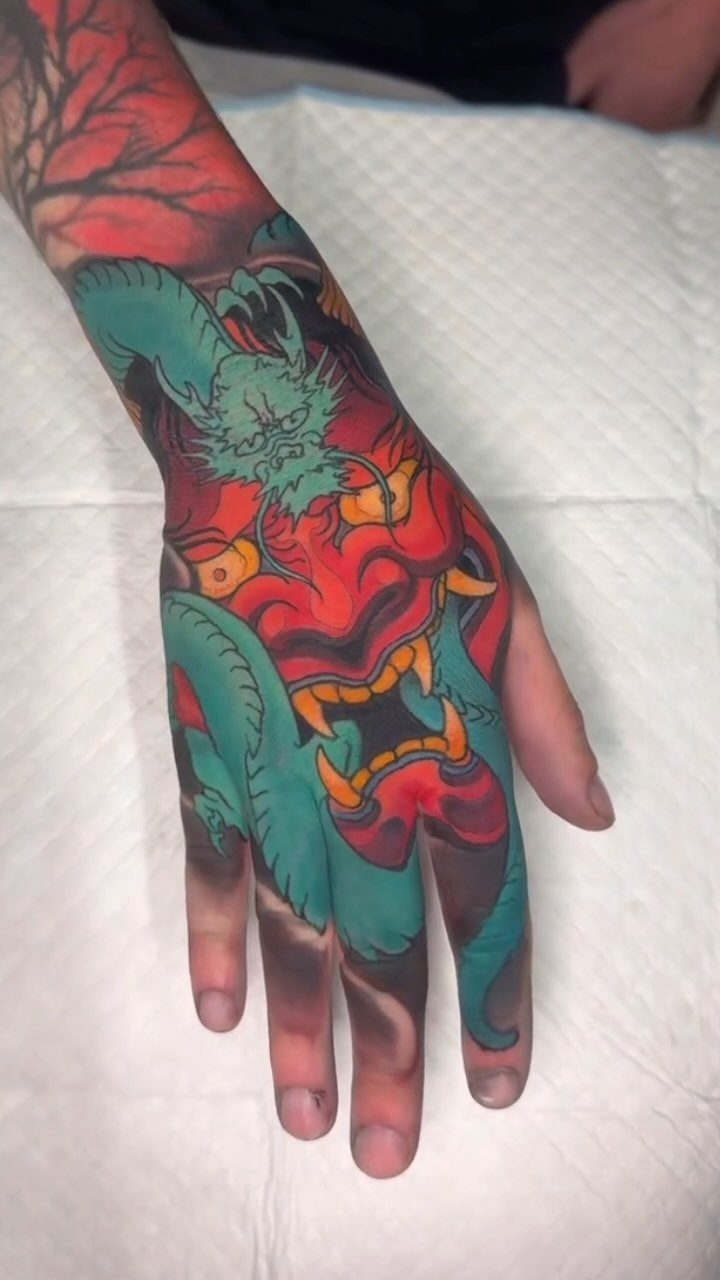
A jade dragon uses green ink to mimic the stone, and the hand or wrist placement puts it where it’s always visible.
The green can be solid or shaded, depending on how much texture you want to show in the scales.
Hand tattoos are high visibility and high maintenance. The ink fades faster here than on the arm or leg, so expect to book touch-ups more often.
If you’re pairing the dragon with another element like a demon mask, keep the color schemes distinct. Green and red separate well and let each piece hold its own space.
13. Quetzalcoatl Dragon Tattoo
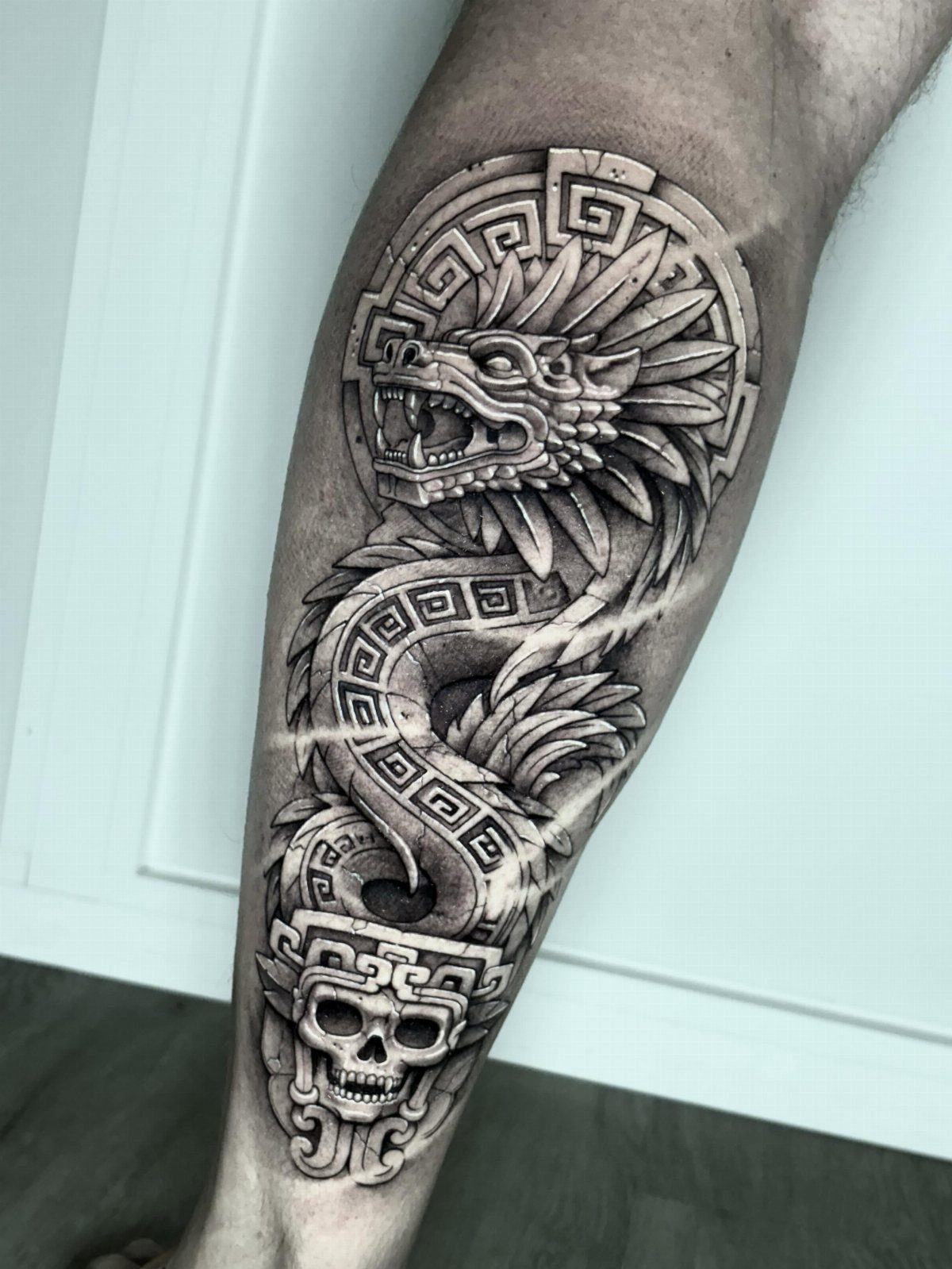
Quetzalcoatl is a feathered serpent from Aztec mythology, and the design places feathers where Western dragons would have scales or spines.
The leg gives you vertical space to run the body from ankle to knee, and pairing it with a skull adds weight to the lower half.
Grey holds every feather and scale detail without extra color pulling the eye around. If you add geometric patterns around the serpent, keep them sparse so the main figure stays clear.
The lower leg takes ink well and the flat surface shows vertical designs clearly. The front of the shin hurts more than the side or back.
14. Dragon Sleeve Tattoo
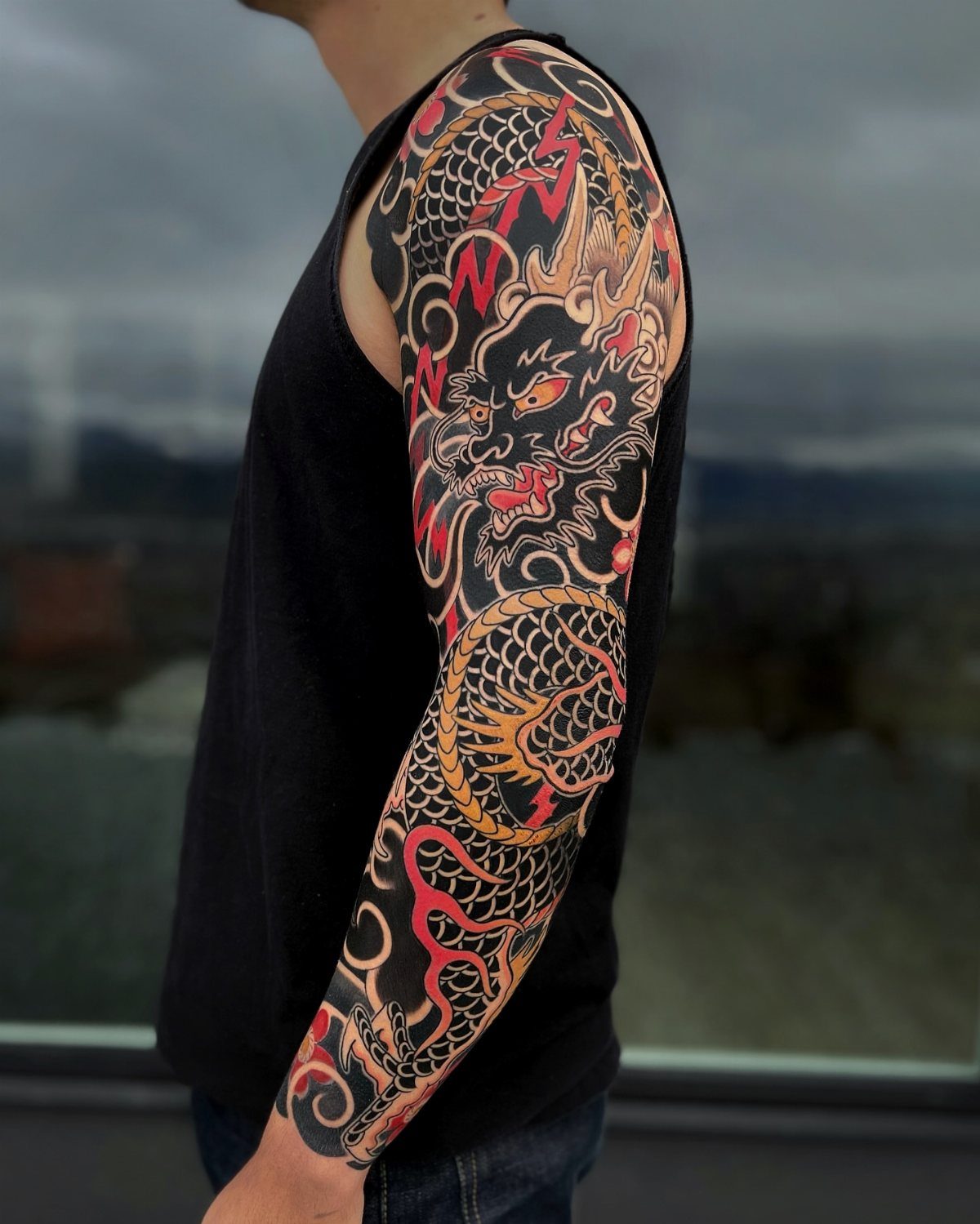
A sleeve lets the dragon wrap the entire arm from shoulder to wrist, using the bicep for the head and the forearm for the body.
The design can follow the muscle so the dragon looks different depending on whether your arm is bent or straight.
Color makes the piece stand out, but it also requires more sessions and costs more than black and grey. Red, black and gold is a common palette for Japanese-style sleeves because the colors contrast well and hold their saturation.
Plan for multiple sessions. A full sleeve is a commitment, plan for multiple long sessions with your artist.
15. Dragon Back Tattoo
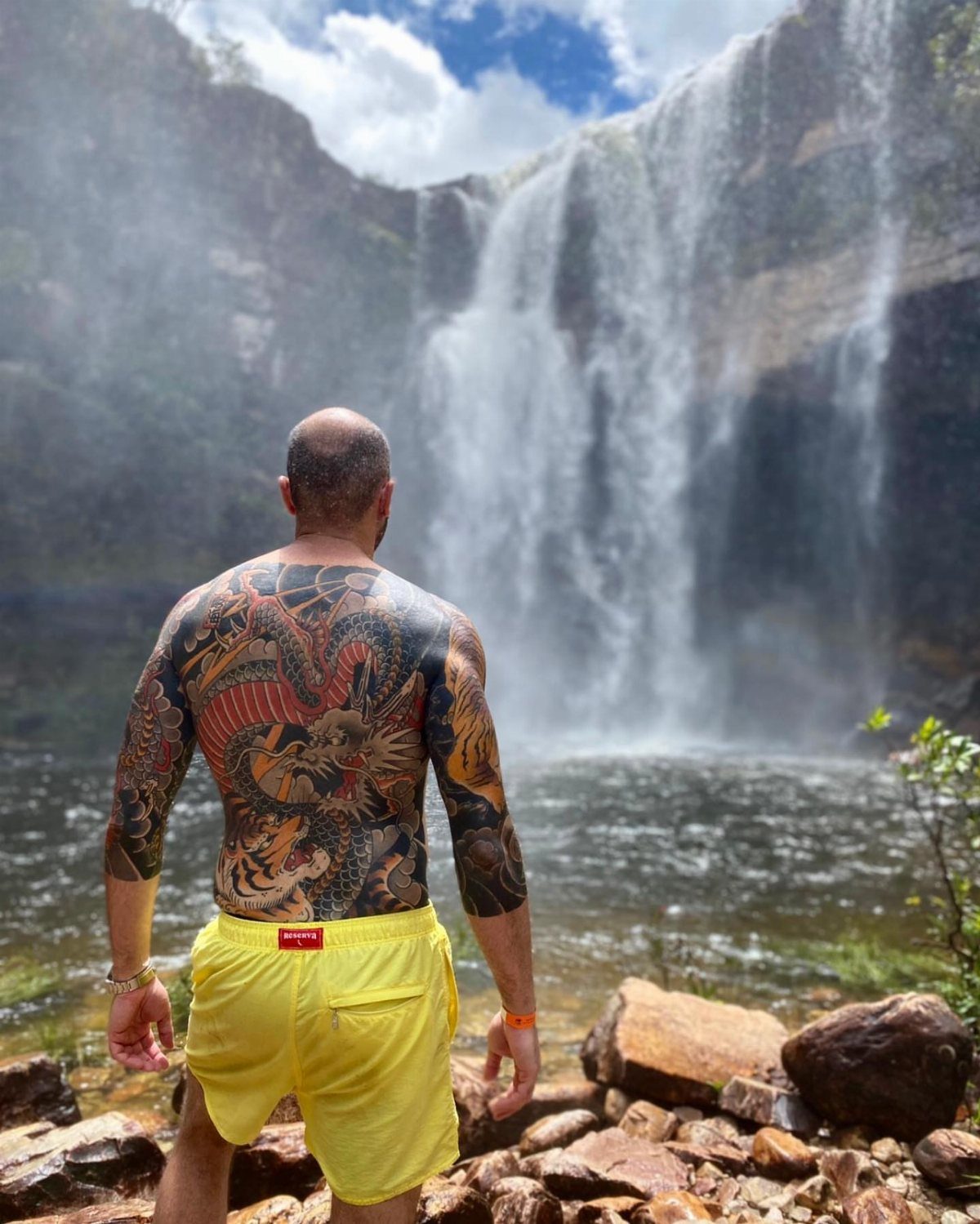
The back is the largest uninterrupted canvas on the body, and a dragon can stretch from shoulder blades to lower back without wrapping around ribs or shifting with muscle.
Color fills the space and lets you separate the dragon from background elements like clouds or waves.
Sitting for a back piece takes stamina.
A piece this large needs multiple sessions, and each one asks you to hold still through serious work. The spine hurts more than the shoulder blades or the sides.
If you want maximum impact, this is the placement that delivers it.
16. Dragon Thigh Tattoo
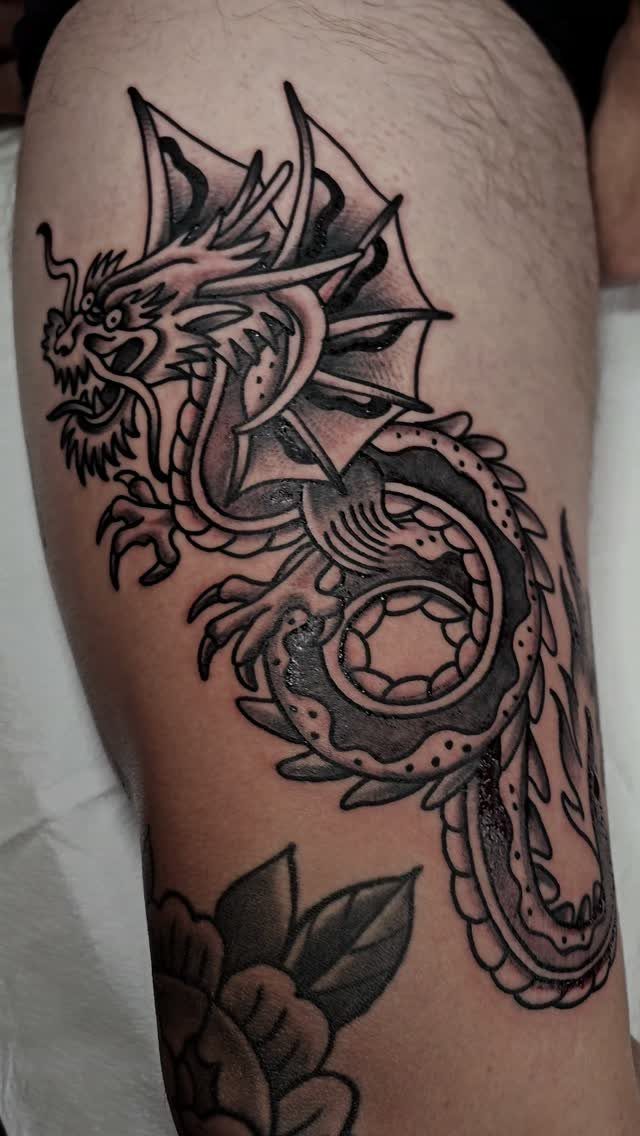
The thigh offers flat, wide space without the distortion you get on joints or muscle that shifts constantly. A dragon head centered on the upper thigh can include scales, horns and shading without cramping the design.
Black and grey works well here because the thigh doesn’t get as much sun exposure as the forearm or shoulder, so the ink holds longer without fading.
Thigh tattoos hurt less than ribs or chest because there’s more fat and muscle between the skin and bone. Healing takes about 2 weeks.
17. Dragon Forearm Tattoo
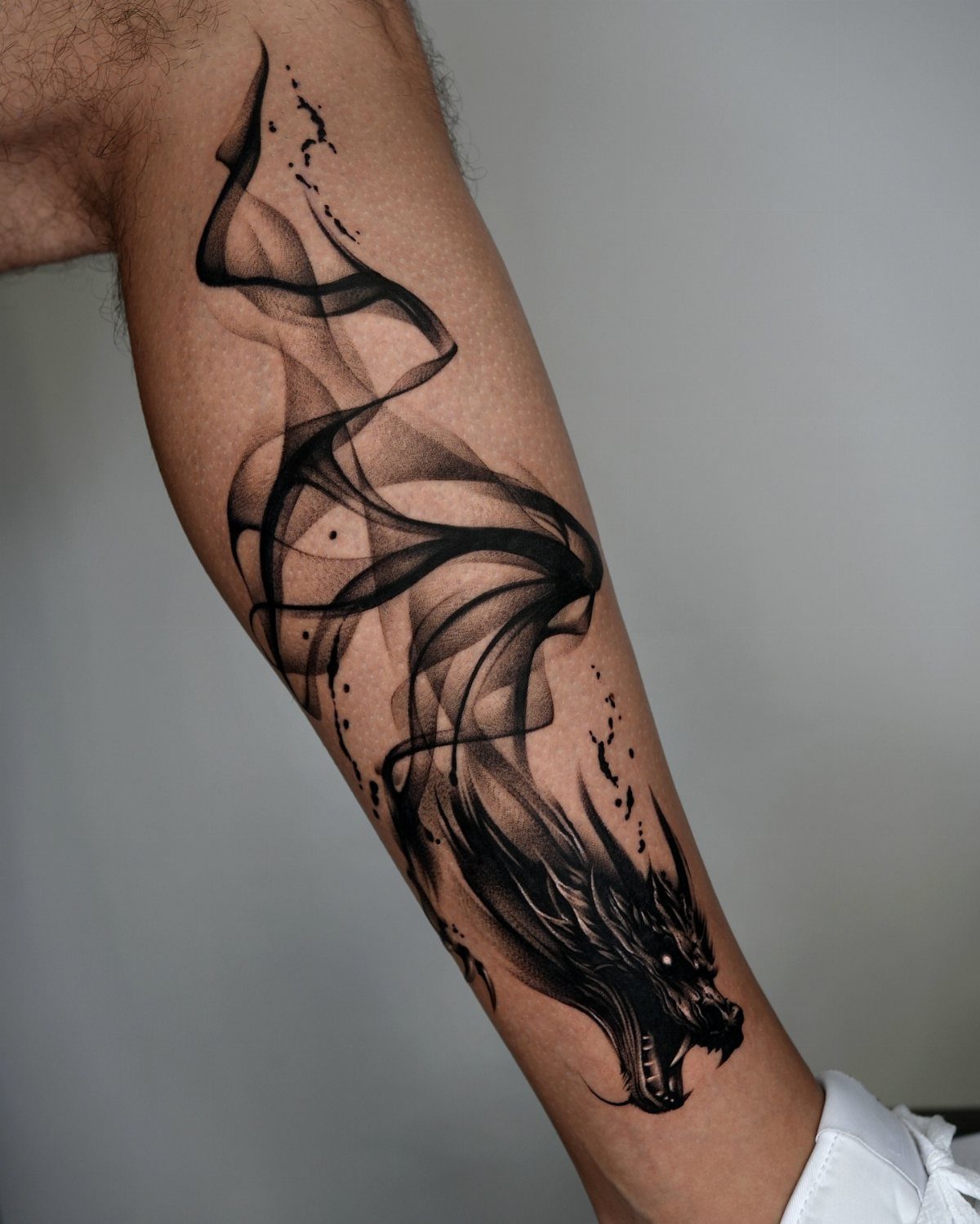
The forearm puts your tattoo in front of you every time you work, drive or eat, which makes it the most visible placement outside of the hands or neck.
A dragon head transitioning into smoke or abstract shapes gives the design movement without needing the full body.
Forearm tattoos are easier to sit for than larger pieces because the sessions are shorter and the pain is manageable. The outer forearm hurts less than the inner side, where the skin is thinner.
If you want something you’ll see often, this is the spot.
18. Dragon Shoulder Tattoo
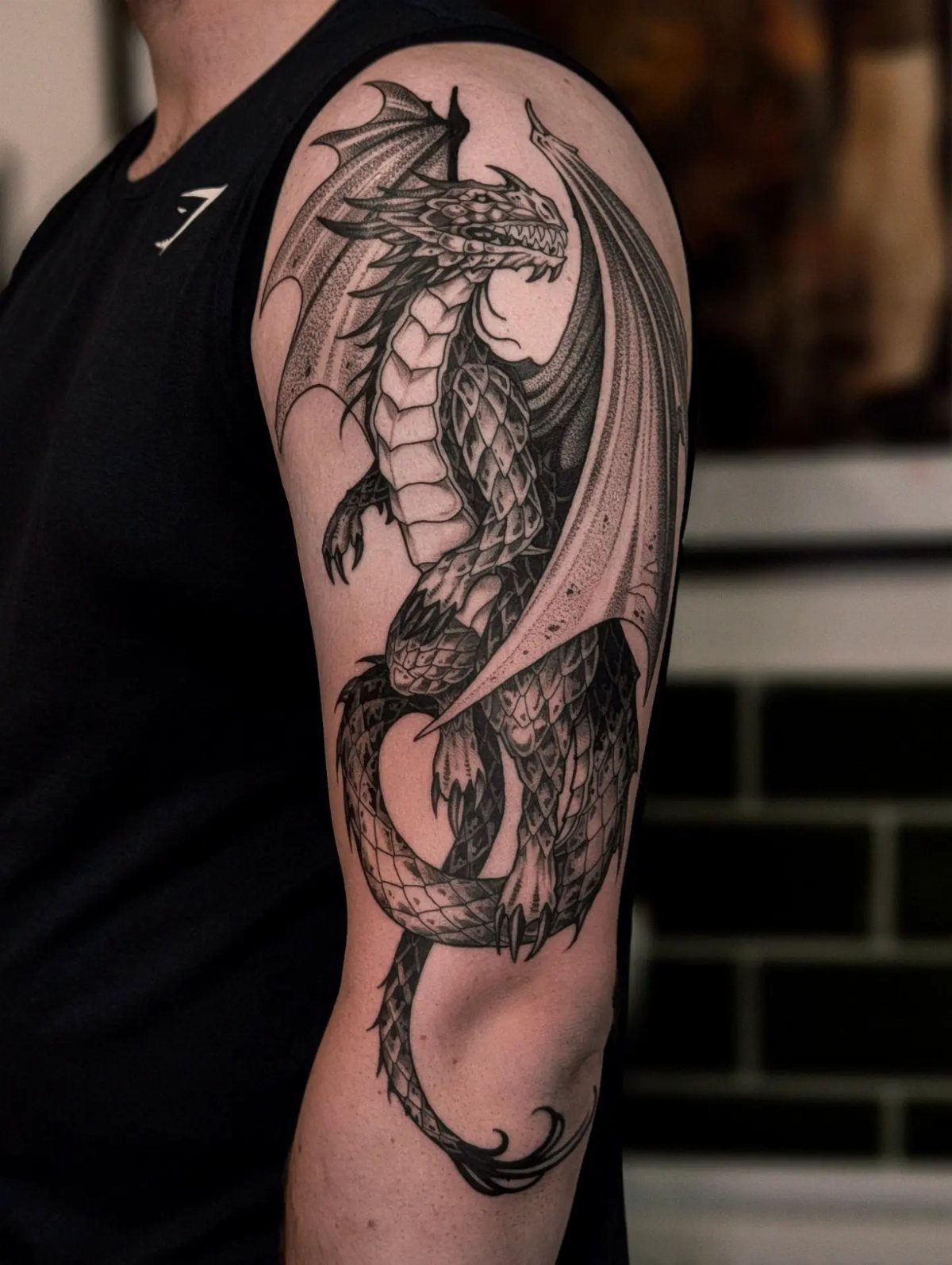
Placing the dragon on the shoulder lets the head sit on the deltoid and the body curve down toward the bicep or chest.
The muscle underneath gives the design depth when you move, and the shoulder stays visible in a tank top or short sleeve.
Black ink with heavy shading makes the dragon look like it’s sitting on top of the muscle. If you want to extend the design later, the shoulder connects easily to a chest piece or sleeve.
A shoulder dragon of any weight needs multiple appointments to finish properly.
19. Dragon Leg Tattoo
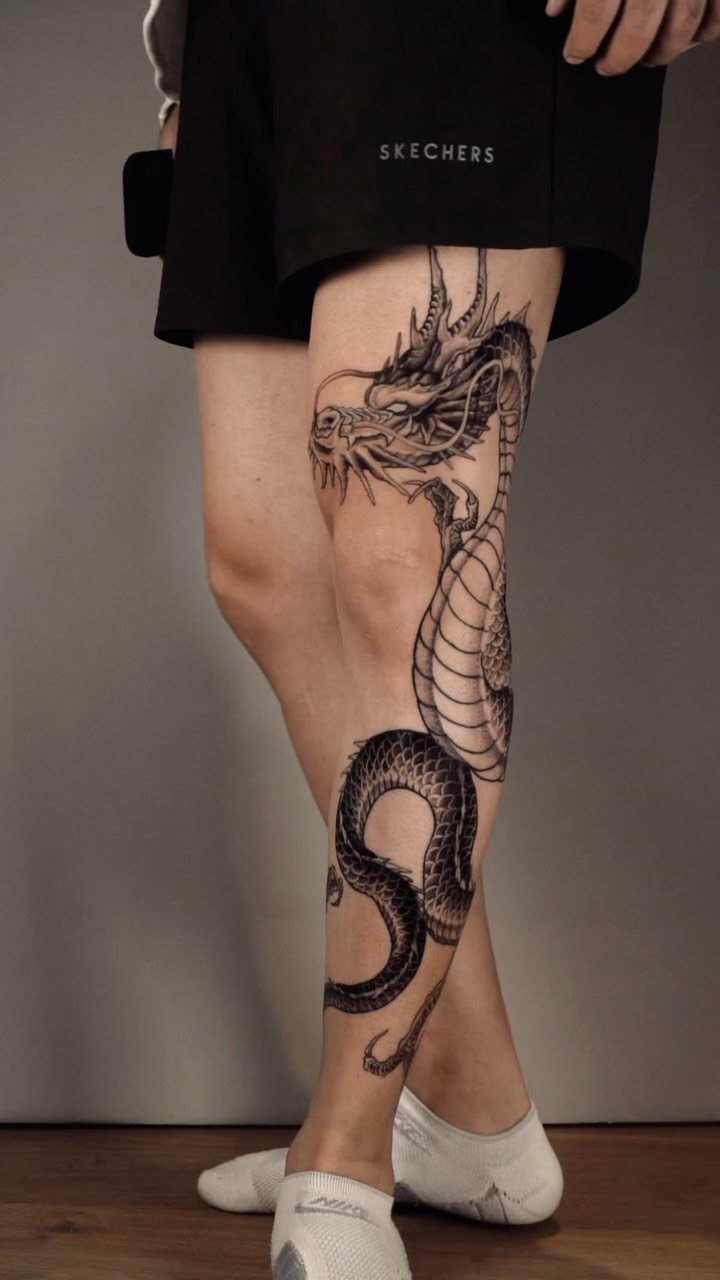
Running a dragon down the length of your leg from thigh to ankle uses the full vertical space without wrapping around tight curves or joints.
The lower leg in particular works well because the surface stays relatively flat and the dragon can coil or stretch along the calf.
Black ink with tight line work keeps the design readable on a limb that moves constantly. If you want the dragon to look three-dimensional, place it on the outer calf where there’s more muscle to work with.
Leg tattoos are easier to cover than forearm or hand placements, which makes this a good option if your workplace has restrictions.
20. Dragon Chest Tattoo
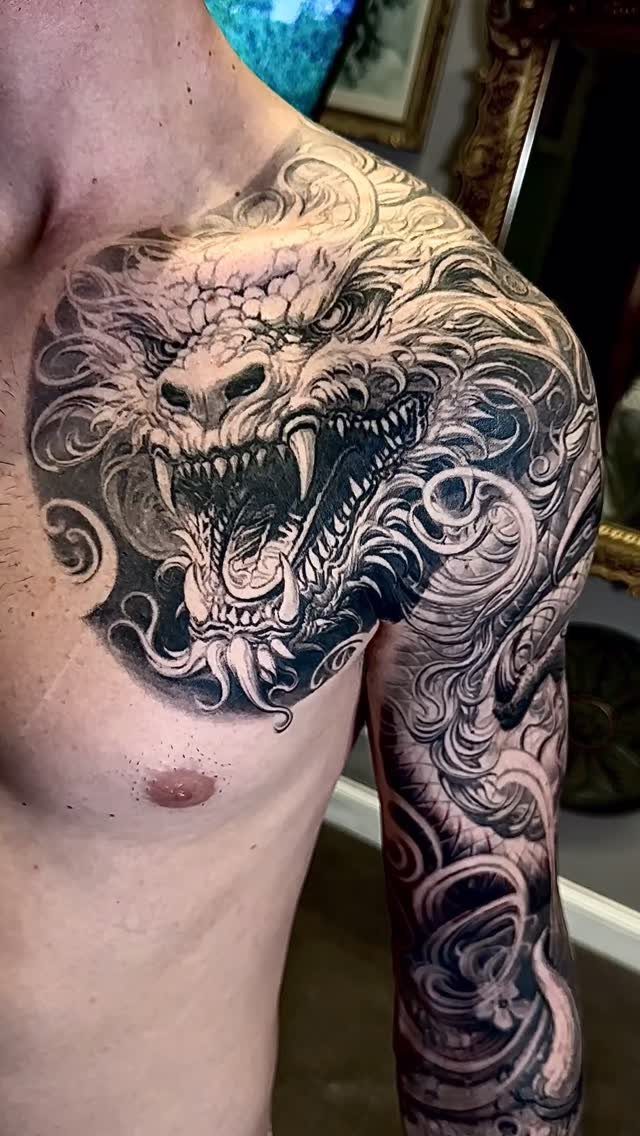
A dragon across the chest can fill the space from collarbone to sternum and extend onto the shoulder or upper arm.
The chest gives you width for the dragon’s head and wings, and the muscle underneath adds dimension when you move.
This placement hurts. The ribs and sternum have less padding than the shoulder or thigh, and sitting for a full chest piece takes multiple sessions.
The chest also bridges naturally into a sleeve or back panel if you want to build the piece out over time. Black and grey shading works here because it follows the natural contours of the muscle.
Best Placement for Dragon Tattoos
A dragon that starts on the chest and wraps into a half-sleeve brings out the shape of the pec and shoulder in a way no other placement can match.
Pain on the chest splits into zones. The thick muscle over the pec rates about a 5 or 6 out of 10 for pain, which most clients handle without much trouble.
The sternum and the skin close to the nipple spike to an 8 or 9 because there’s barely any cushion over the bone.
The shoulder gives you size and discretion at the same time.
You can cover it with a T-shirt for work and show it in a tank top when you want to. If you need a large dragon but can’t commit to full visibility, the shoulder bridges both.
Trends in Dragon Tattoos
The effect makes the wearer look bigger and more physically commanding. Placement matters more here than in static designs because the dragon needs to align with how the muscle actually runs, not just fit the available space.
Full sleeves and back pieces take 20 hours or more to finish.
Pain Factors for Tattoo Locations
The sternum and inner bicep are the two most painful spots for dragon tattoos because the skin sits directly over bone or nerve clusters with almost no fat in between. Both areas rate around 8 or 9 out of 10.
Dragon tattoos placed on the outer arm, shoulder, or thigh sit closer to a 5 or 6 on the pain scale, which makes them easier to sit through for multi-hour sessions.
The pain depends on how close the needle gets to the center of the ribcage, where the bone is most exposed.
If the design extends onto the side of the torso where there’s more padding, that section will feel lighter than the ribs themselves.
Frequently Asked Questions
What does a dragon tattoo mean for a man?
Dragon tattoos carry different meanings depending on the tradition they come from. In Asian mythology, dragons represent wisdom, strength, and protection, while European folklore leans toward power and fierceness.
The symbolism shifts with the design: a Japanese dragon speaks to perseverance and balance, a black dragon to experience and survival, a blue dragon to calm strength tied to water and sky.
Should a dragon tattoo go up or down?
The dragon’s head typically faces forward or upward to create a confrontational, intentional look.
On vertical placements like the leg or forearm, the body can flow downward while the head turns to face the viewer. Make sure the dragon reads clearly from the angles people will actually see it.
Is a dragon tattoo satanic?
No, dragon tattoos are not satanic. Dragons appear across many cultures with varied meanings: Asian traditions view them as benevolent protectors and bringers of wisdom, while European folklore portrays them as fierce but not evil.
The symbolism depends on the culture the design draws from, not on any single religious interpretation.