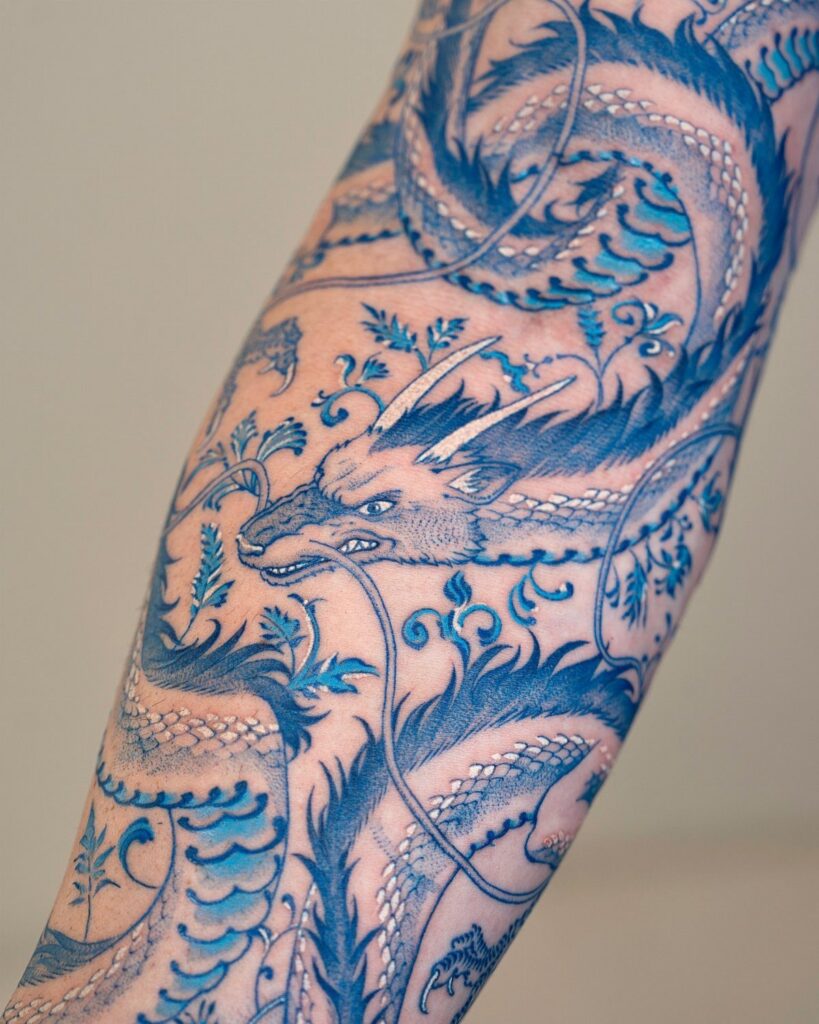
Dragon tattoos range from minimalist single-line designs under 3 inches to full back and sleeve pieces that take multiple sessions and cover shoulder to hip or wrap an entire arm.
The version that fits depends on whether you want the creature to read as protector or threat, because Chinese and Japanese dragons coil and guard while European dragons perch and strike.
Chinese dragons date back to at least 4500 BCE in jade sculptures from Inner Mongolia, and that serpentine form still lets the body wind across a forearm or wrap a full sleeve without fighting the limb’s natural shape.
1. Chinese Dragon Tattoo
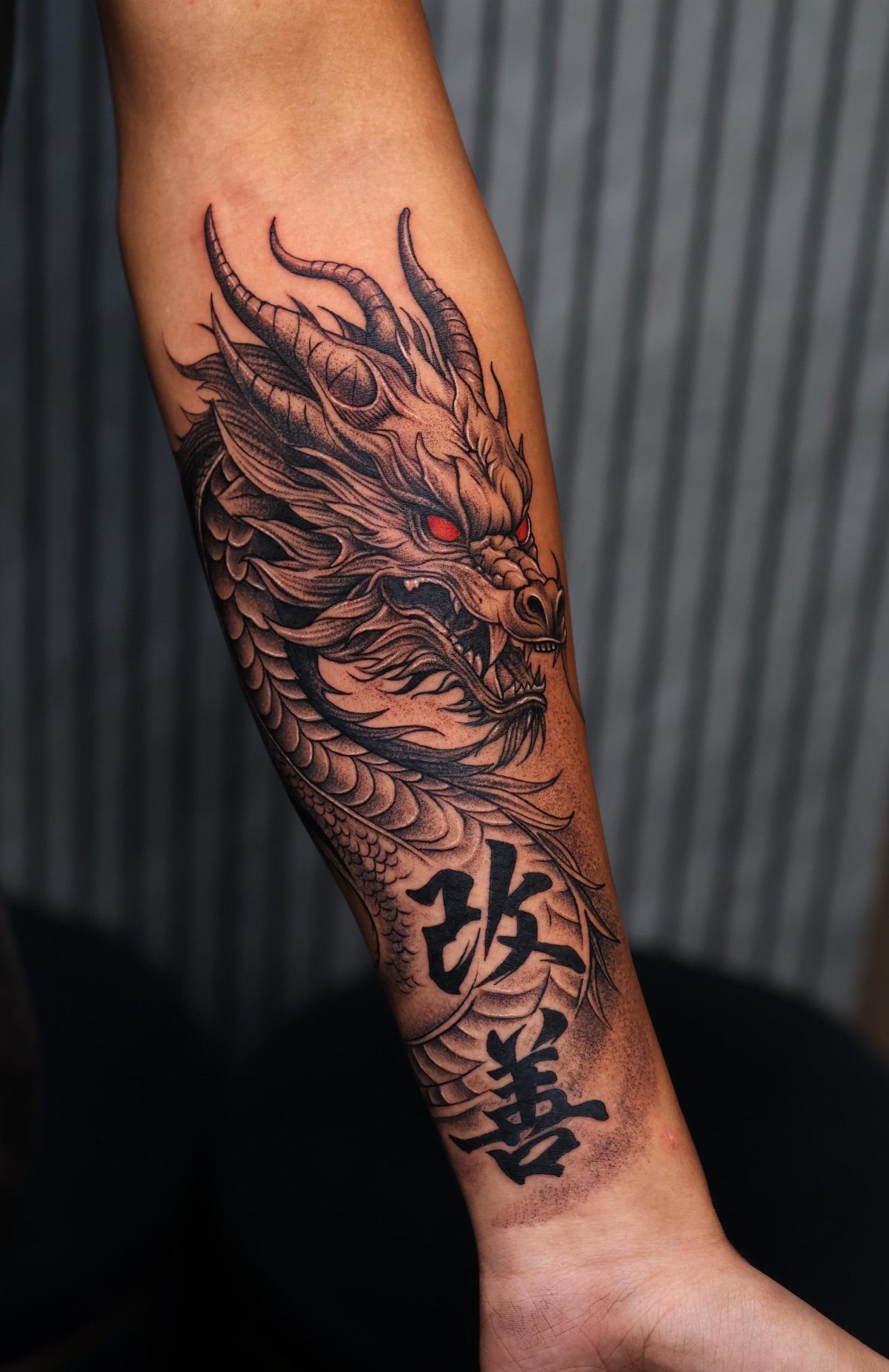
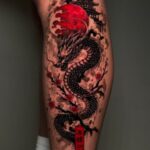
Chinese dragons read as long, serpentine bodies that wind through space rather than perch in one place.
The form lets you follow the body across a limb or let it coil around the forearm, and that movement gives the design energy even when the dragon itself is still.
Red eyes show up often because they snap against black and grey ink without needing a full-color piece.
If you want the dragon to feel protective rather than menacing, softer shading around the face and fewer sharp angles in the scales will shift the tone.
Pair it with calligraphy if the characters mean something specific to you, but make sure the translation is correct before it goes on permanently.
2. Japanese Dragon Tattoo
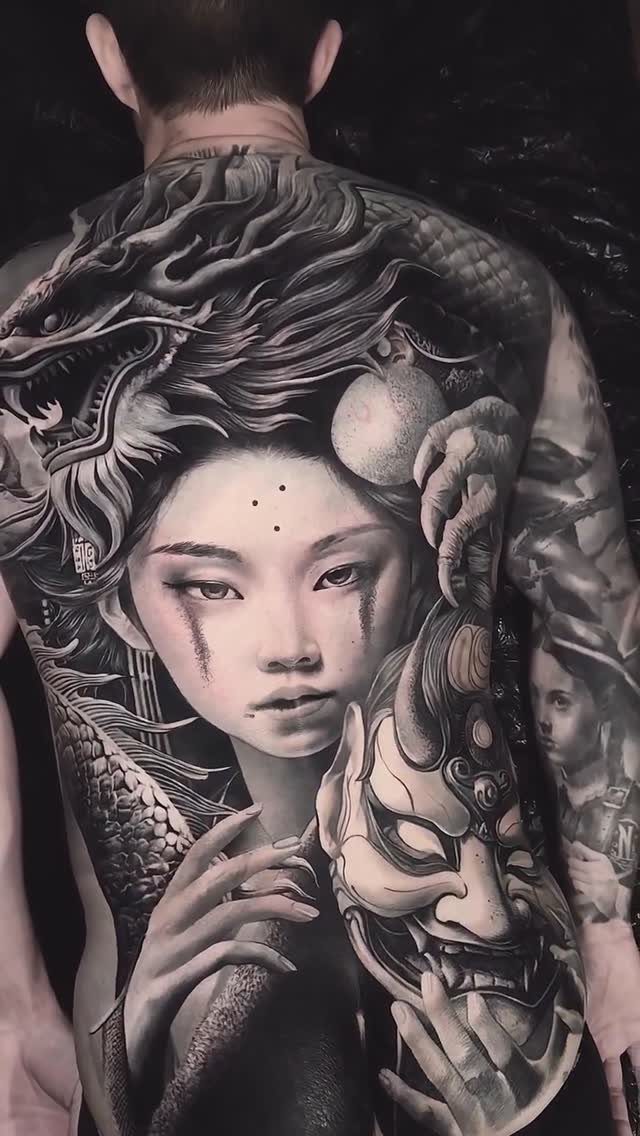
Japanese dragons tend to appear in larger compositions that include other elements from the same tradition: masks, waves, peonies, or figures.
The dragon itself usually has a more muscular, coiled body than the Chinese version, and the head is broader with prominent horns.
Placement matters here because the design needs room to breathe. A back piece gives you space to include secondary imagery that balances the composition, and the dragon can wrap across the shoulders or down toward the ribs.
If you’re building a sleeve or a back piece over multiple sessions, the dragon can anchor the layout while you add surrounding details later. Black and grey keeps the focus on form and shading rather than competing colors.
3. Celtic Dragon Tattoo
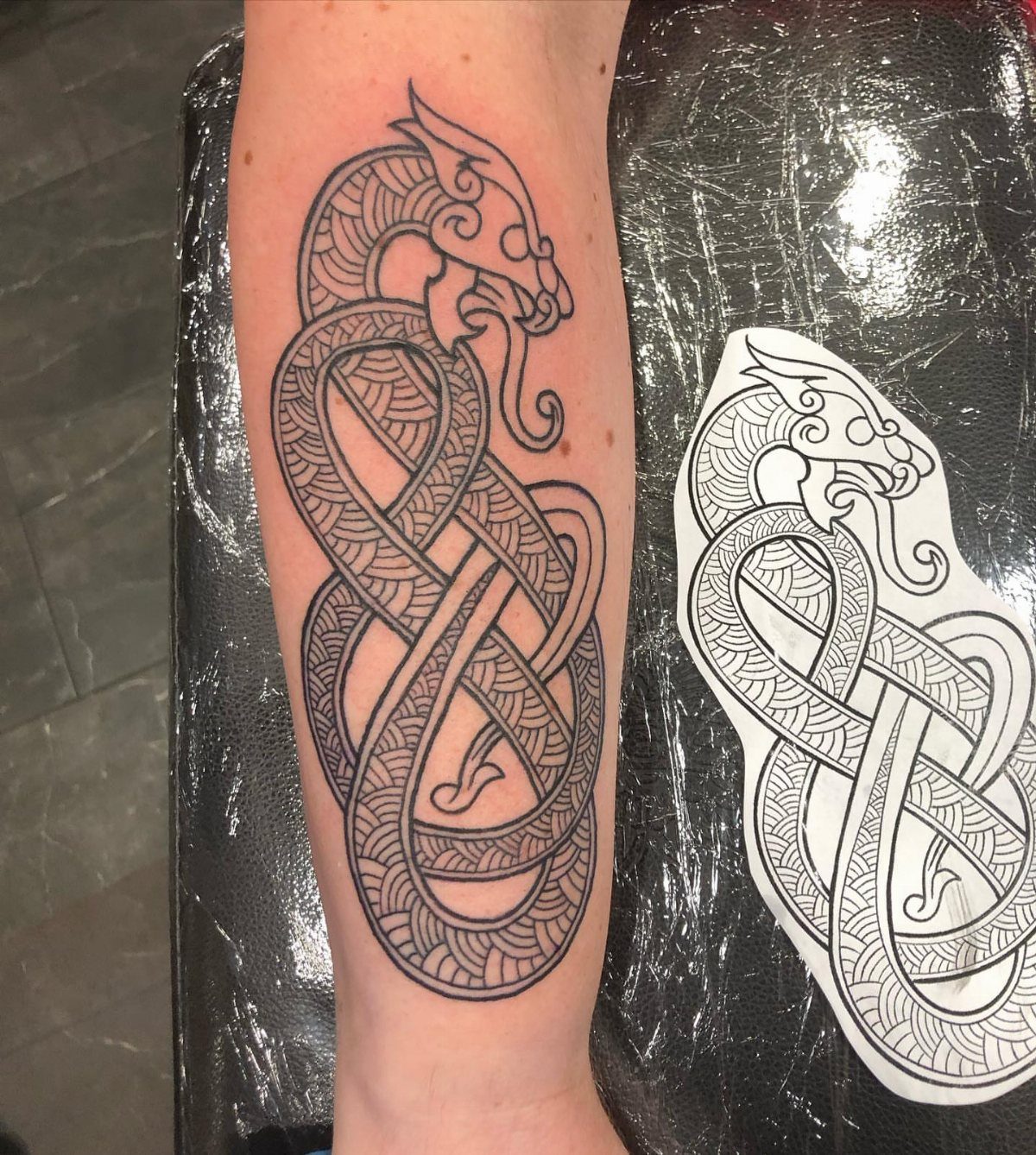
Celtic dragons are built from knotwork, so the body loops back on itself and the lines never end. The design reads as pattern first and creature second, which makes it feel more decorative than aggressive.
Forearms work well because the dragon’s length can follow the arm’s natural taper, and the knots stay readable without shrinking too small.
The style relies on clean, consistent line weight to hold the pattern together, so it’s worth finding an artist who has experience with Celtic work.
Black ink alone is enough; color doesn’t add much to a design that’s already about the interlocking structure.
4. Tribal Dragon Tattoo Designs
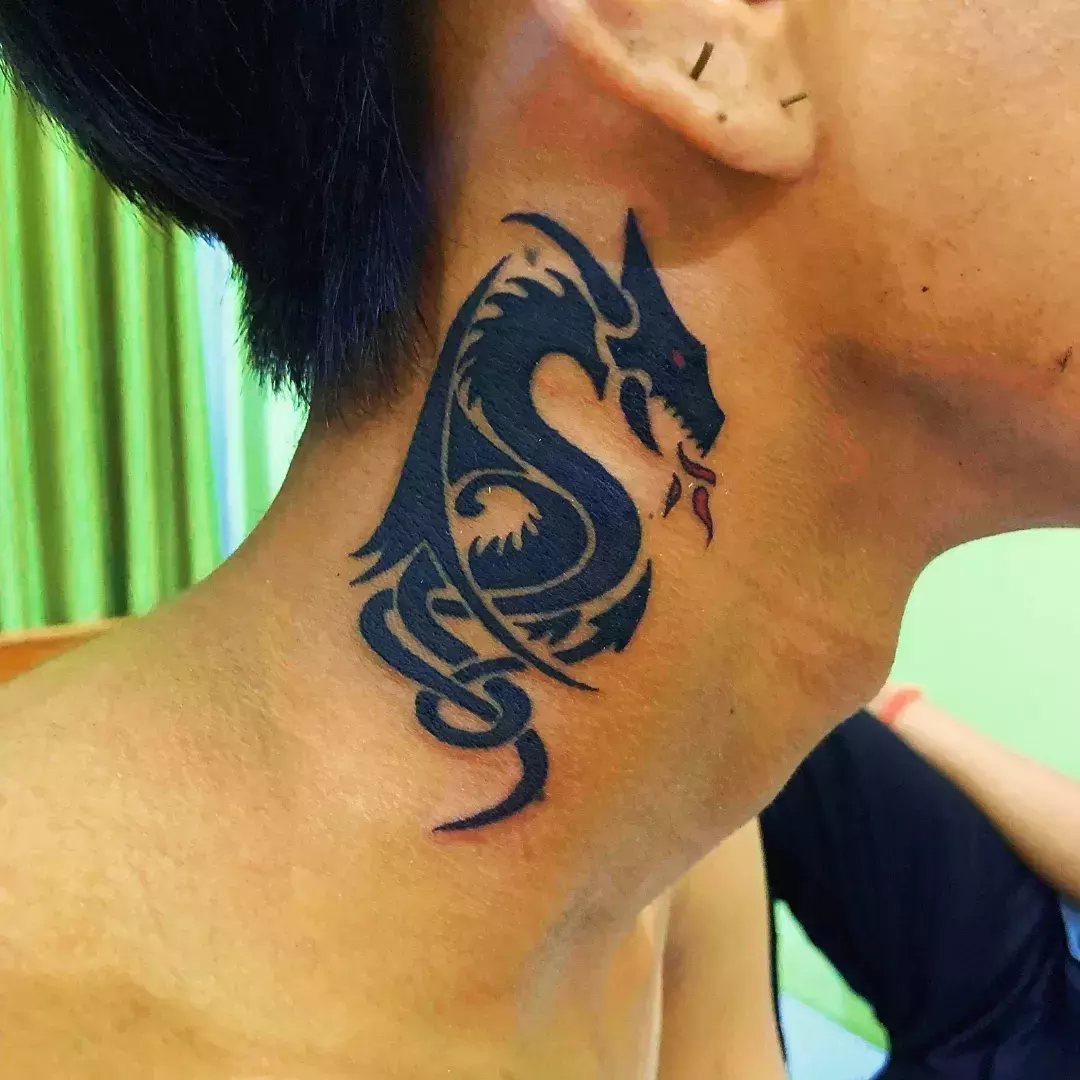
Tribal dragon designs strip the creature down to bold, flowing shapes with sharp points and negative space doing most of the work.
The style comes from older tattooing traditions that used solid black ink and high contrast, so there’s no shading or fine detail to soften the look.
Placement on the neck or upper back lets the lines follow the body’s natural curves, and the design reads clearly from a distance because the forms are simple and graphic.
Tribal work can feel dated if the shapes are too generic, so look for an artist who can keep the design tight and intentional rather than filling space with filler swirls.
5. Minimalist Dragon Tattoo Designs
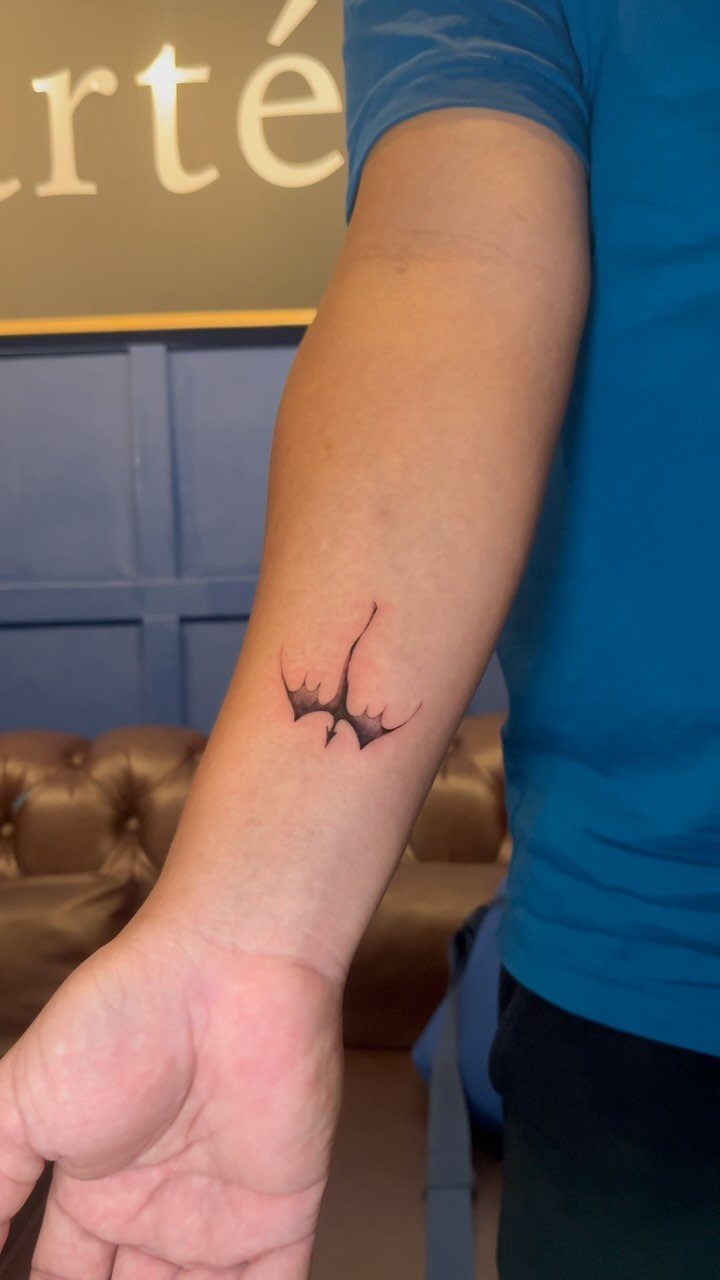
Minimalist dragons reduce the creature to a single continuous line or a few essential shapes, and the result reads as a gesture rather than a portrait.
The style works when you want something dragon-coded but not literal, and it takes up less space than a fully detailed piece.
Inner forearm or wrist placements suit the small scale, and black ink keeps it legible as the piece ages.
Fine lines fade faster than bold ones, so expect to touch it up after a few years if you want the crispness to last.
If you’re adding a first tattoo and you’re not ready to commit to a large piece, this is a low-risk entry point that still carries the symbolism.
6. European Dragon Tattoo
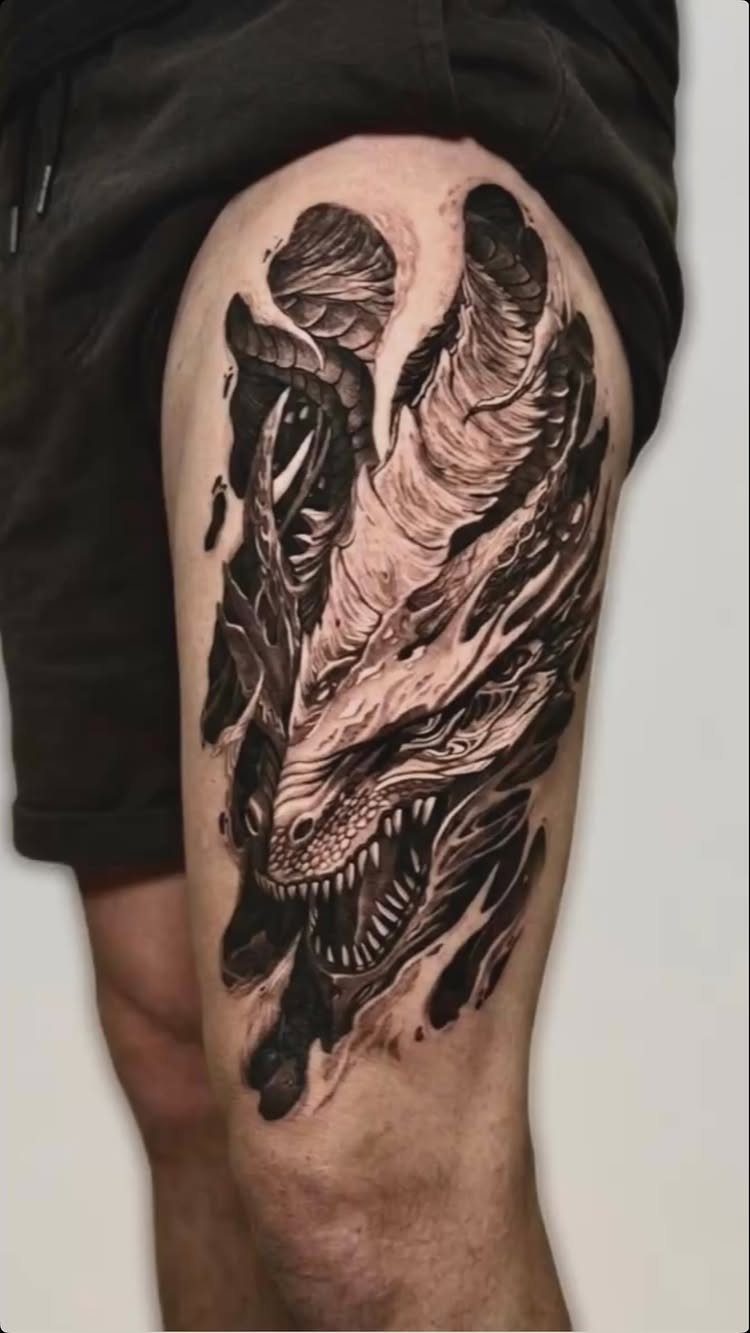
European dragons are the winged, fire-breathing type from medieval art and fantasy, usually shown with a heavier build and a more reptilian face.
The creature reads as a threat rather than a protector, so the imagery skews darker and more aggressive than Eastern dragon designs.
Thigh placement gives you a wide, flat canvas where the dragon’s head can fill the space without crowding, and the design can extend down toward the knee or up toward the hip.
Black and grey shading adds depth to the scales and makes the piece feel three-dimensional. If you want a design that looks ready to strike, keep the mouth open and the teeth visible.
However, despite its less-than-friendly association, the European-style Dragon makes for an impressive tattoo design.
7. Realistic Dragon Tattoo Designs
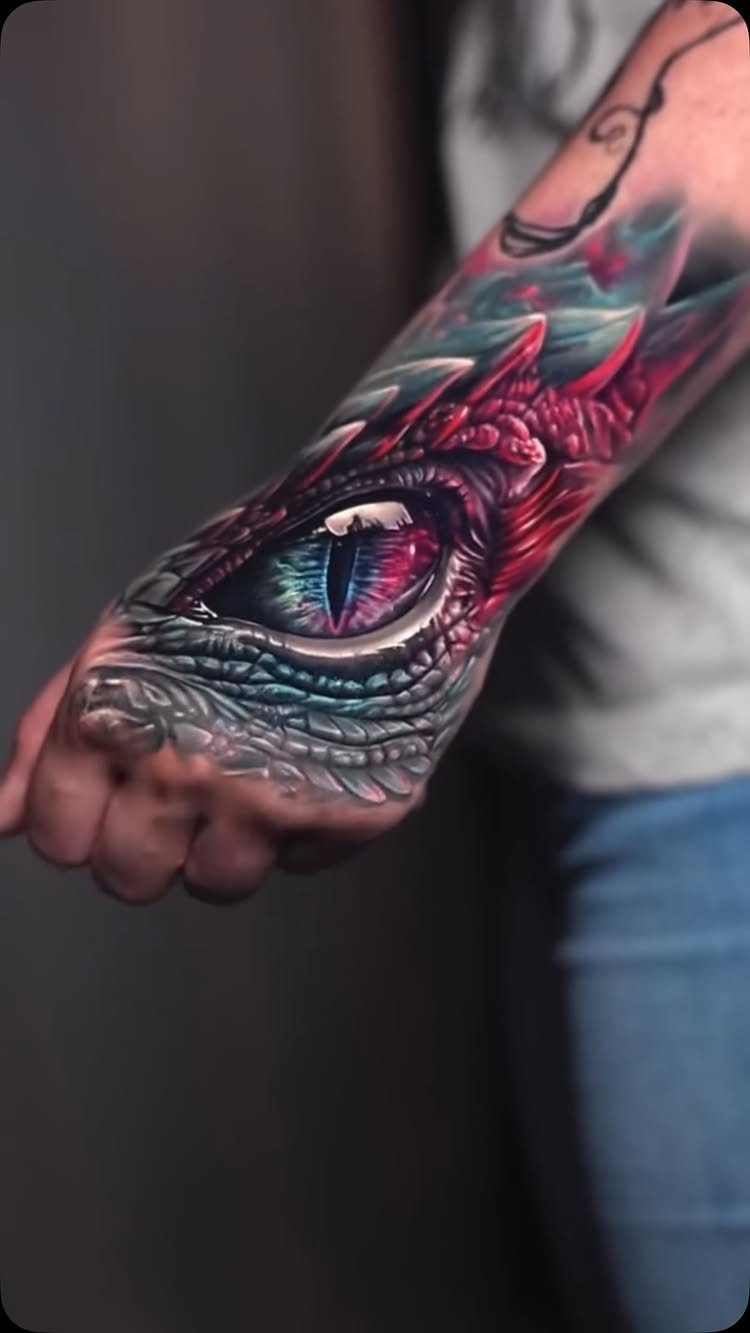
Realistic dragon tattoos aim to make a creature that doesn’t exist look like it could. The scales need dimension, the eye needs a catch light, and the shading has to suggest mass and texture rather than flat color.
Dragon eyes work as standalone pieces when you don’t want the full creature but still want something recognizable.
Forearm placement keeps the detail visible, and color in the iris gives the design a focal point without filling the whole piece. The style demands good shading, so find an artist whose portfolio shows clean gradients and tight detail work.
8. Watercolor Dragon Tattoo
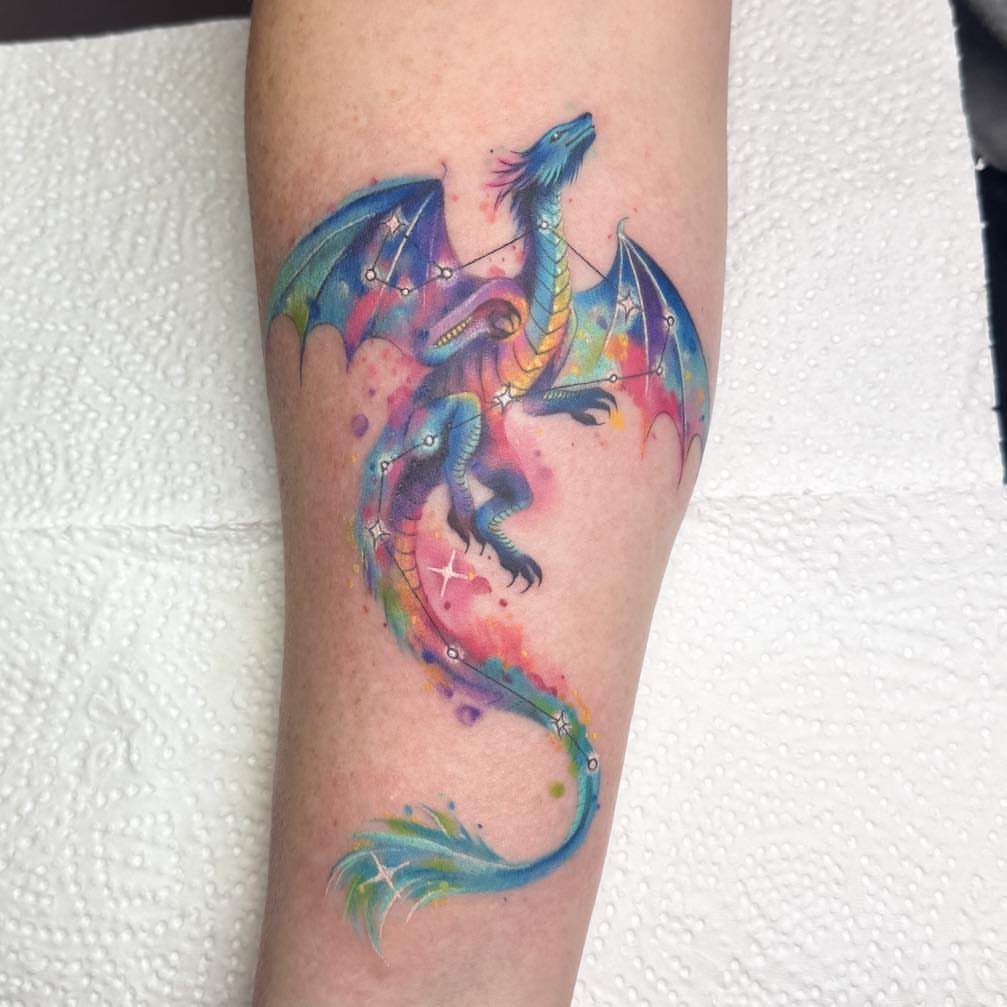
Watercolor dragons layer bright, blended colors behind or around the creature’s outline, giving the piece a painted, fluid look instead of solid fills.
The style borrows from art rather than traditional tattooing, so it reads as softer and less graphic than most dragon work.
Blue and purple tones keep the palette cool and let the dragon feel mythical rather than aggressive. The colors will fade faster than black linework, so expect the vibrancy to drop after a few years and plan for a refresh.
If you want something expressive and less literal, this approach trades longevity for a lighter, more artistic feel.
9. Traditional Dragon Tattoo Designs
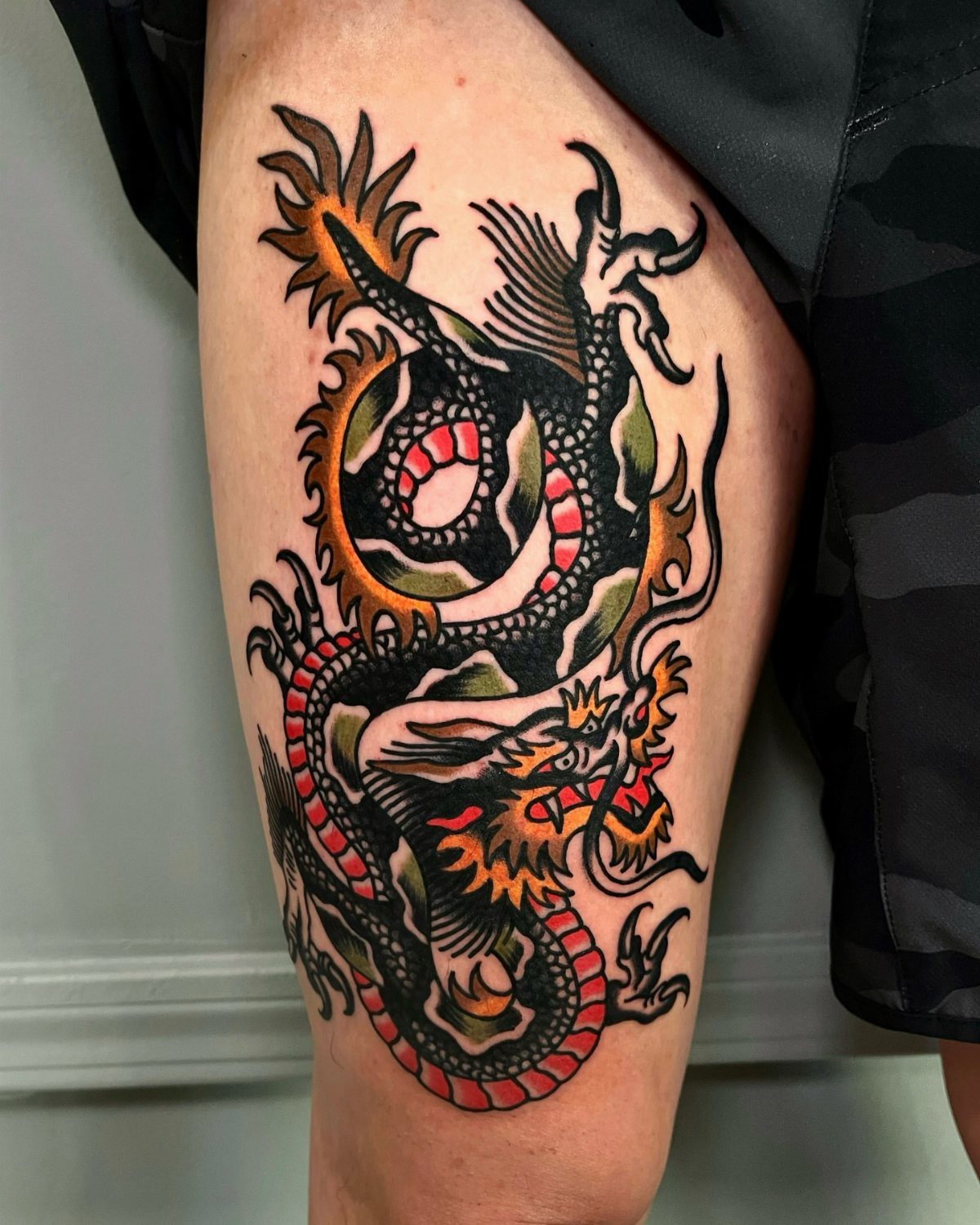
Traditional dragon tattoos use thick black outlines, limited color, and high contrast to make the design hold up over time.
The style comes from American traditional tattooing, where simplicity and boldness were necessary because the tools and techniques were less precise than what’s available now.
Red and orange work well because they stay bright against black and give the dragon a fiery look without needing a full spectrum.
Thigh placement offers a flat surface where the design can sit without bending around joints, and the bold lines won’t blur as the tattoo ages.
If you want something that will still read clearly over time, this is the safest bet.
10. Dragon and Phoenix Tattoo
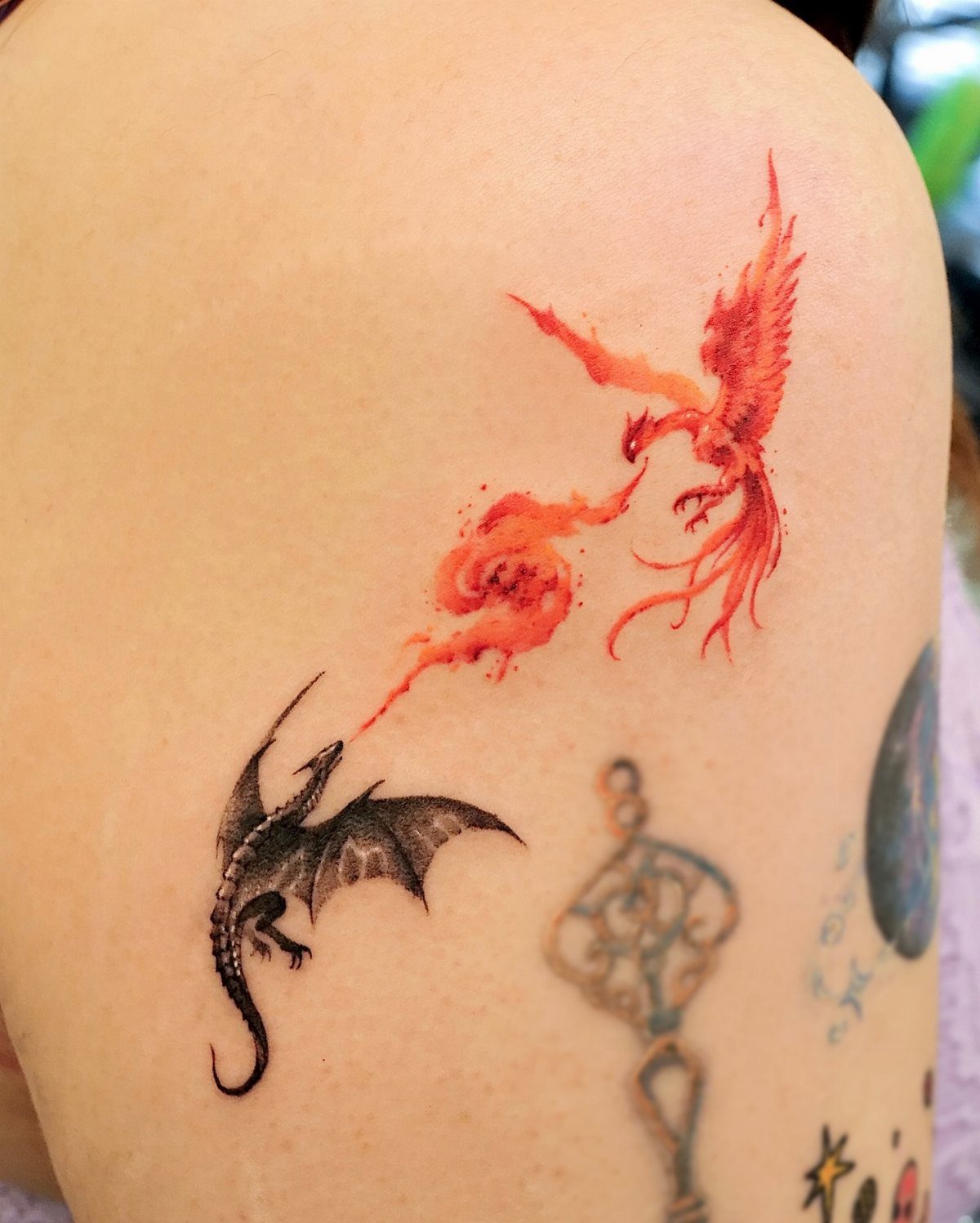
Pairing a dragon with a phoenix sets up a visual balance between 2 creatures that represent opposing forces: the dragon as power and the phoenix as rebirth.
The design usually shows them facing each other or circling a central point, and the composition needs enough space to keep both readable.
Black and red is a common split, with each creature taking one color so they stay distinct. Shoulder placement works because the roundness of the joint lets the 2 animals wrap around it without crowding.
If you’re drawn to duality or balance as a concept, this pairing gives you a way to show both sides in one piece.
11. Dragon Sleeve Tattoo
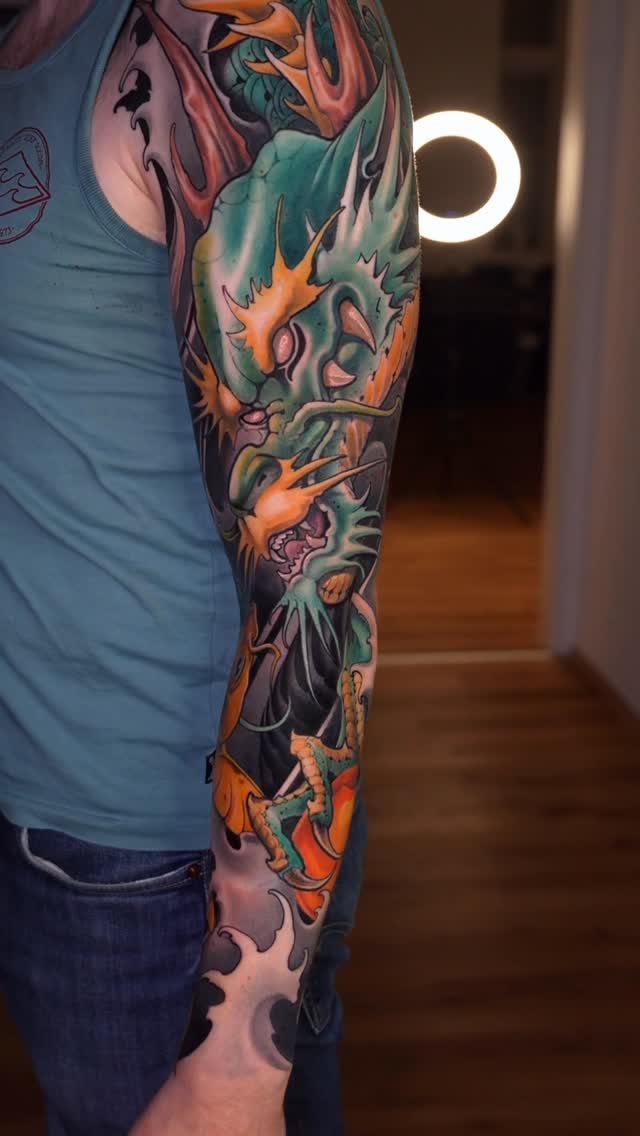
A dragon sleeve gives you the full length of the arm to develop the creature’s body, and the design can coil from shoulder to wrist or weave between other elements if you’re building a larger composition.
The extra space lets you include more detail in the scales, the head, and any surrounding imagery without cramping the layout.
Color adds depth but also increases session time and cost, so decide early whether you want a monochrome piece or a full-color one.
Multi-session work is typical for sleeves, and the dragon can anchor the design while you add background or secondary elements later. If you’re committing to a large piece, this placement delivers maximum impact.
12. Full Back Dragon Tattoo
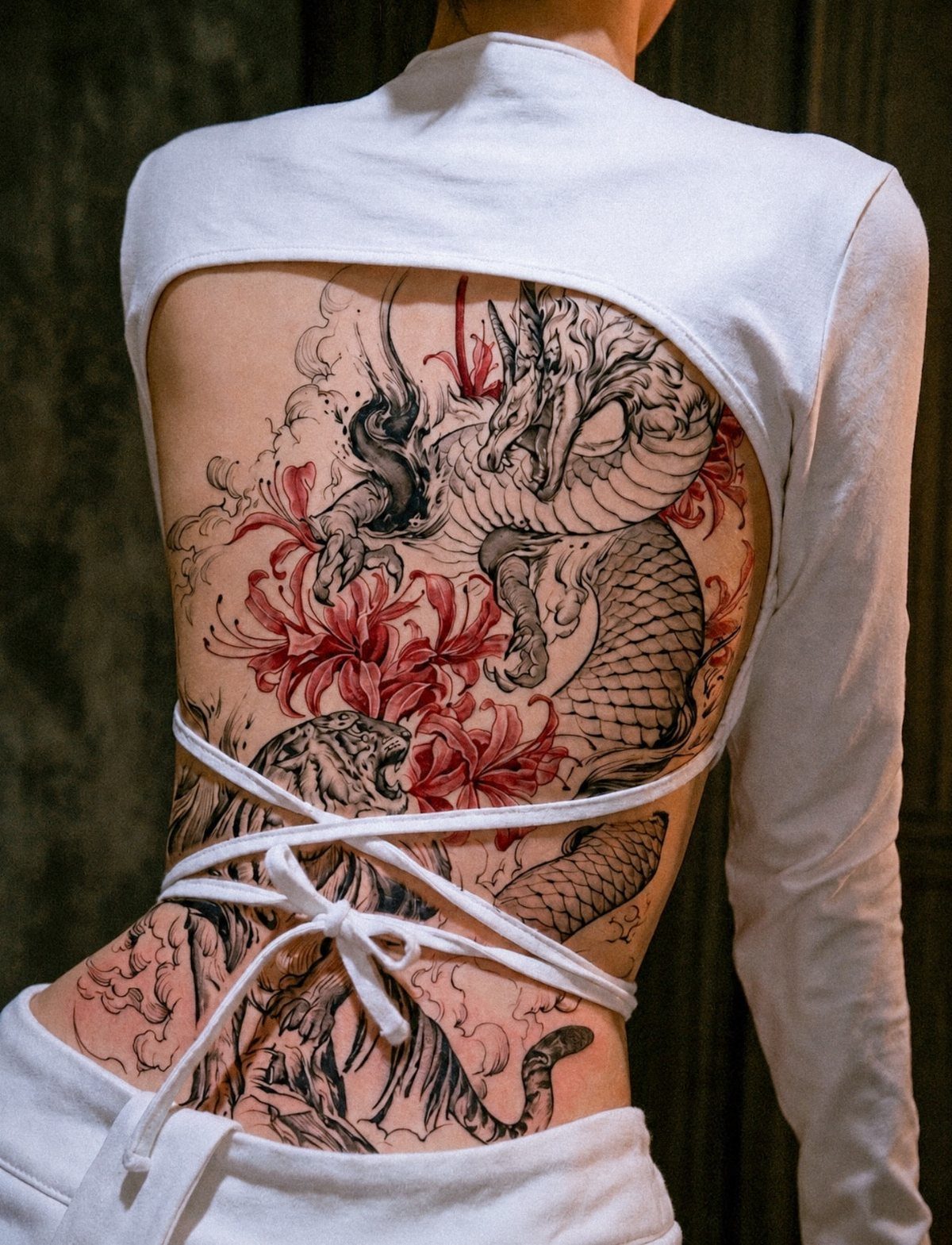
A full back piece gives the dragon an entire canvas, and the scale of the design makes it the most dominant tattoo you can get.
The creature can stretch across both shoulder blades, wrap down the spine, or share the space with other imagery like the tiger in traditional East Asian compositions.
Expect multiple sessions, higher cost, and longer healing times because the back is a large surface with varying pain levels depending on proximity to the spine or ribs.
The design reads as a statement piece, so it suits someone ready for a tattoo that will define their body art rather than blend into a collection.
If you want maximum coverage and a design that commands attention, this is the format that delivers.
13. Chest Dragon Tattoo
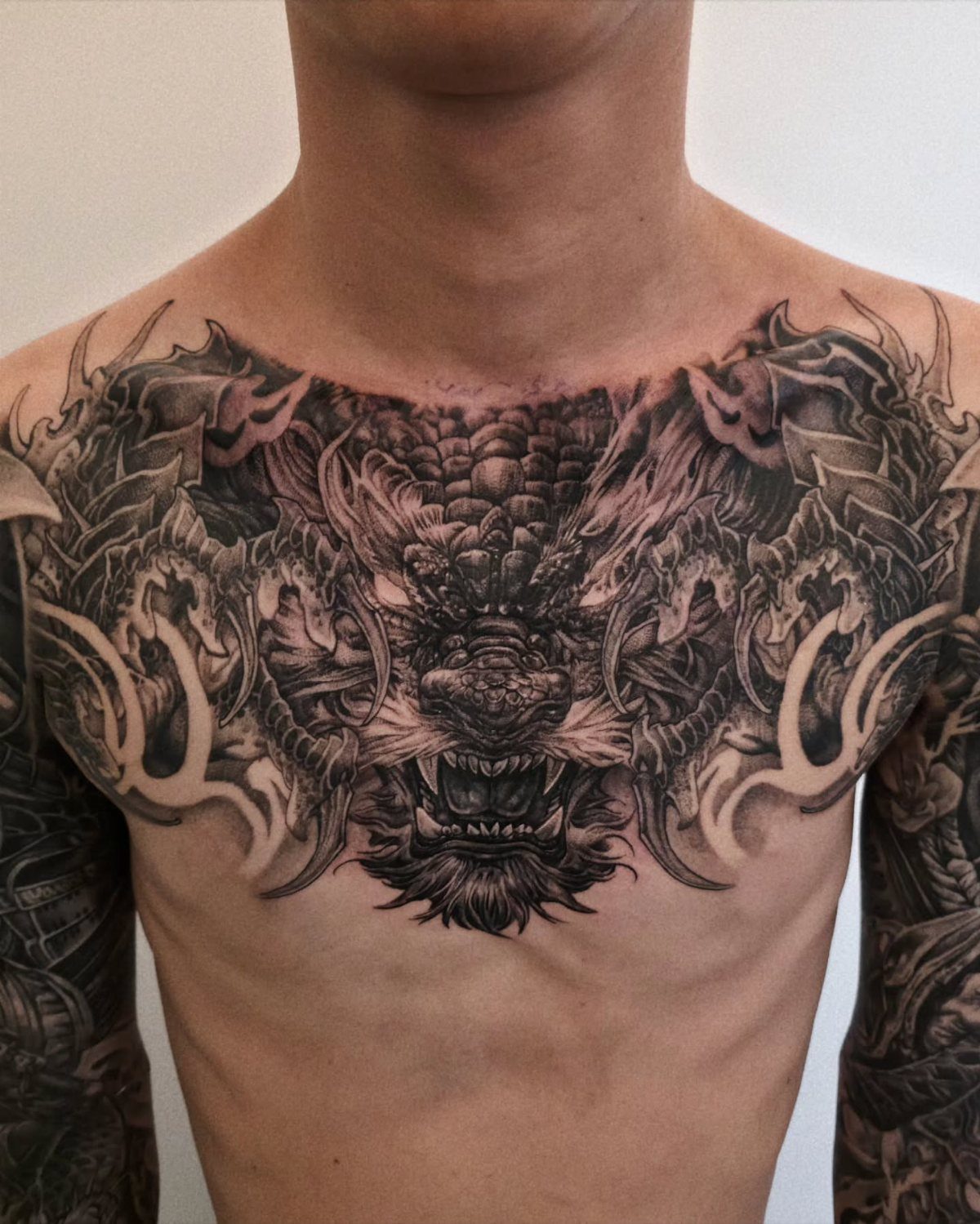
Chest placement centers the dragon over your heart and lets the design spread across the collarbones or down toward the ribs.
The symmetry works when the dragon’s head sits in the middle and the body curves outward, but you can also offset it to one side if you want a less formal composition.
Monochrome ink gives each scale room to speak without distraction.
Pain levels are higher near the sternum and collarbone because there’s less padding, but the flat surface makes it easier for the artist to work cleanly. If you want a piece that sits front and center, this placement delivers.
14. Leg Dragon Tattoo
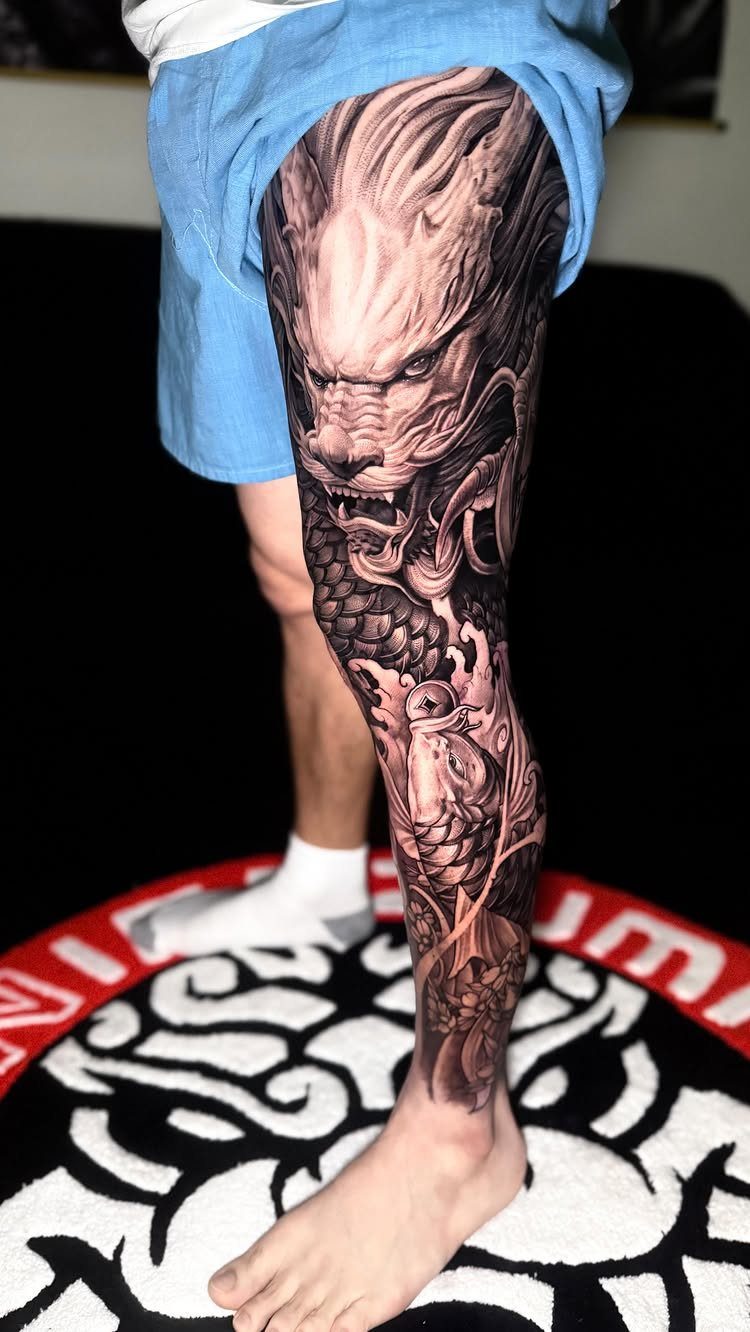
Leg placement gives you vertical space to let the dragon’s body run from thigh to ankle, and the design can wrap around the calf or sit on the outer thigh where the surface stays flatter.
More canvas means the head gets the definition it deserves and the scales stay legible.
Black and grey works well because it ages better on the leg, where sun exposure is easier to control with clothing.
The outer thigh is less painful than the inner thigh or knee, so if pain is a concern, keep the bulk of the design on the outside.
A dragon works as the foundation for a full leg piece, leaving space for background and supporting imagery down the line.
15. Skeleton Dragon Tattoo
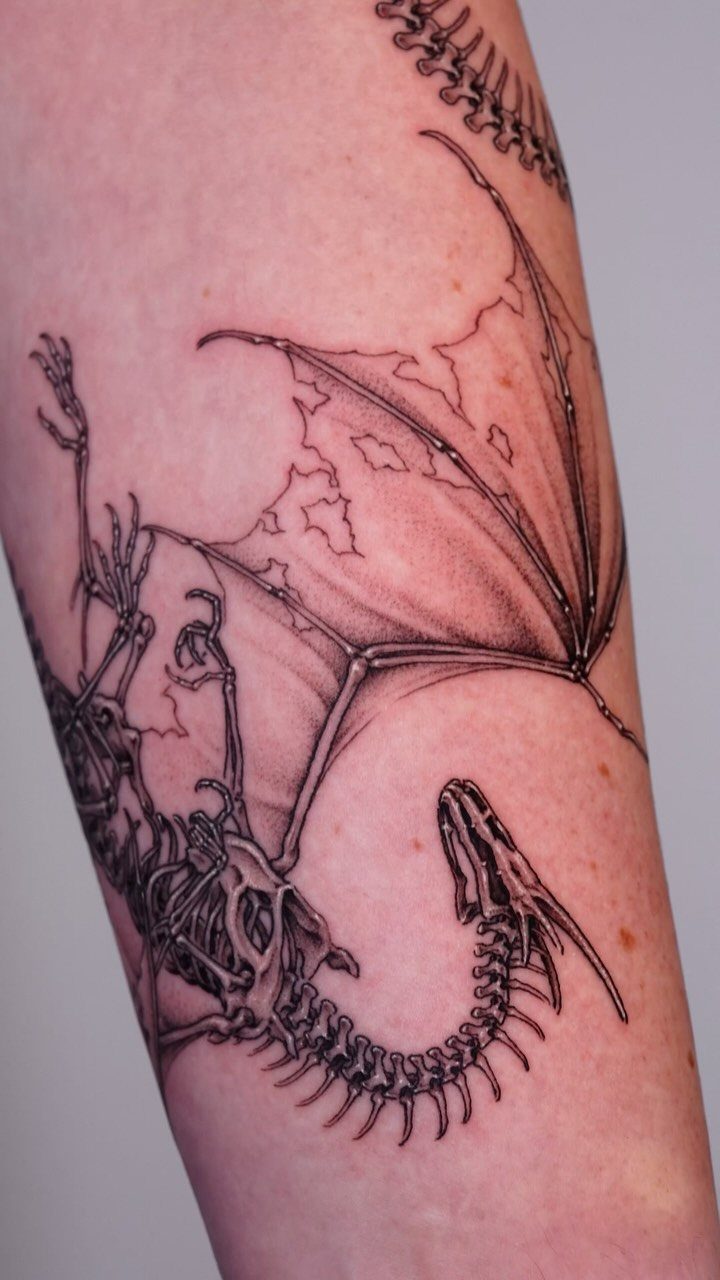
A skeleton dragon trades muscle and scales for exposed bone structure, and the result reads as decay or rebirth depending on how the shading is handled.
The design shows the ribs, spine, and skull in detail, and the wings usually appear as bare membranes or skeletal frames.
Black ink alone is enough because the bones need sharp contrast to stay readable, and adding color risks muddying the structure. Forearm placement keeps the detail visible and gives you a flatter surface where the bones can sit without distorting.
If you want a dragon that feels closer to death than power, this version shifts the tone without losing the creature entirely.
16. Dragon and Rose Tattoo
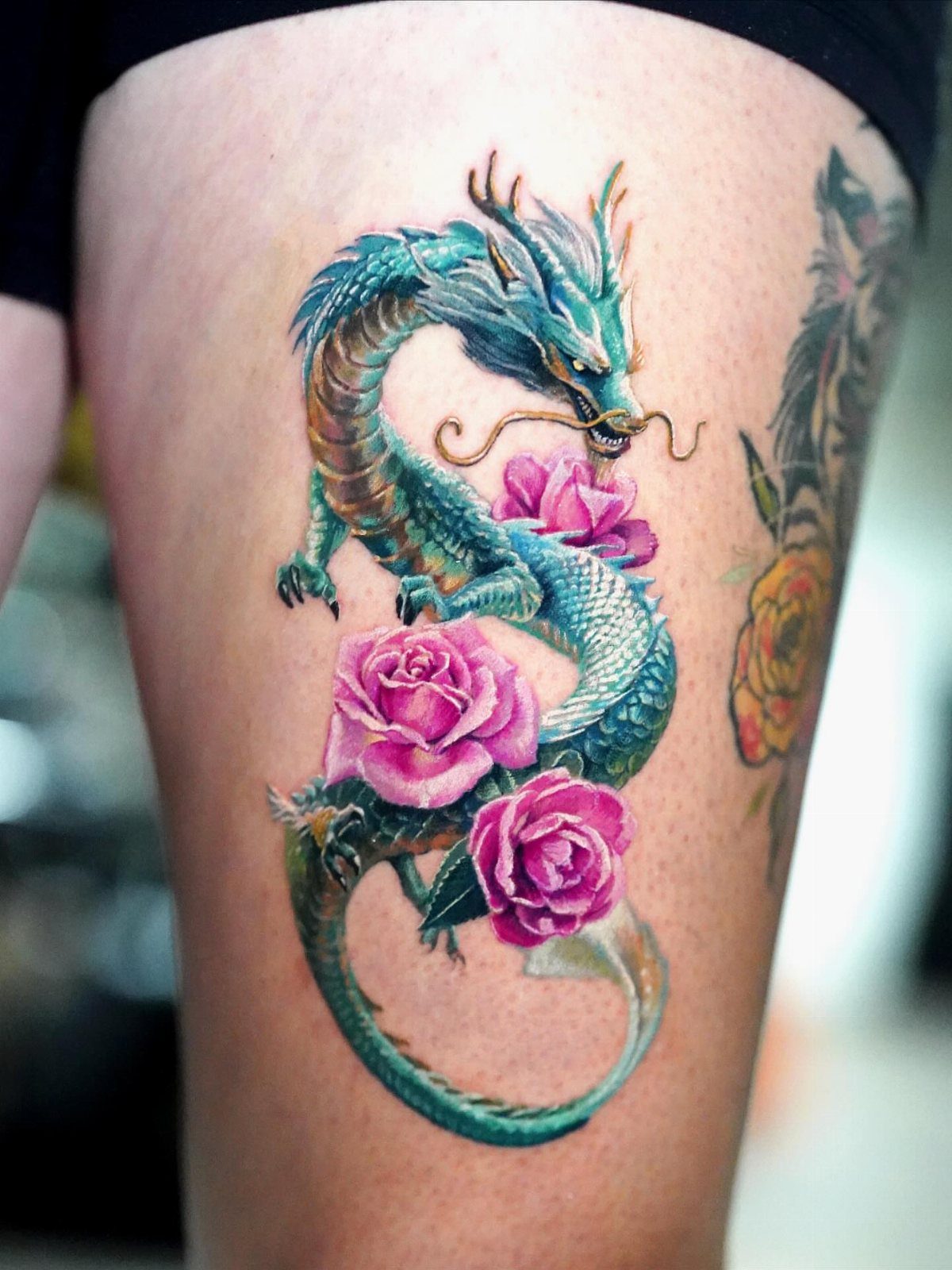
Pairing a dragon with roses softens the creature’s aggression and adds a contrast between strength and beauty. The roses usually sit near the dragon’s head or wind through its body, and the combination reads as balance rather than conflict.
Color brings the roses to life, and pink or red petals stand out against blue or teal dragon scales without clashing.
Thigh placement gives you enough space to develop both elements without crowding, and the flat surface keeps the details legible. The floral softens the creature’s edge and adds a lyrical note that balances raw power with something gentler.
Dragon Tattoo Meanings
Dragons carry weight because the creature shows up in nearly every culture’s mythology, and each tradition assigns its own meaning.
In Eastern traditions, the dragon protects and brings good fortune. In Western stories, it guards treasure and represents a challenge you overcome rather than a force that watches over you.
Power and wisdom are the constants, but the tone shifts depending on which version you choose.
A Chinese dragon reads as benevolent, while a European dragon skews aggressive. If the tattoo represents resilience or personal growth for you, the symbolism is there, but nothing says you need to explain it to anyone.
The creature’s flexibility is part of why it works. You can lean into the mythology or ignore it entirely and still end up with a design that feels right.
Cultural Significance of Dragons
Dragons date back to at least 4500 BCE, when jade sculptures of the creature appeared in Inner Mongolia. The meanings have evolved across generations, yet knowledge, fortune, and strength remain at the center.
In Asian cultures, dragons bring rain and sustain life. In European mythology, they hoard treasure and hold captives, standing in as the obstacle you defeat to prove courage or claim a reward.
The difference matters when you’re choosing a design, because the visual language carries that cultural context whether you intend it or not.
If the tattoo connects to a specific belief system or heritage, make sure the style matches the tradition. A Japanese dragon in a Celtic knotwork pattern will read as confused rather than intentional.
Choosing a Tattoo Artist
Look at portfolios for dragons specifically, because the creature demands good shading, consistent line weight, and an understanding of how scales and movement read on skin.
If you want a realistic dragon, find someone whose portfolio shows tight gradients and dimensional work. For traditional or tribal designs, look for bold, confident lines and high contrast.
An artist who specializes in watercolor won’t necessarily handle blackwork well, and someone who does fine line minimalism may not have the shading skills a full-color piece requires.
Book a consultation before committing, and bring reference images that match the style you’re after.
Frequently Asked Questions
What does a dragon tattoo symbolize?
Dragon tattoos symbolize power, wisdom, and strength, though the meaning shifts depending on the cultural tradition. Eastern dragons represent protection and good fortune, while European dragons read as obstacles to overcome and tend to carry a more aggressive tone.
The symbolism connects to resilience and personal growth, but the design carries weight even without a specific meaning attached.
Should a dragon tattoo face up or down?
Direction depends on placement and composition rather than a fixed rule.
When a dragon wraps around an arm or flows across the back, the head typically ends up near a natural anchor point: the top of the shoulder, the center of the chest, or wherever the eye lands first.
Upward-facing dragons can read as rising or ascending, while downward designs often feel more grounded, but the choice comes down to how the piece fits the space and what feels right visually.