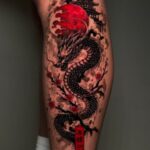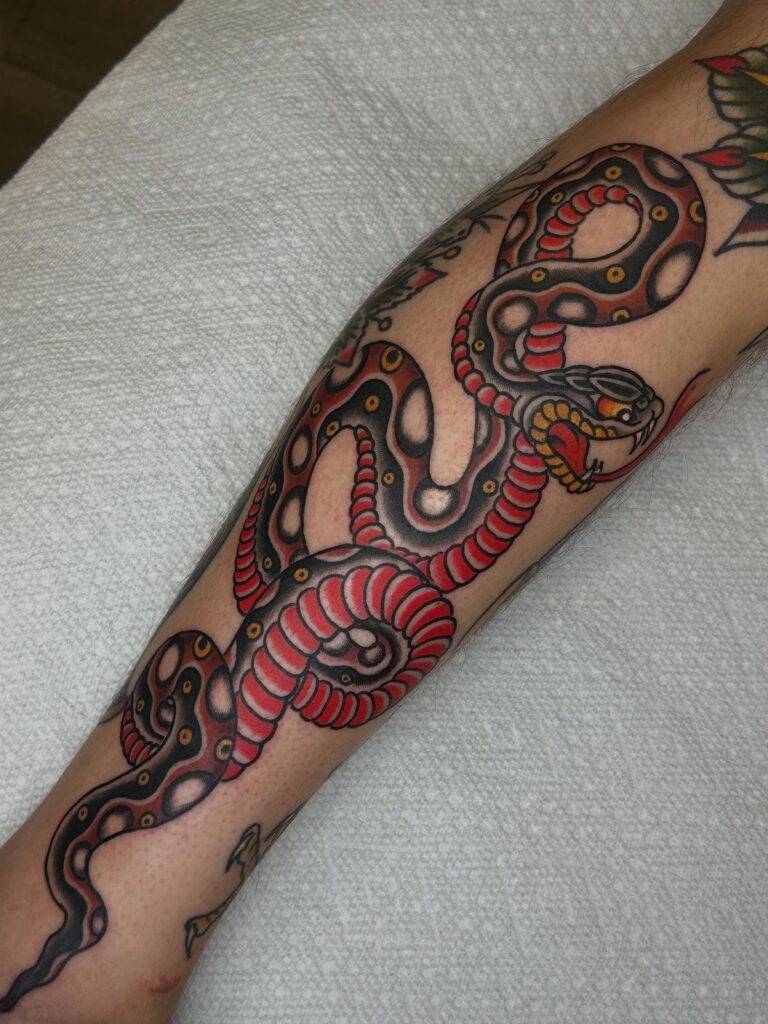
The snake’s body gives you a design that can wrap a forearm at 4 inches or spiral across a chest piece large enough to need multiple sessions.
Placement decides how much pain you sit through: ribs and inner arms hurt more than the flat surface of a forearm, and visibility shifts depending on whether the ink stays under a shirt or shows every time you move.
Traditional versions keep bold black outlines and tight color palettes, reds and greens that still read clearly decades later, while modern fine line work trades that longevity for delicate detail that fades faster.
1. Snake and Dagger
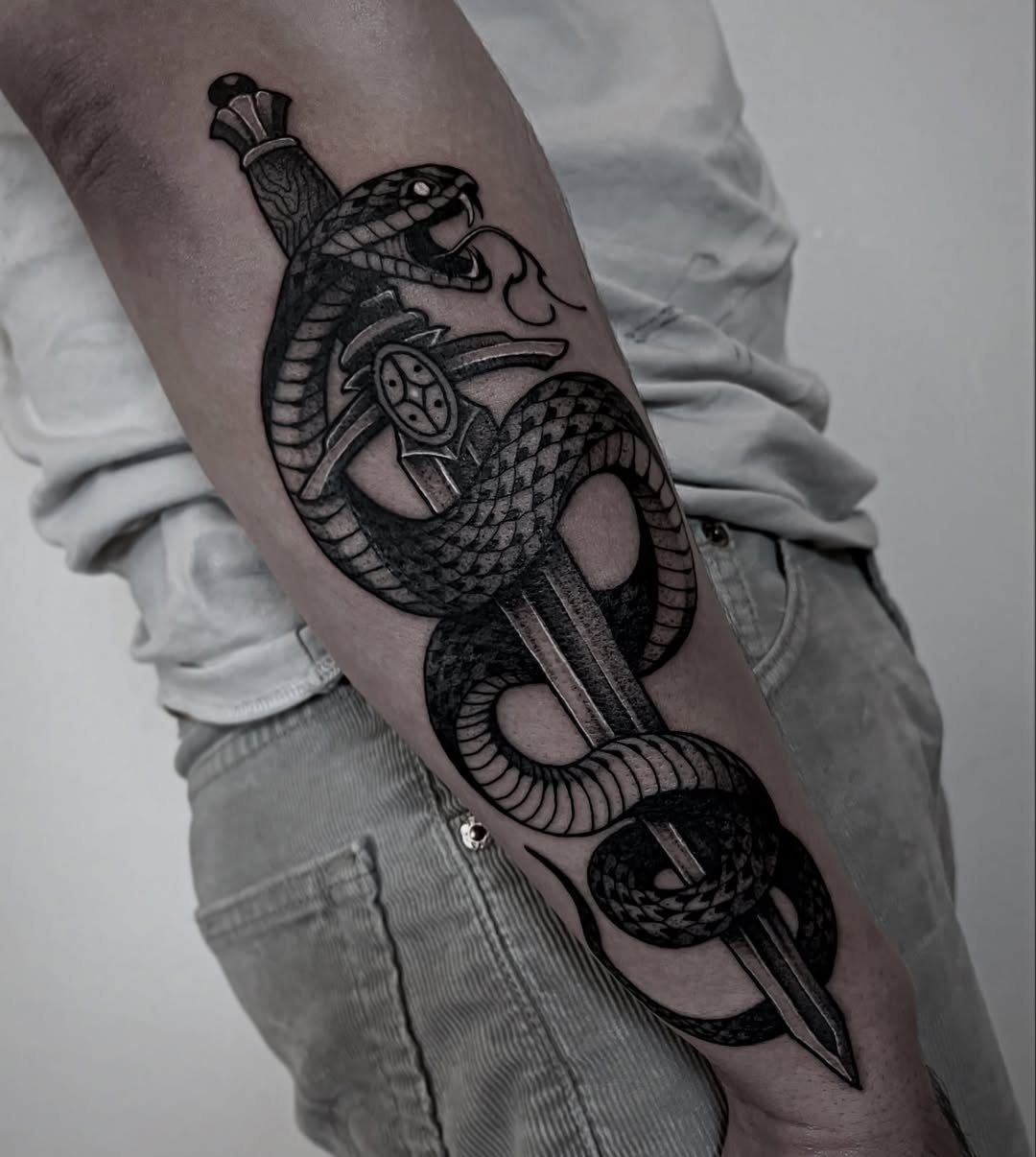
The dagger pinned through the snake’s coils turns a symbol of cunning into a reminder that temptation can be beaten.
Traditional tattoo artists shade the blade in steel grey and the scales in heavy black, sometimes adding a drop of red at the strike point.
The coil around the blade reads clearly on an upper arm or forearm. Smaller than that and the detail collapses; much larger and the composition stretches thin.
If you want the fight visible, this one shows it without needing a second animal.
2. Snake and Rose Tattoo
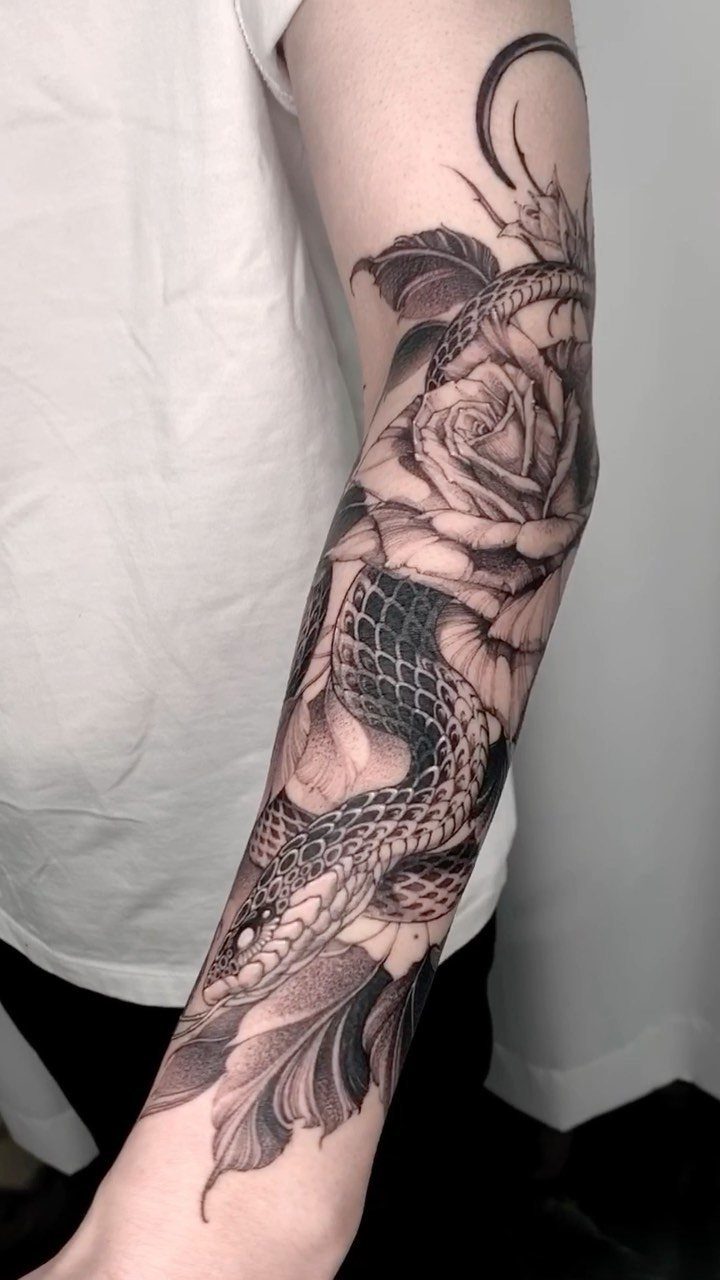
A snake wrapped through rose petals says you know beauty comes with risk. The scales sit dark against soft shading on the bloom, and traditional versions often keep the rose red while the serpent stays black and grey.
The pairing works well on a forearm or outer thigh where both elements get room to breathe. Cramming both into a small space turns the petals into mush and the coils illegible.
Placement matters: you want the snake’s head and the flower’s center both visible when the arm hangs naturally.
3. Skull and Snake Tattoo
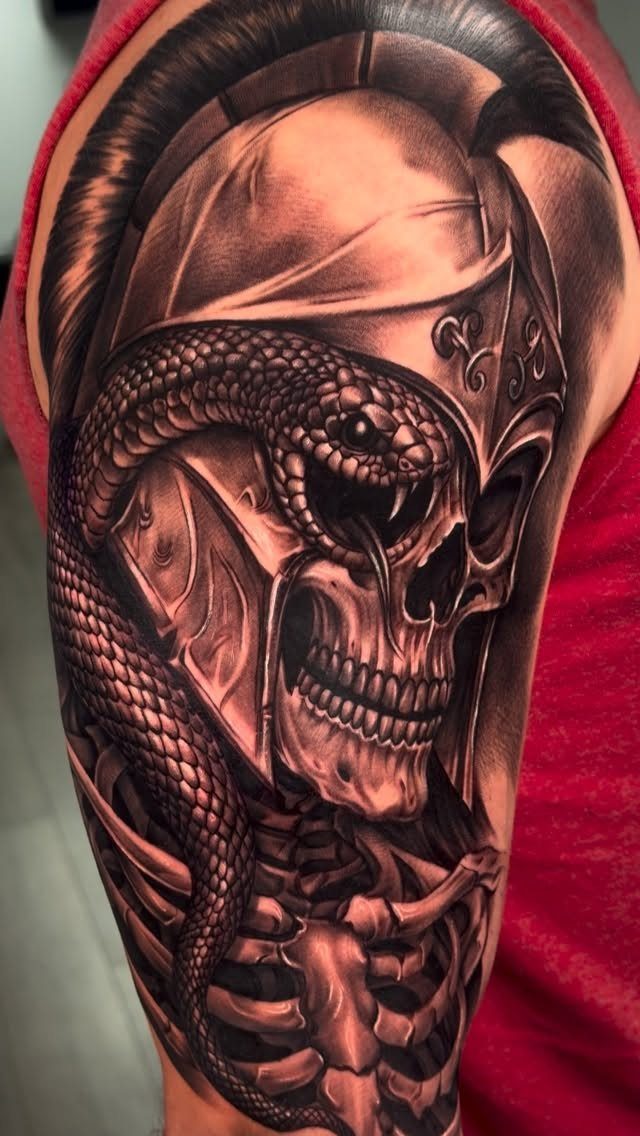
A skull wrapped in serpent coils marks the line between what dies and what sheds its skin and starts again.
In traditional work the skull gets deep black shading in the sockets and the snake’s body winds through the jaw or over the crown.
This one fits best on the upper arm or shoulder cap so both shapes hold their weight.
Too small and the skull loses its hollow menace; too large and you run out of room to complete the coil without wrapping awkwardly around the limb.
The helmet detail in some versions adds another layer: a life lived, armor left behind.
4. Snake and Eagle Battle Tattoo
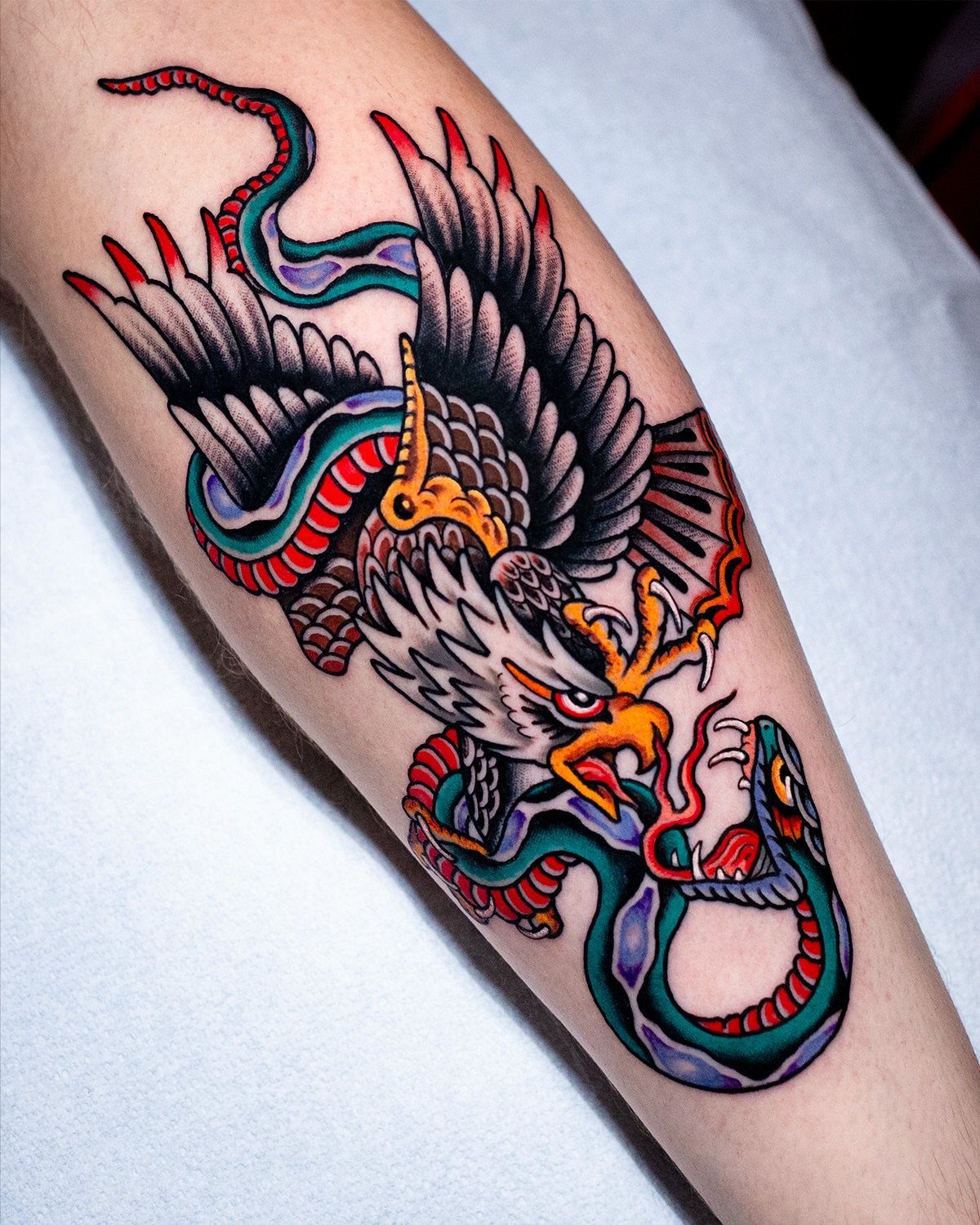
The eagle drives talons into the snake mid-strike, wings spread wide. Traditional versions lean into bold color: the bird in white and brown, the snake in green or red, both outlined thick and shaded heavy.
This battle suits a large canvas, an outer arm or thigh where the wingspan and coil both register from a distance. Anything smaller and the fight compresses into a blob.
The design carries American traditional roots, often tattooed on sailors as a reminder that survival takes aggression. If you want movement in the piece, this one delivers it.
5. Coiled Snake Tattoo
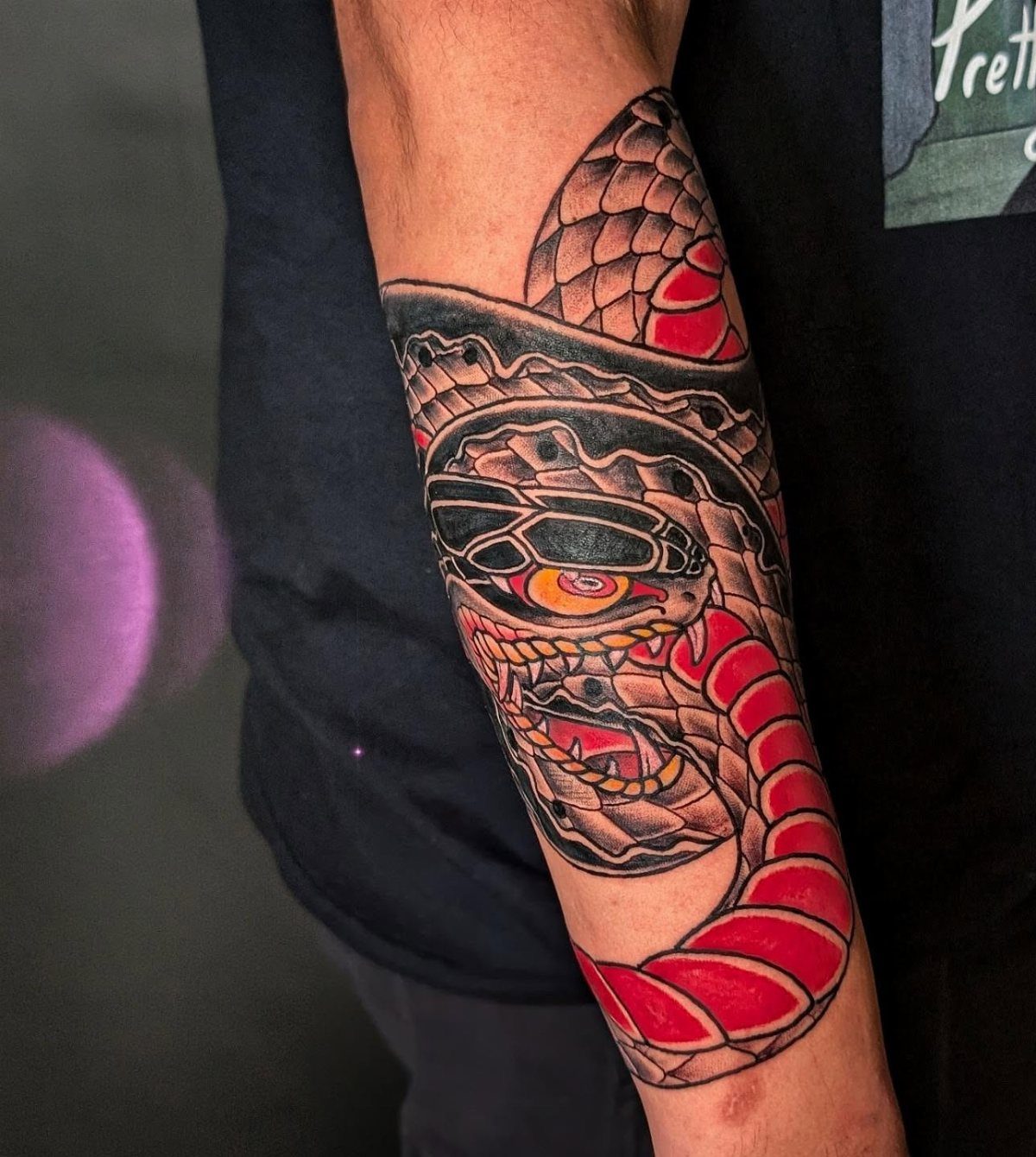
Coiled tight with the head raised, this snake is all potential.
The body spirals inward and the mouth gapes open, fangs forward. Traditional artists pack the coils with solid black and use red or yellow sparingly on the eyes or tongue.
A forearm or calf gives the design the vertical space it needs. The coil reads cleanest when it sits on a flat plane; wrapping it around a limb can distort the spiral.
This one suits anyone who wants the threat visible without the strike already landing.
6. Twin Snakes Tattoo
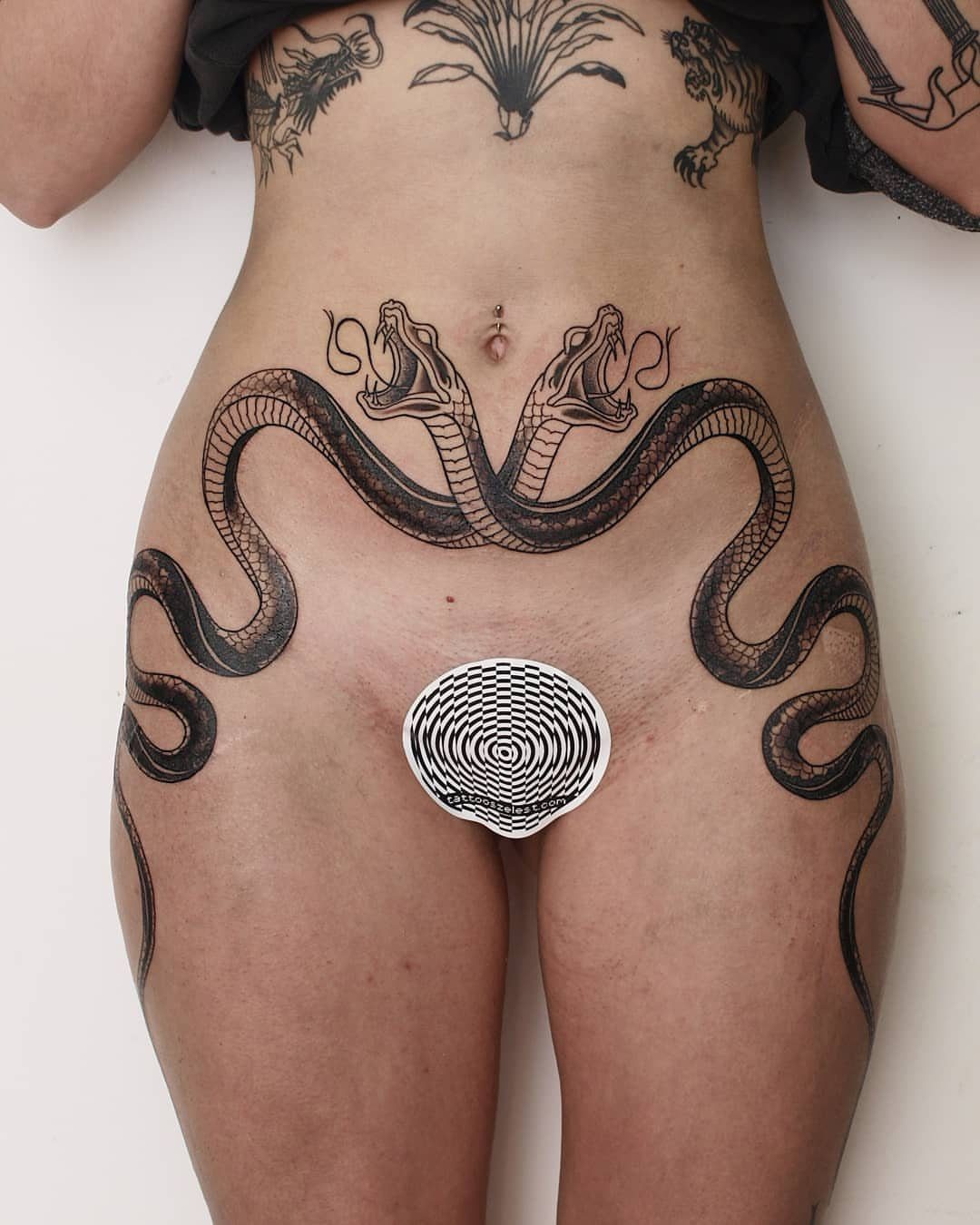
2 snakes mirrored across the body’s centerline create symmetry where ink usually avoids it.
The heads face outward or toward each other, and the tails cross below. Traditional black ink keeps the design stark, and the curves follow the hips or ribs naturally.
Placement across the lower torso or upper thighs requires a large commitment, and sitting through it takes stamina since the hip bones and groin area hurt more than most spots.
This layout balances left and right, making it a good fit if you want ink that treats the body as one canvas instead of separate limbs.
7. Ouroboros Snake Tattoo
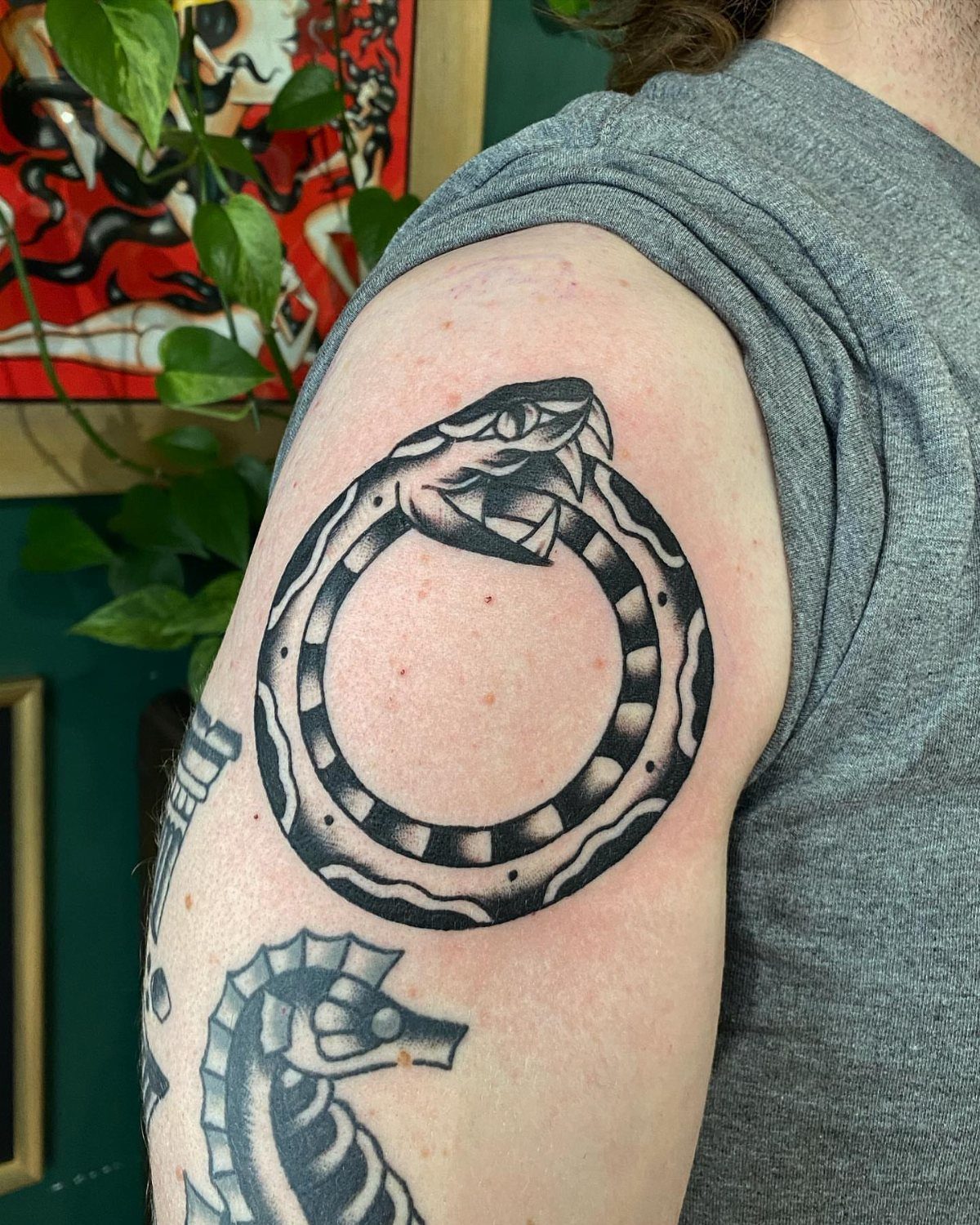
The snake swallows its own tail in a closed loop, marking time as a circle with no start and no finish.
Traditional black and grey shading keeps the image clean, and the curve fits naturally on a shoulder or upper arm where the circle holds its shape.
Size matters here: too small and the scales blur, too large and the loop can look unfinished if it doesn’t close cleanly. I prefer a diameter around 4 inches for the detail to read without crowding the limb.
If you want the idea of return without spelling it out, this one carries it.
8. Snake Around Sword Tattoo
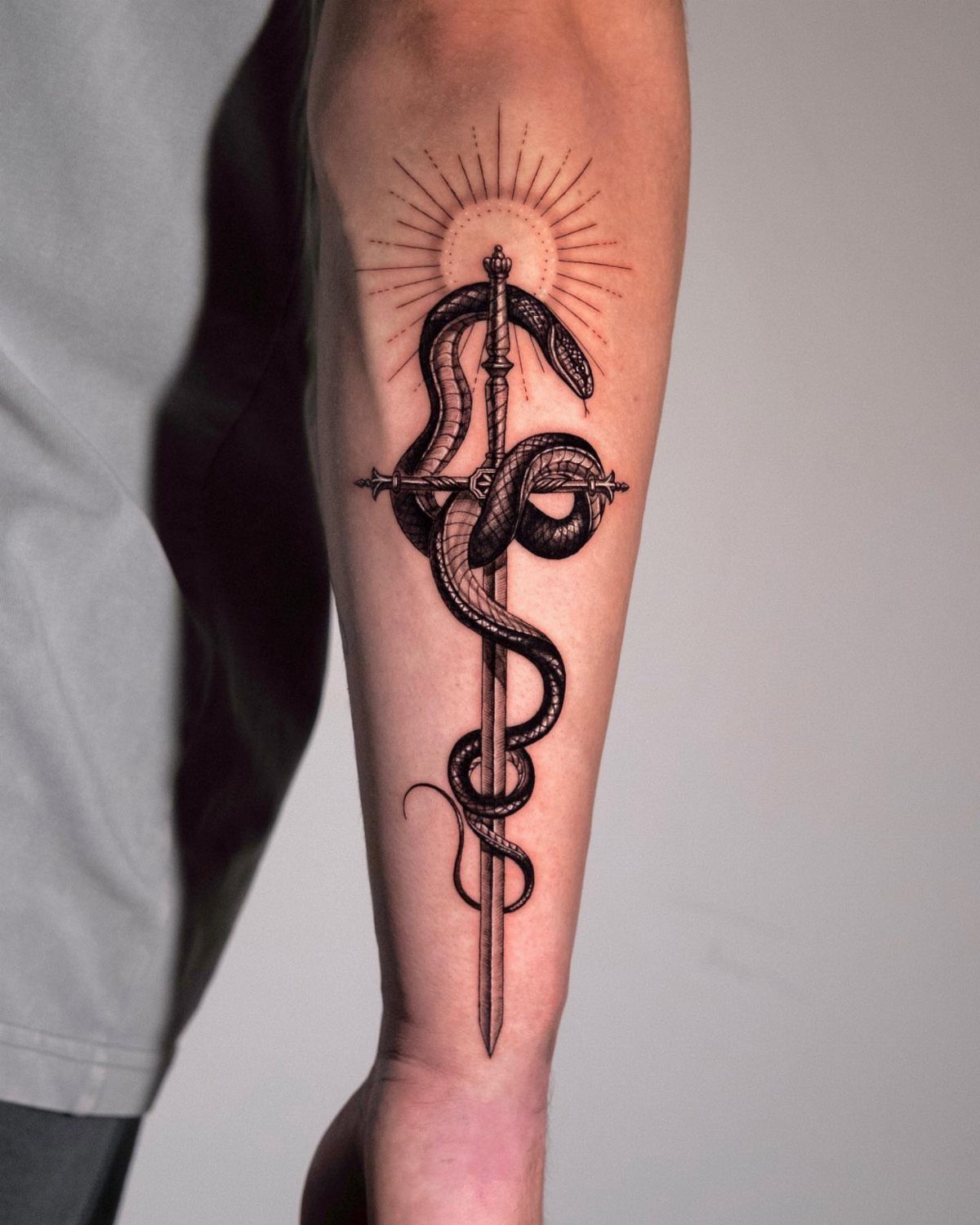
The sword stands vertical, the snake winds up the blade and wraps the hilt.
The scales break up the straight line of the weapon, and traditional bold outline holds both elements together. A sunburst above the pommel adds another layer: power lit from within.
The forearm’s natural length lets the sword stay straight and the snake wrap cleanly. Size down too much and the coil compresses, the blade shortens, and the whole piece loses proportion.
The snake softens the sword’s aggression, and the sword keeps the snake from looking passive. If you want both strength and cunning in one piece, this pairing does it.
9. Snake with Flames Tattoo
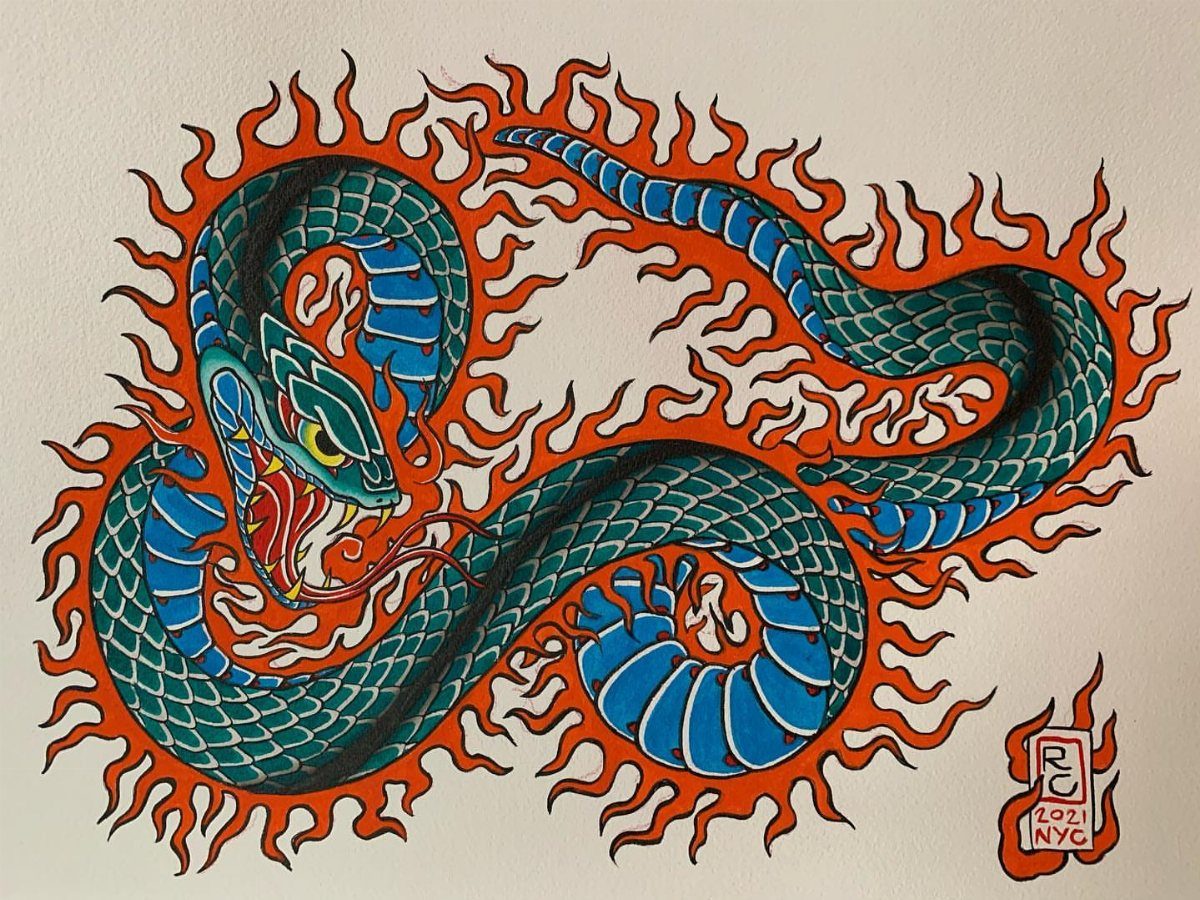
Flames lick up around the serpent’s body, and the heat reads as either destruction or renewal.
Blue and green scales against orange fire create contrast that registers from across a room, and traditional artists layer the flame shapes to add depth without muddying the color.
This design needs space for both elements to breathe. A thigh or outer arm works better than a wrist or ankle, where the flames compress into streaks.
If you want the snake to carry more than itself, fire adds weight without adding another animal or object.
10. Rattlesnake Tattoo
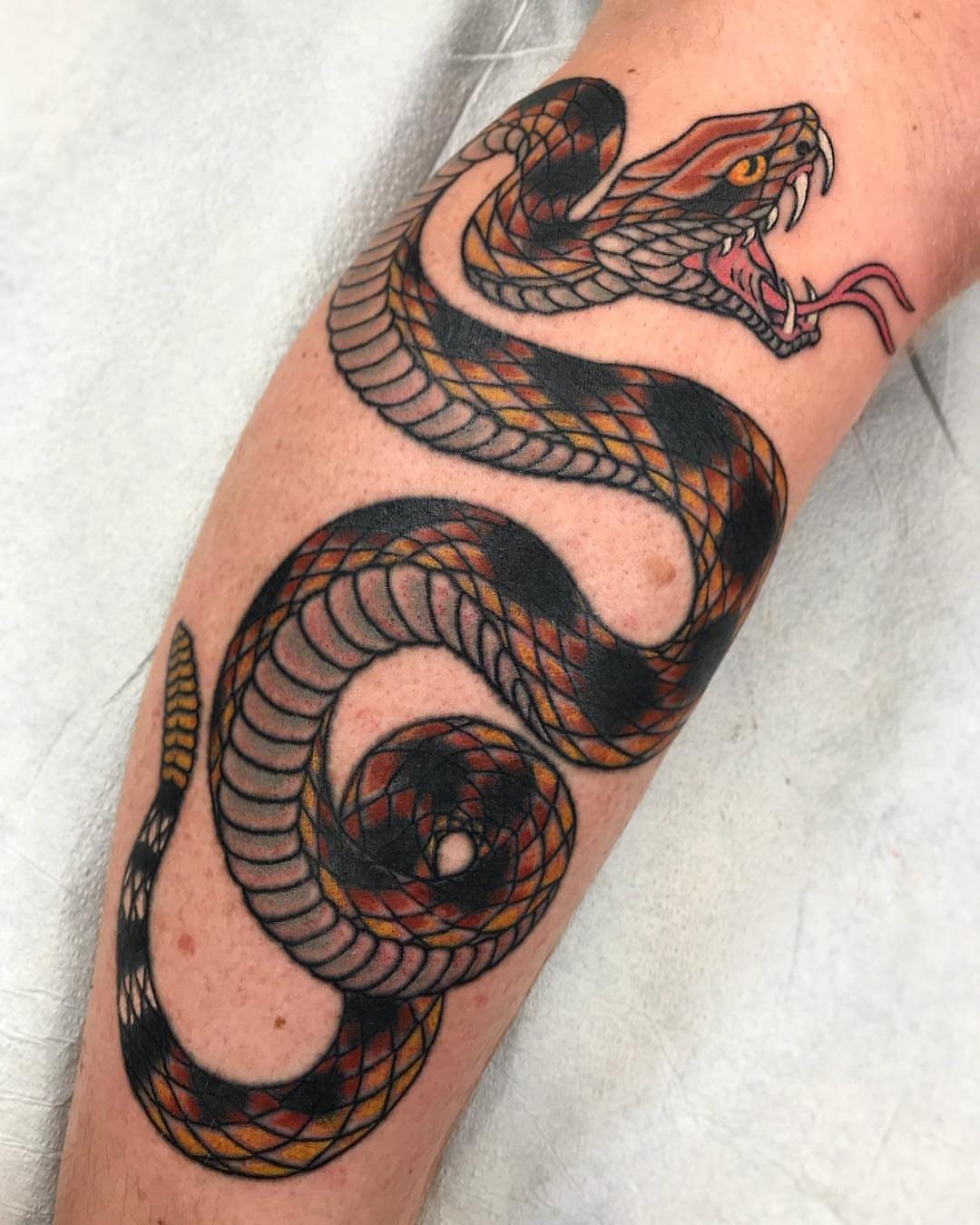
The rattlesnake coils tight with its tail raised, rattle visible. Orange and brown scales stand out against black shading, and the design carries American colonial weight: the Gadsden flag, the warning before the strike.
A forearm lets the coil sit flat and the rattle stand upright. Wrapping it around the limb can bend the body in ways that weaken the posture.
This one suits anyone who wants a snake that names itself. The rattlesnake doesn’t hide what it is, and the tattoo shouldn’t either.
11. Snake and Heart Tattoo
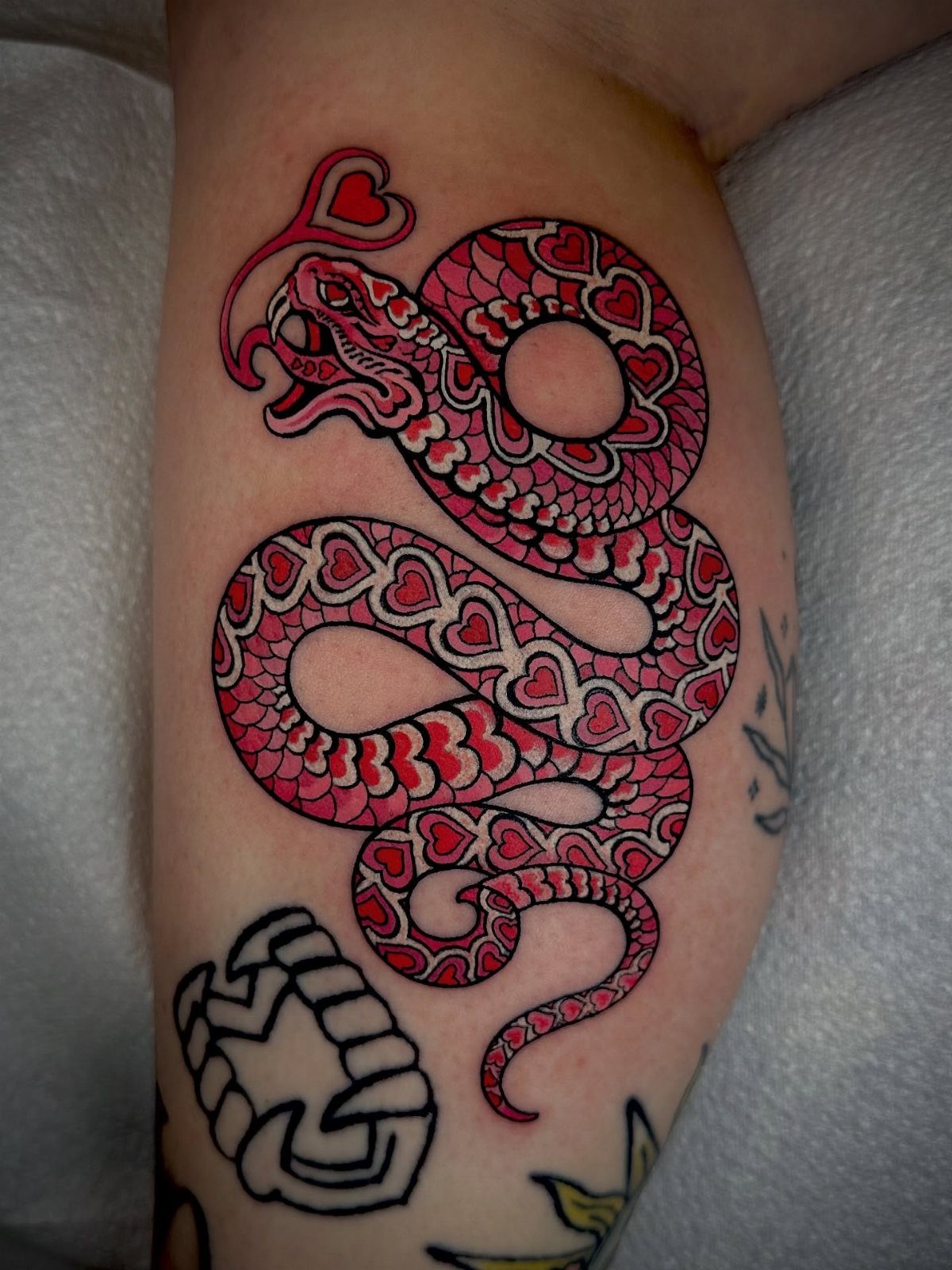
Heart-shaped scales run down the snake’s body, and a second heart floats above the coil.
Pink and red ink softens the serpent’s usual menace, and the design plays with the idea that love can coil around you just as tightly as fear.
Legs and arms both work, though the curve of a thigh or calf follows the snake’s natural S-shape better than a flat forearm.
If you want a snake that reads less like a threat and more like a reminder that attachment has teeth, this version flips the script.
Symbolism of Snake Tattoos
Snakes shed their skin as they grow, which is why the animal has carried ideas of rebirth and starting over for as long as people have been marking skin.
If you’re moving past something or stepping into a different version of yourself, a snake can hold that without you needing to explain it.
Protection sits on the other side of the symbolism.
In plenty of cultures the serpent guards against threats you don’t see coming, the kind that slip in quietly. Some people ink one as a ward against bad energy or people who mean harm.
The meaning shifts depending on where you look.
Danger, temptation, cunning, renewal: the snake has been all of those things in different stories. What it means on your skin comes down to which part of that history you’re claiming.
Choosing Tattoo Placement
A snake’s shape gives you options most other animals don’t. The body coils, wraps, and follows curves, so an artist can fit it to almost any part of you and make it look like it belongs there.
Forearms work well because they’re flat and visible.
You can glance down and see the whole piece without a mirror. Chests and backs give you room for larger designs where the snake can stretch or spiral without running out of canvas.
Ribs and inner arms hurt more than forearms, so if pain is a concern, placement matters beyond how the design looks.
Visibility is the other trade: some spots stay private, others are out in the world every time you move. Pick the one that matches how public you want the ink to be.
Tattooing Techniques
Bold black outlines are the backbone of these pieces, keeping the shape crisp as the ink settles over the years.
Those bold borders keep color from spreading and detail from blurring, which is why pieces done this way still read clearly decades later.
Color palettes stay tight: reds, greens, yellows, maybe a touch of blue.
The shading is deliberate, with solid fills and high contrast between light and dark. That approach gives the scales weight and makes the coil look three-dimensional without soft gradients.
Modern work has opened up other paths.
Fine line snakes trade boldness for delicacy, and watercolor effects layer transparent washes instead of solid blocks. If longevity matters to you, the old approach with heavy outlines and limited color still wins.
Frequently Asked Questions
What does a traditional snake tattoo mean?
A traditional snake tattoo most often signals transformation, renewal, or a kind of protection that comes from staying alert to what you can’t see.
Are snake tattoos satanic?
No, though Christian stories link the serpent to temptation, which is where that idea starts. In other traditions the snake carries healing, renewal, and protection, like the Greek rod of Asclepius used in medicine.