Tiger designs in traditional Japanese tattooing range from solo heads that fit the forearm to full-sleeve compositions pairing tigers with bamboo, peonies, or dragons.
The pairing you choose decides whether the piece reads as pure aggression or balanced strength: wind and waves push the energy outward, while bamboo, pine, lotus or peonies temper the tiger’s force with endurance or growth.
1. Tiger in Waves
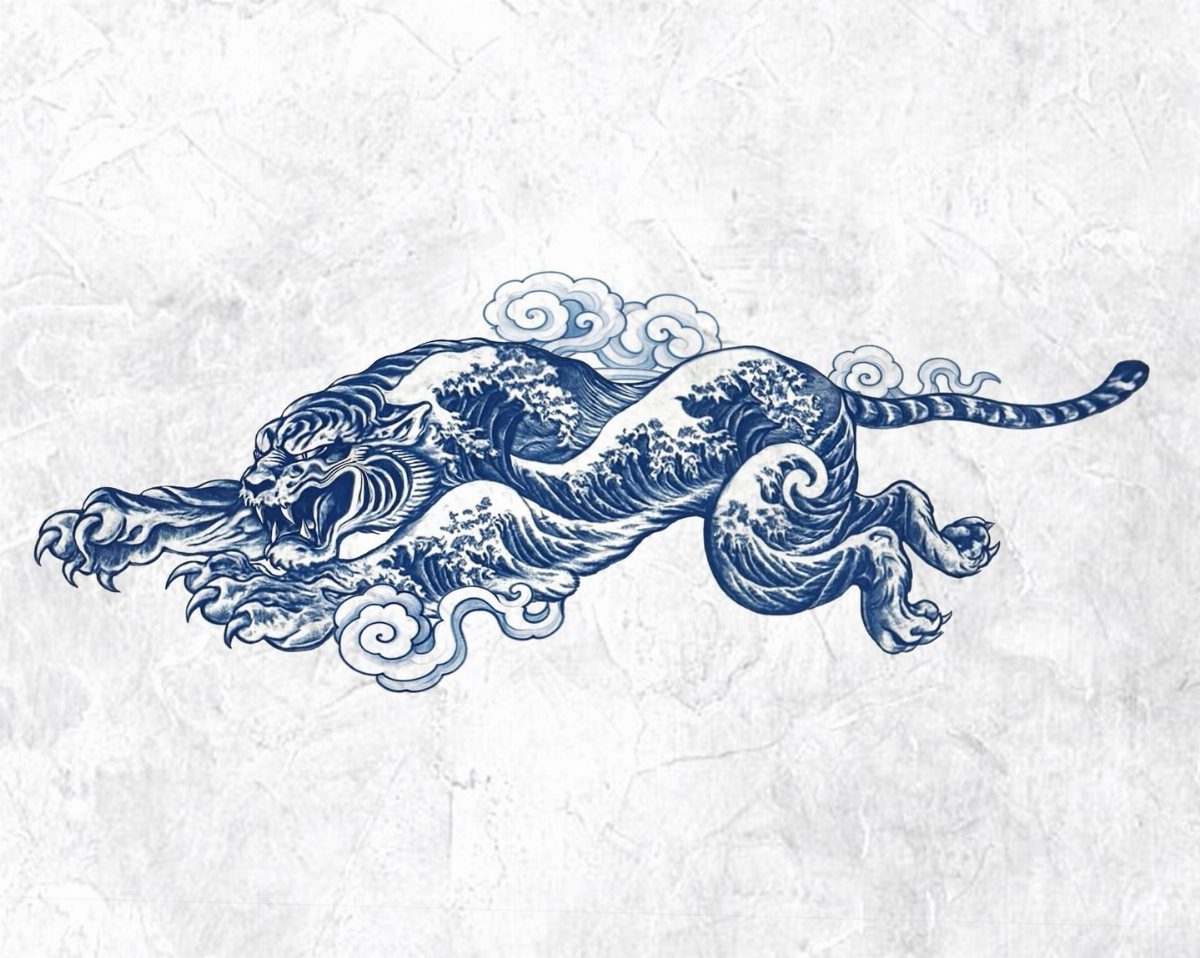
The tiger leaping through waves captures one of the oldest pairings in Japanese tattooing: raw power meeting unstoppable force. Water in Irezumi isn’t just background, it shows movement and adds tension to the entire piece.
This fills space and carries energy across your skin better than most other pairings.
The waves let the tiger break past a single frame, so the design can wrap around an arm or cover a back panel without feeling boxed in.
Best on the upper arm, thigh or back, where the water has room to curl and crash.
2. Traditional Japanese Tiger Tattoo
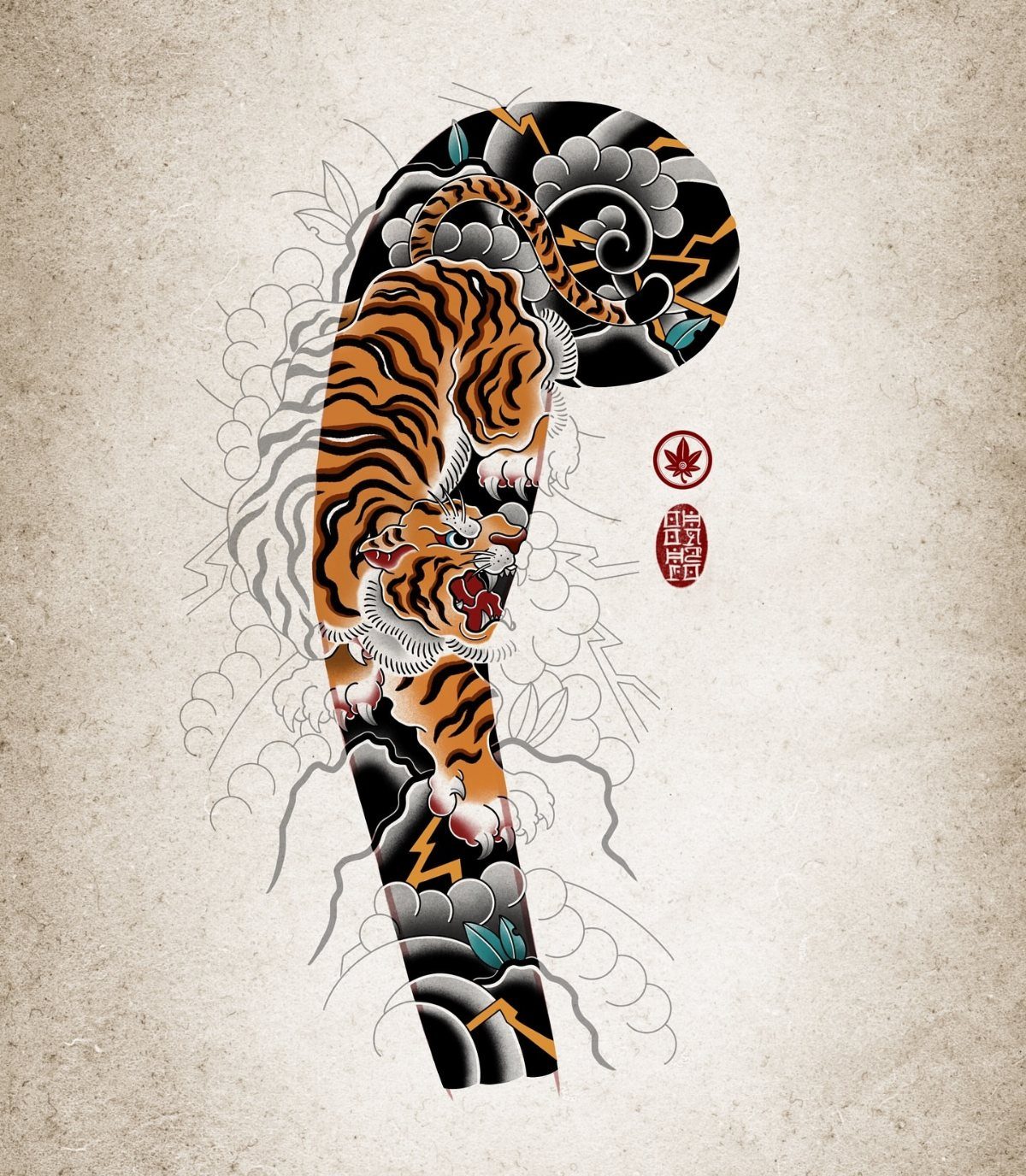
This is the version that leans hardest into Irezumi convention: bold orange and black on the tiger, clouds rolling behind it, sometimes lightning cutting through the sky.
The eyes are drawn wide and direct, staring straight out, and that gaze is half the point.
In traditional Japanese tattooing, the tiger’s direct stare stands for courage that holds steady under pressure. It’s not subtle, and it’s not meant to be.
The style holds up better than softer realism because the high contrast and clean linework stay sharp as the tattoo ages.
3. Tiger with Bamboo
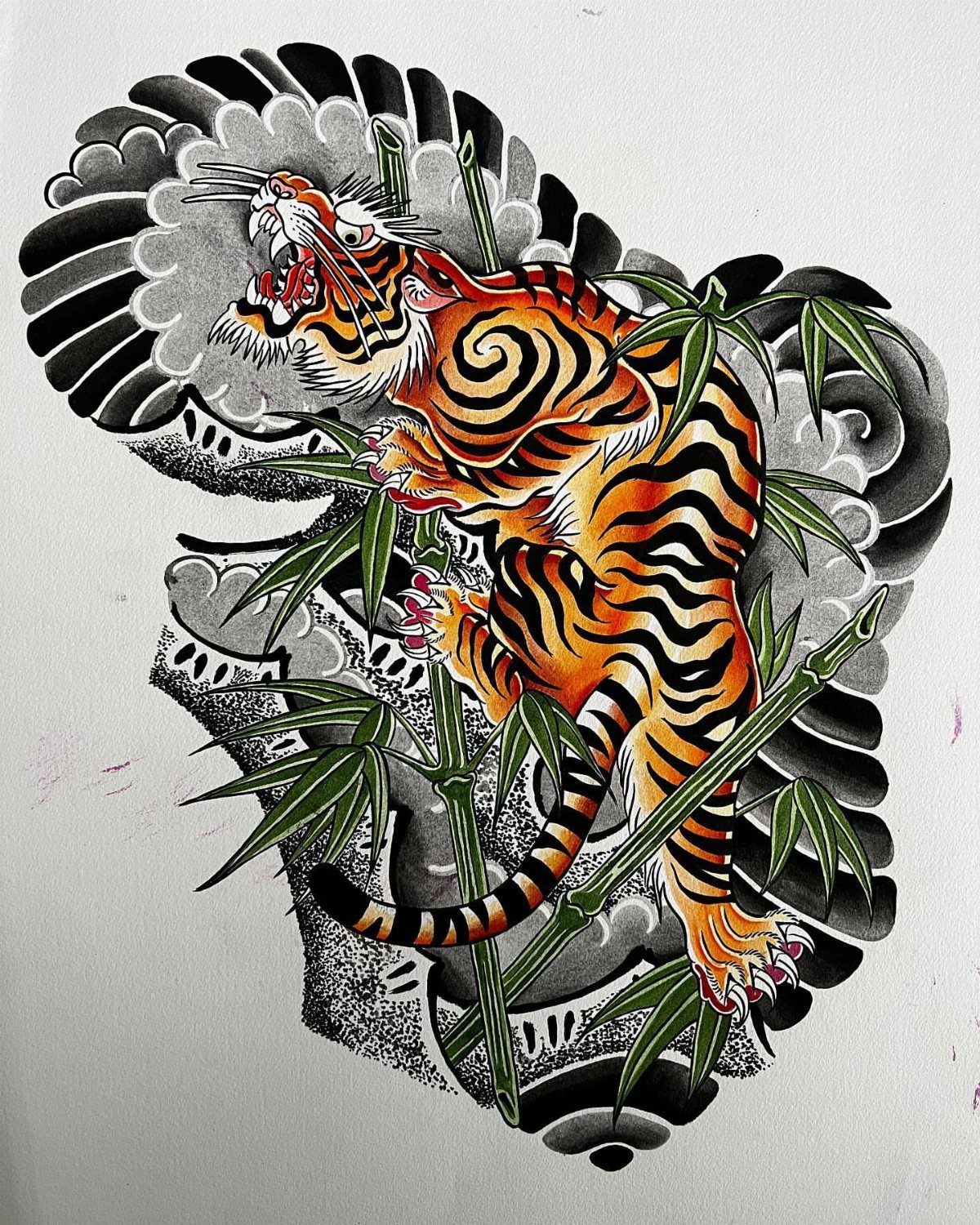
Bamboo bends but doesn’t break, so pairing it with a tiger builds a design around 2 kinds of strength. The green stalks balance the tiger’s aggression and give the composition vertical lines that guide the eye without competing for attention.
I like this version on the forearm or outer thigh, where the bamboo can run long and frame the tiger naturally. The color stays readable, green and orange hold their separation well over time.
Size matters here. Below a certain size, the bamboo detail starts to blur, and once that happens the pairing loses what makes it worth doing.
4. Tiger with Cherry Blossoms
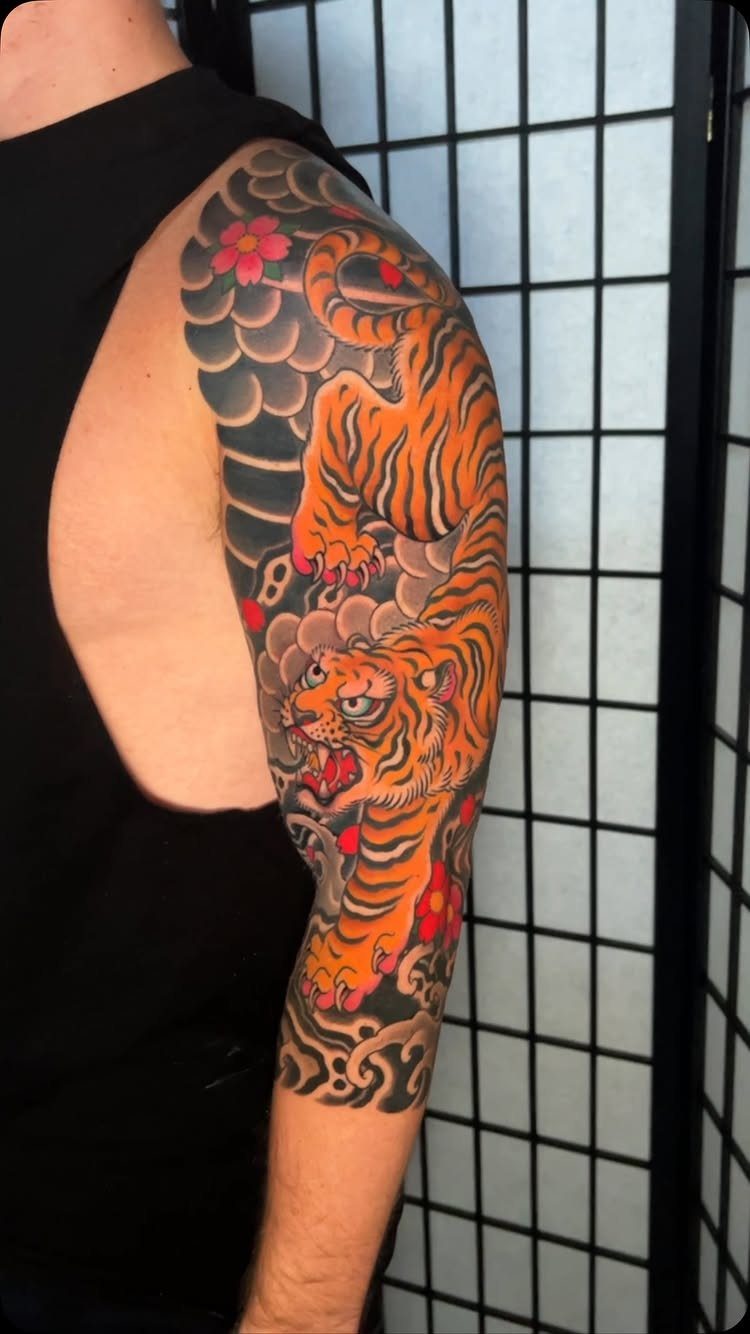
Cherry blossoms soften a tiger without weakening it. The contrast works because the flowers add color and texture in places the tiger doesn’t fill, usually around the shoulder, upper chest or negative space near the elbow.
This is one of the few tiger designs where pink belongs. The blossoms also mark time, they bloom and fall fast, so the pairing can mean strength during a short window or beauty that doesn’t last.
Full sleeves handle this best.
The blossoms need room to scatter, and cramming them into a small piece makes the design feel busy instead of balanced. Touch-ups on the pink may be needed after a few years.
5. Tiger with Lotus Flower
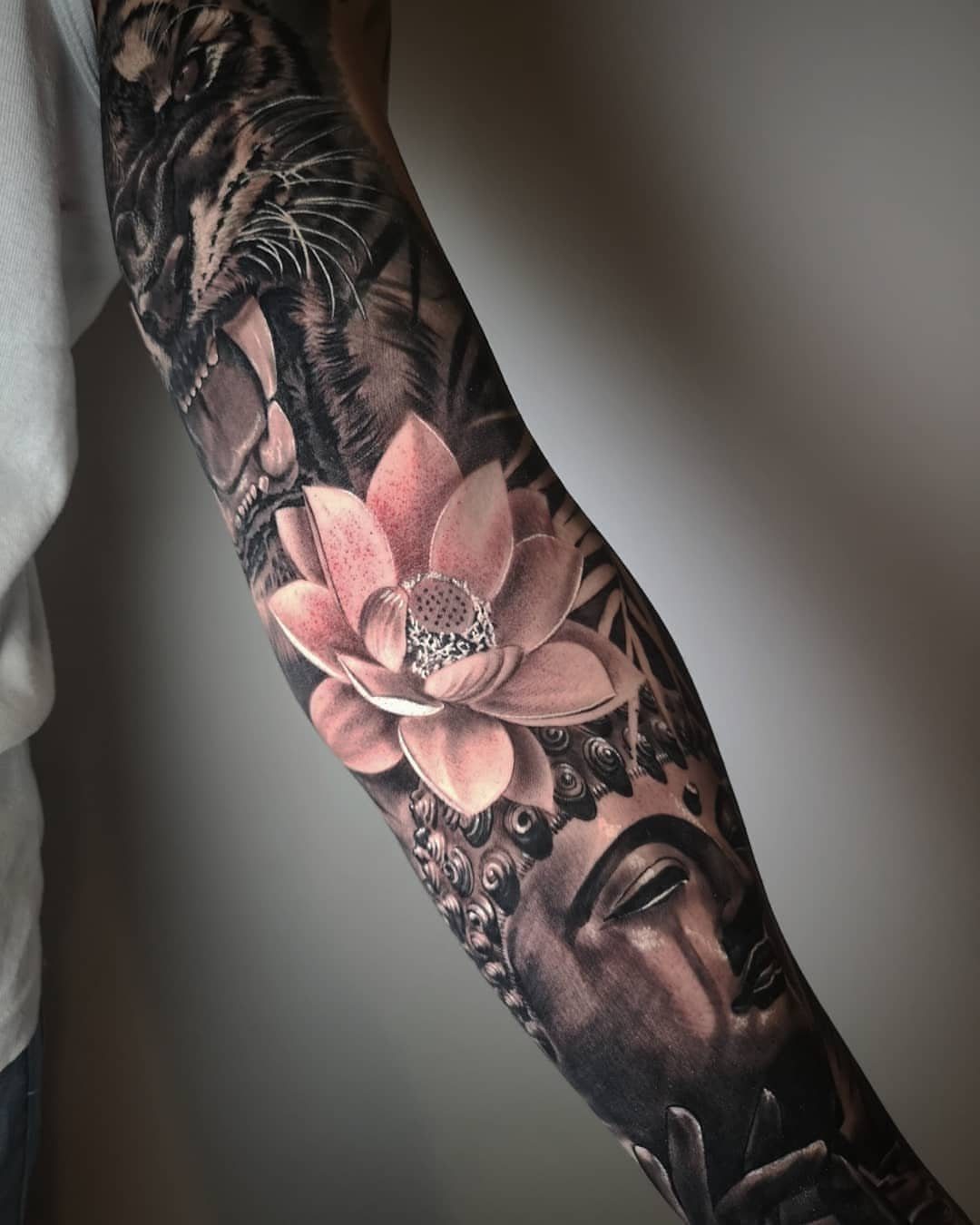
The lotus grows in mud and blooms clean, so placing it with a tiger turns the design into a statement about rising through difficulty.
Adding the Buddha face, as seen here, deepens that reading and pulls the piece toward spirituality rather than pure aggression.
If you go black and grey on the tiger, the pink lotus becomes the only color and draws the eye first. That changes the balance.
6. Tiger with Pine Branches
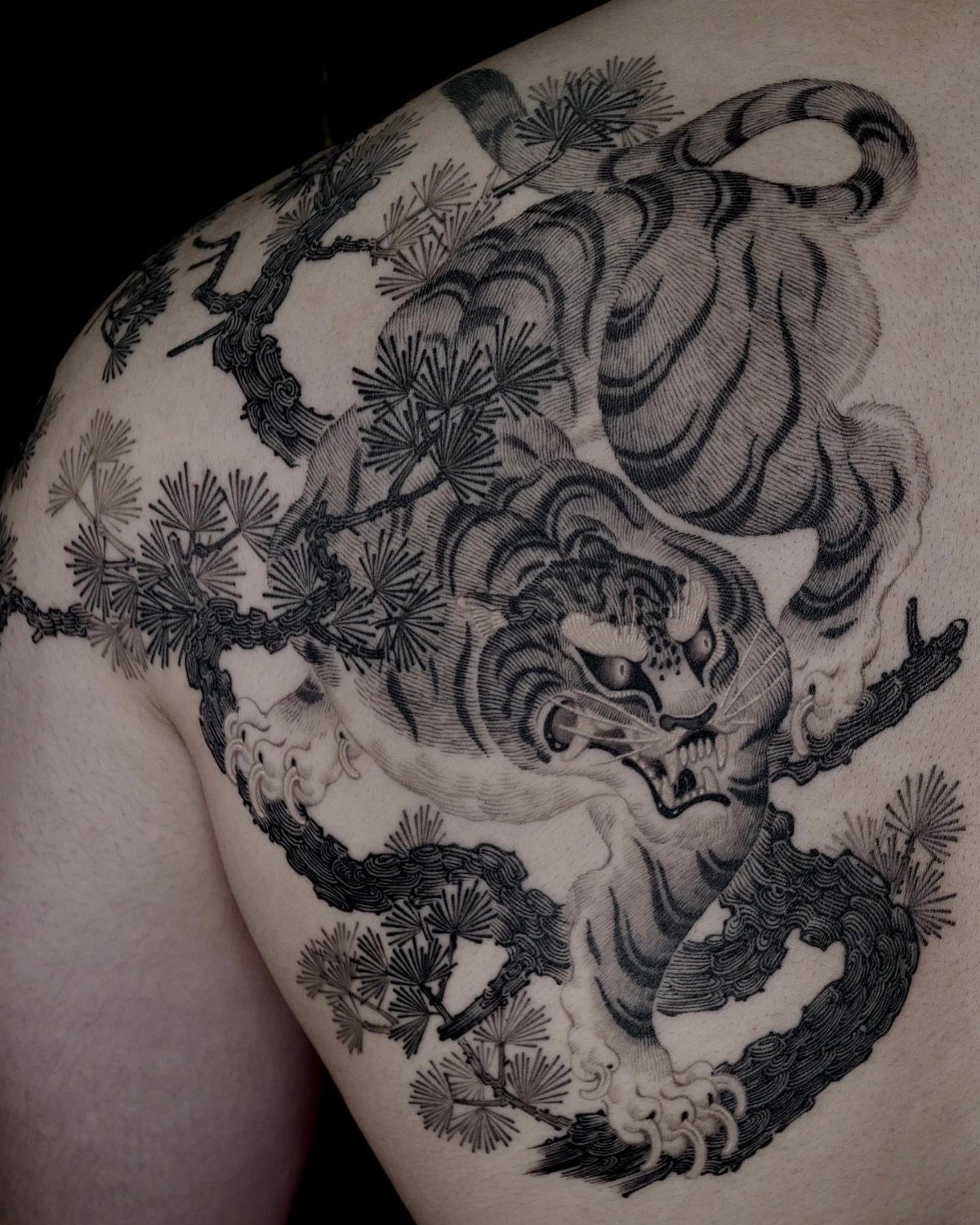
Pine branches in Japanese tattooing represent longevity, the tree stays green year-round and lives for centuries. Pairing it with a prowling tiger anchors the composition and makes it feel less explosive than versions with waves or clouds.
Black and grey suits this one.
The pine needles and bark texture give the artist room to show detail in black and grey alone, and the result ages cleanly. The tiger here is mid-step, not lunging, so the whole piece reads calmer than most tiger work.
Upper arm and shoulder placements let the branches wrap naturally. Skip this pairing for high-energy work; the pine slows the mood down on purpose.
7. Tiger with Wind and Clouds
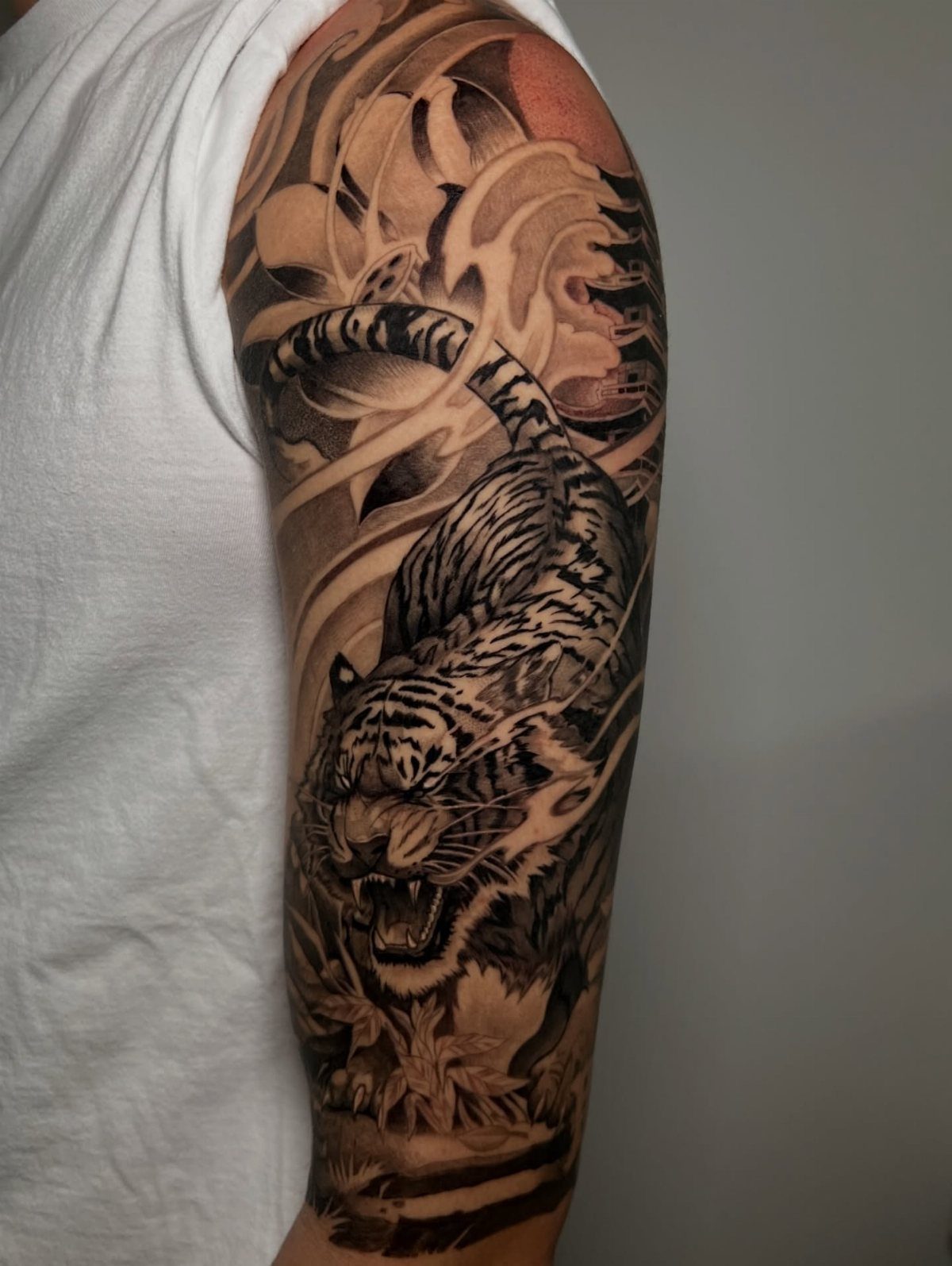
Wind bars and clouds give a roaring tiger the sense that it’s breaking through, not just sitting in place. The bars, drawn as curved speed lines in traditional Japanese work, push the energy outward.
Black and grey keeps the focus on form. Without orange or pink competing for attention, the tiger’s open mouth and the motion of the clouds carry the piece.
Upper arm placement works because the muscle gives the tiger volume and the clouds can trail toward the shoulder or elbow. This version reads more aggressive than tigers paired with flowers or bamboo.
8. Pouncing Tiger Arm Tattoo
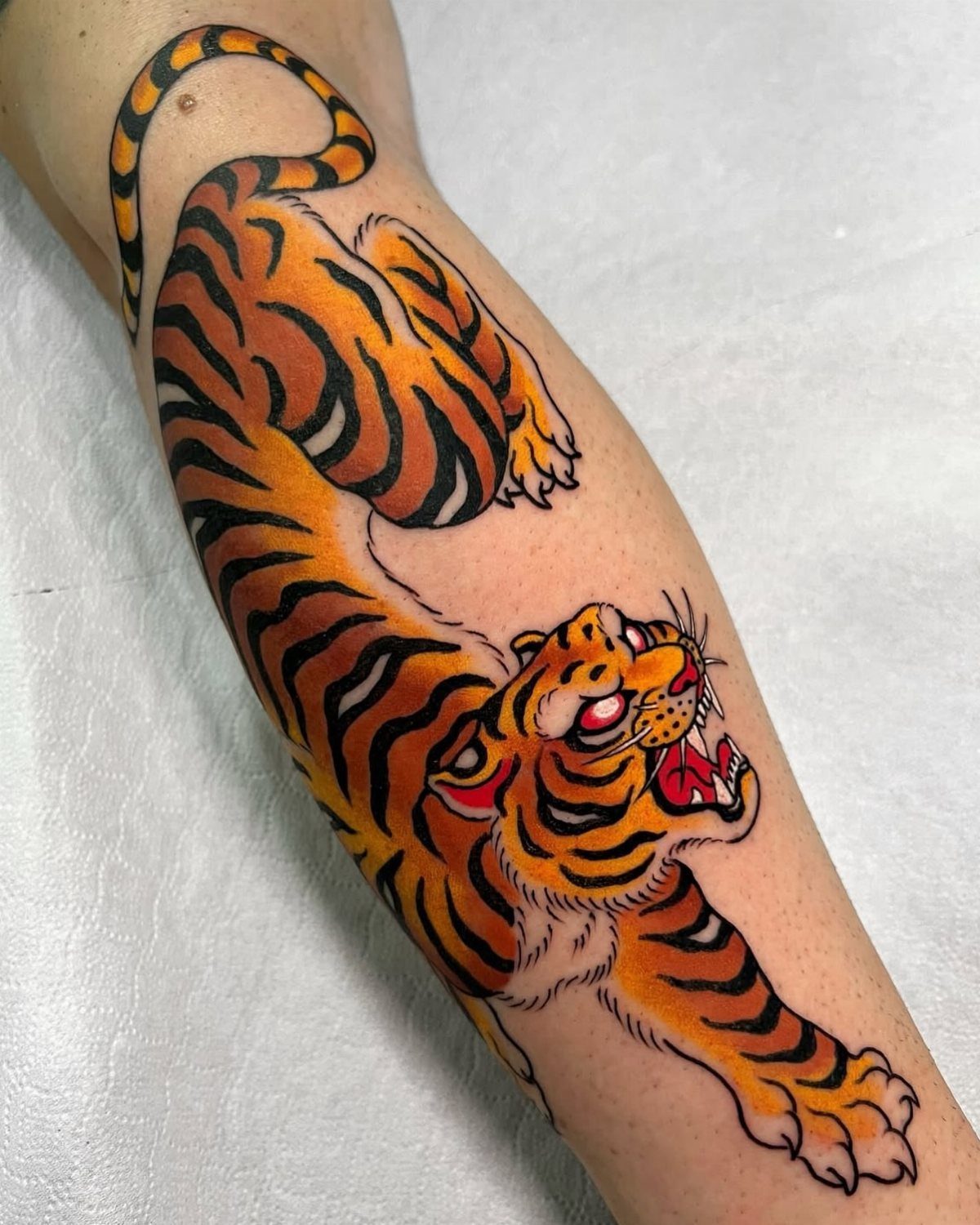
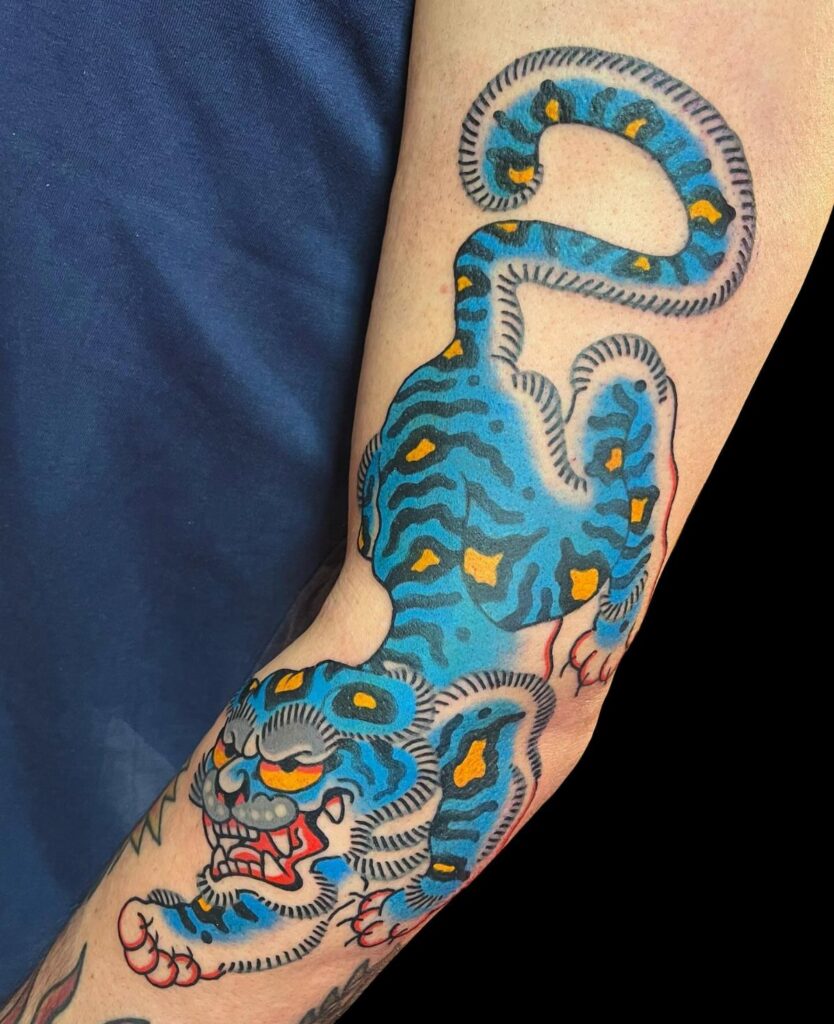
A pouncing tiger stretched across the arm captures motion better than a head-only design. The red eyes and extended claws make the piece read as pure aggression, no balance from flowers or water.
This suits the outer arm, where the tiger’s body can follow the muscle and stay visible.
Full color holds up if the orange and black contrast stays high. If the shading softens too much during healing, the stripes lose their snap.
Expect this to take 2 sessions minimum for clean color and detail at this size.
9. Tiger with Peonies Tattoo
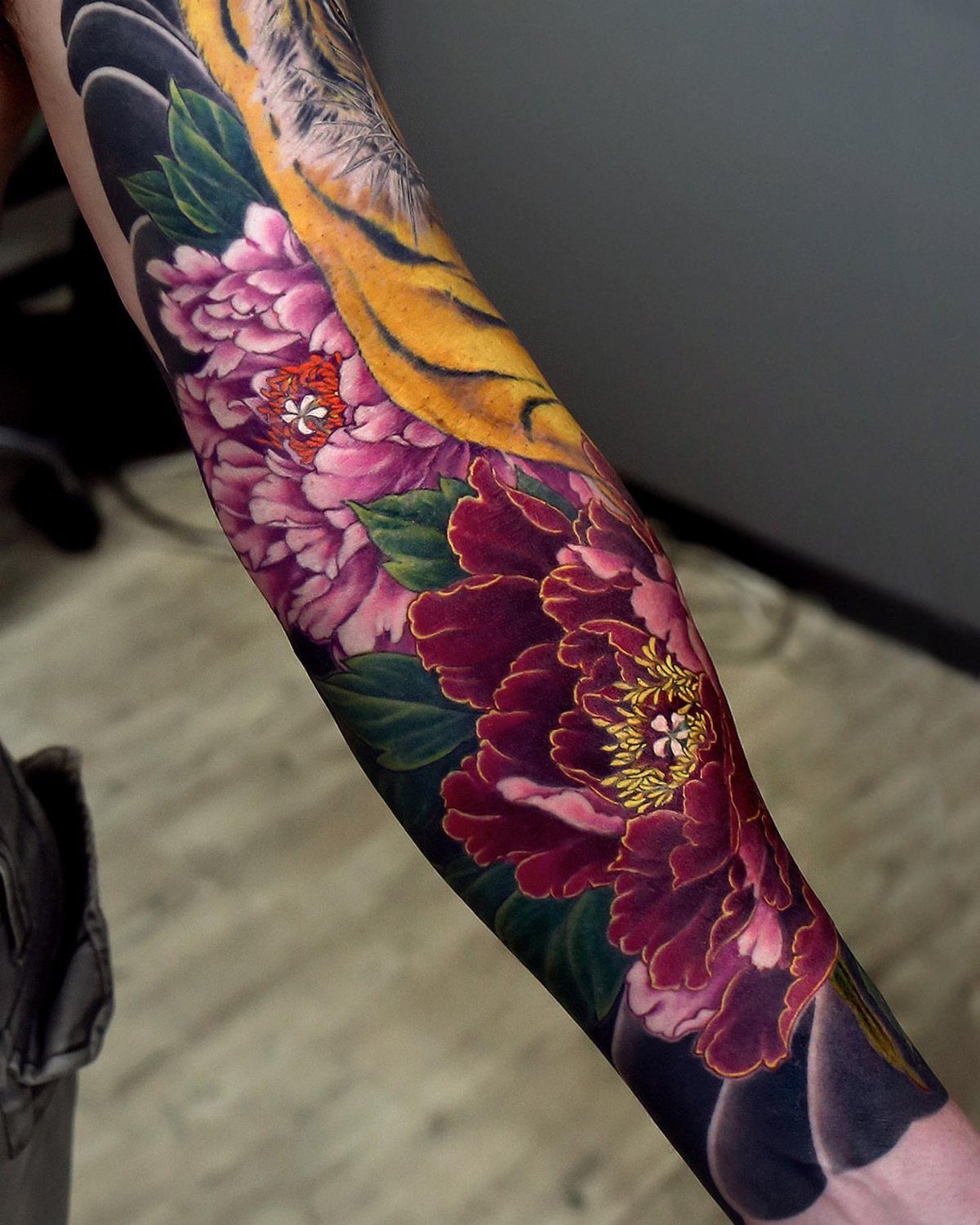
Yellow tigers are less common than orange, and that alone makes this version stand out. Pairing it with red and pink peonies keeps the palette warm and lets every element stay bright without clashing.
Peonies mean prosperity and good fortune in Japanese tattooing, so the combination reads less fierce than a tiger on its own.
The flowers fill negative space around the head and chest, which helps when you’re building a sleeve and need something to connect multiple elements.
Color this saturated will fade faster in direct sun. Plan for touch-ups.
10. Traditional Japanese Tiger Leg Tattoo
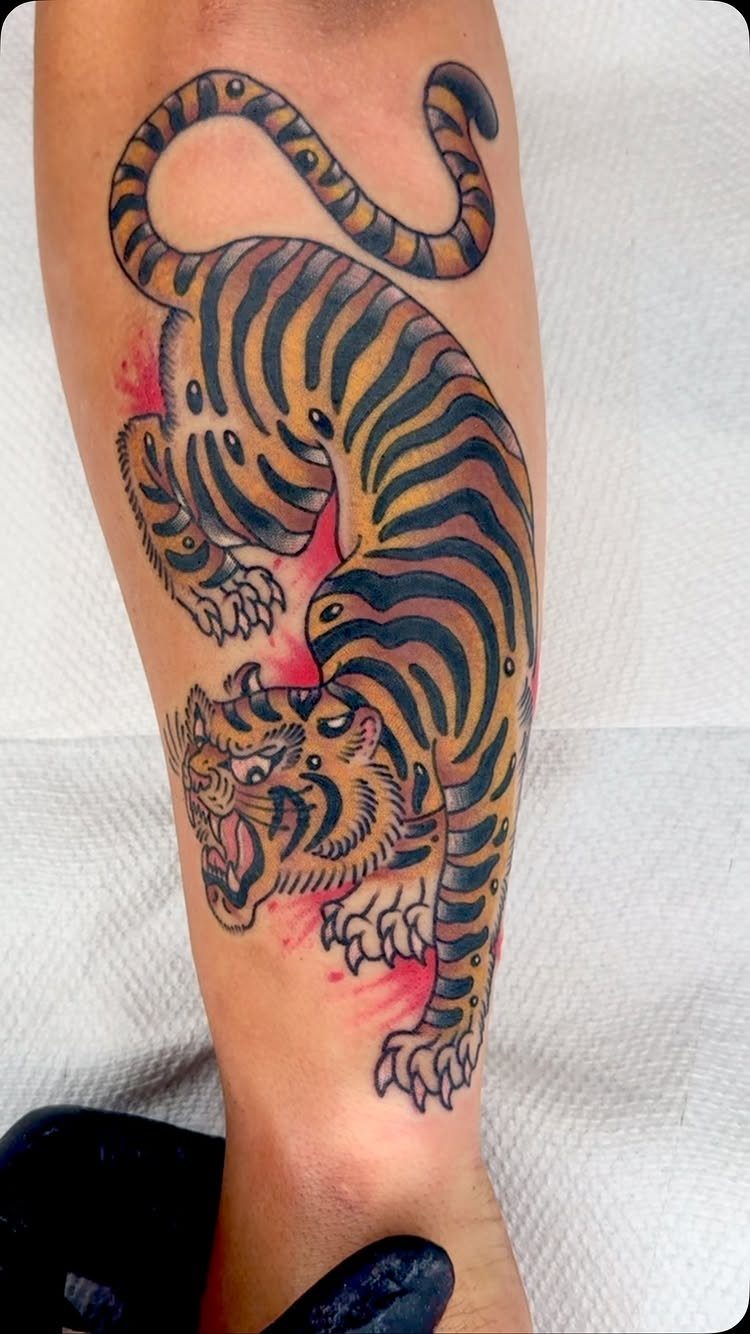
Legs give you length, and a tiger running downward or wrapping around the calf uses that better than most designs.
The curve of the muscle adds dimension, so the tiger looks like it’s moving over the surface instead of printed flat.
Orange and black stay sharp on the leg because there’s less friction and sun exposure than on hands or forearms. Healing takes longer here, keep pants loose during the early stage.
This placement hides easily, which matters if your job has restrictions.
11. Tiger and Dragon Tattoo
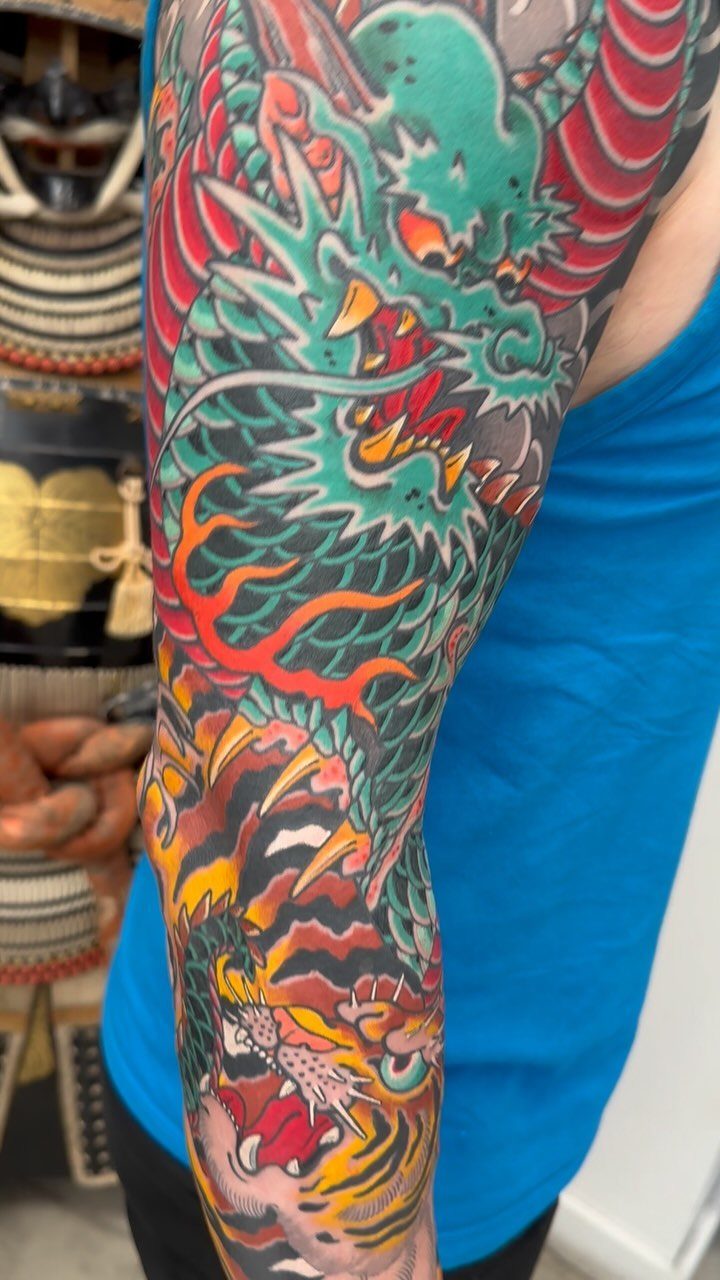
Tiger and dragon together is the classic opposition piece in Japanese tattooing: earth and sky, physical strength and spiritual power.
The serpentine green dragon wraps one way, the orange tiger fills the other, and their opposing forms keep the sleeve balanced.
This is a full commitment. You need the entire arm to give both animals enough room to read clearly, and if either one gets cramped the whole design suffers.
Expect multiple sessions and a higher cost than single-subject sleeves. The result is a piece that holds more meaning and visual weight than most tiger work.
Cultural Significance of Tigers
In Japanese culture, the tiger stands as a guardian against evil spirits and bad luck.
The tiger appears often in folklore as a sacred creature that wards off negative energy and misfortune.
That protective quality is why you’ll see it in traditional Irezumi alongside other symbolic elements like waves, clouds and flowers, each one adding another layer to what the piece means.
If you’re drawn to a tiger for its protective symbolism rather than pure aggression, the pairing you choose matters.
A tiger with pine or bamboo leans into endurance and resilience. A tiger with wind bars or lightning reads as active defense, something breaking through obstacles.
The strength and courage tied to the tiger aren’t abstract. They show up in how the animal is drawn: eyes wide, stance firm, claws extended.
Traditional Tattoo Techniques
Tebori is the hand-poking method that defined Japanese tattooing for centuries. Each mark is placed manually using a bundle of needles attached to a handle, and the result has a texture machine work can’t replicate.
The technique is slower and demands steadier hands than a machine.
Traditional Japanese hand-poked tattooing (Tebori) requires more time and pain tolerance than machine work, but the finished piece will carry something distinct.
Tebori hurts differently than machine work. The sensation is sharper and more sustained, so talk through what to expect before committing to a large piece done this way.
Care for Tattoos
For the first few days, treat your new tattoo as a wound that needs careful attention.
Wash it gently with mild, fragrance-free soap and lukewarm water, then pat it dry with a clean towel. Apply a thin layer of unscented moisturizer, just enough so the skin stays supple without suffocating it.
Overdoing the moisturizer suffocates the skin and slows healing. A light coat twice a day is enough.
Keep it covered with the protective film your artist gives you for the initial period, then let it breathe between washes.
Avoid sun exposure entirely during the first 2 weeks. UV light fades color fast, and fresh ink is especially vulnerable.
Loose clothing helps.
Tight fabric rubbing against a healing tattoo irritates the skin and pulls ink out before it sets. If your tiger is on your leg, skip jeans until the skin has closed.
Frequently Asked Questions
What is a Japanese tattoo?
Japanese tattoos, called Irezumi, are traditional designs built around symbolic elements like animals, flowers, waves and clouds, each carrying specific cultural meanings.
The tiger is drawn as a guardian figure that protects against bad luck and evil spirits, often paired with bamboo, peonies or water to add layers of meaning.
High contrast and bold linework define the style, and the compositions are designed to wrap around the body rather than sit flat.
What does a tiger tattoo symbolize?
A tiger in Japanese tattooing represents courage, strength and protection against negative energy.
The wide eyes and firm stance show that strength directly, and pairing the tiger with other elements shifts the reading: bamboo or pine emphasize endurance, while wind bars or lightning lean toward active defense.
In folklore, the tiger wards off misfortune and evil spirits, so the design carries protective symbolism alongside raw power.
What does an Irezumi dragon tattoo symbolize?
The dragon in Japanese tattooing represents spiritual power and the forces of sky and water, the opposite of the tiger’s earthbound physical strength.
When paired together in a sleeve, the tiger and dragon create a balance between those 2 forces, each animal wrapping in opposing directions to fill the arm.
The green serpentine dragon contrasts with the orange tiger, and the composition needs the full arm to give both creatures enough room to read clearly.