A hummingbird tattoo reads differently depending on whether you want geometric patterns, fine-line minimalism, full-color realism or traditional outlines.
Black ink holds better over time than saturated color, and traditional work with thick outlines resists spreading better than fine shading as the tattoo ages.
1. Black Ink Hummingbird in Flight
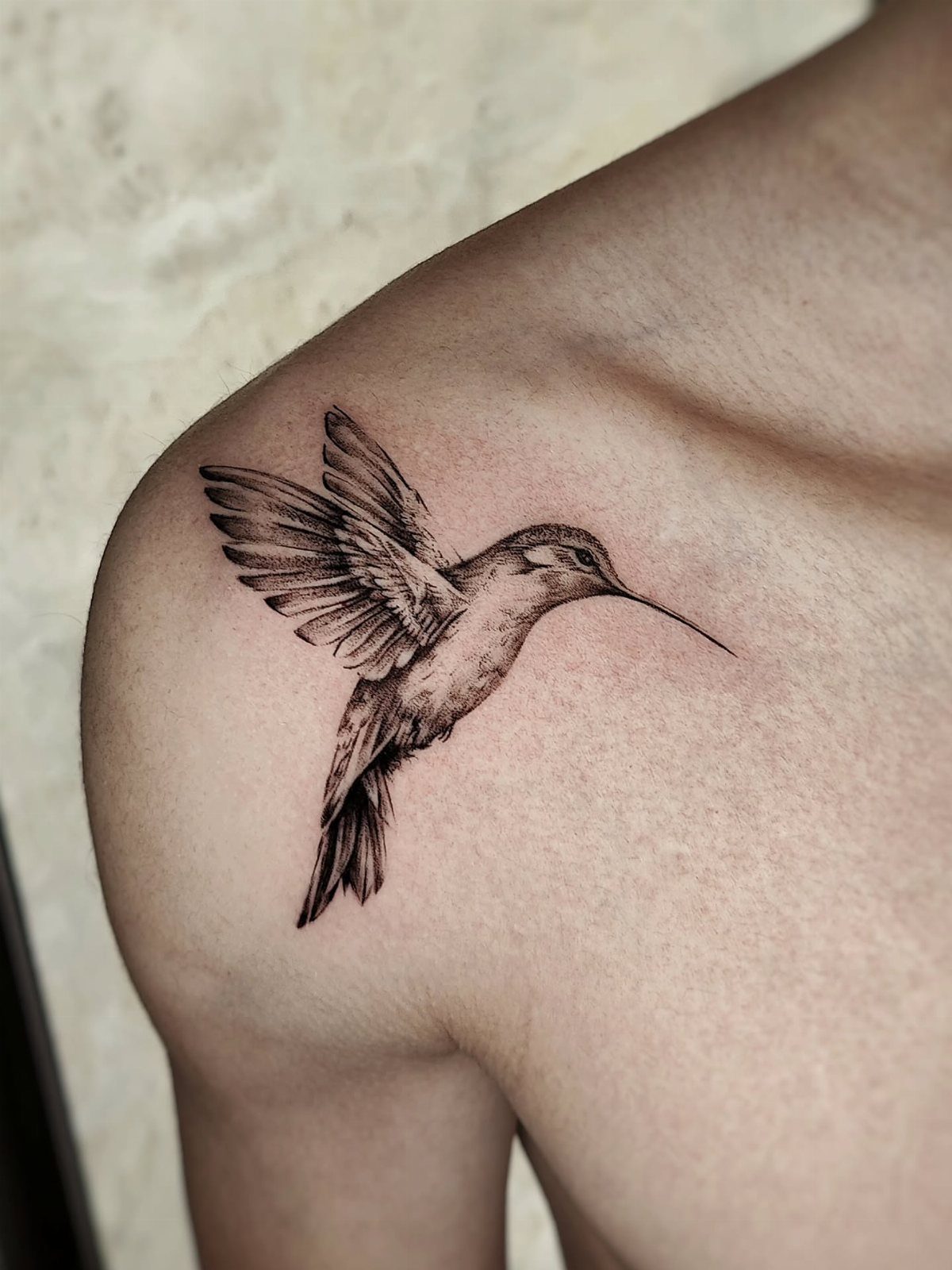
A hummingbird rendered entirely in black ink, mid-flight, reads bold and masculine on the shoulder or upper arm. The shading gives it depth without needing color: darker ink pools in the wings and throat, lighter gradients along the body.
This placement works because the shoulder’s natural curve matches the bird’s horizontal movement.
Size matters here. Size the wingspan large enough that feather detail stays readable as it ages.
Black ink holds better over time than color, and the high-contrast shading stays crisp even after a decade.
2. Geometric Hummingbird Tattoo
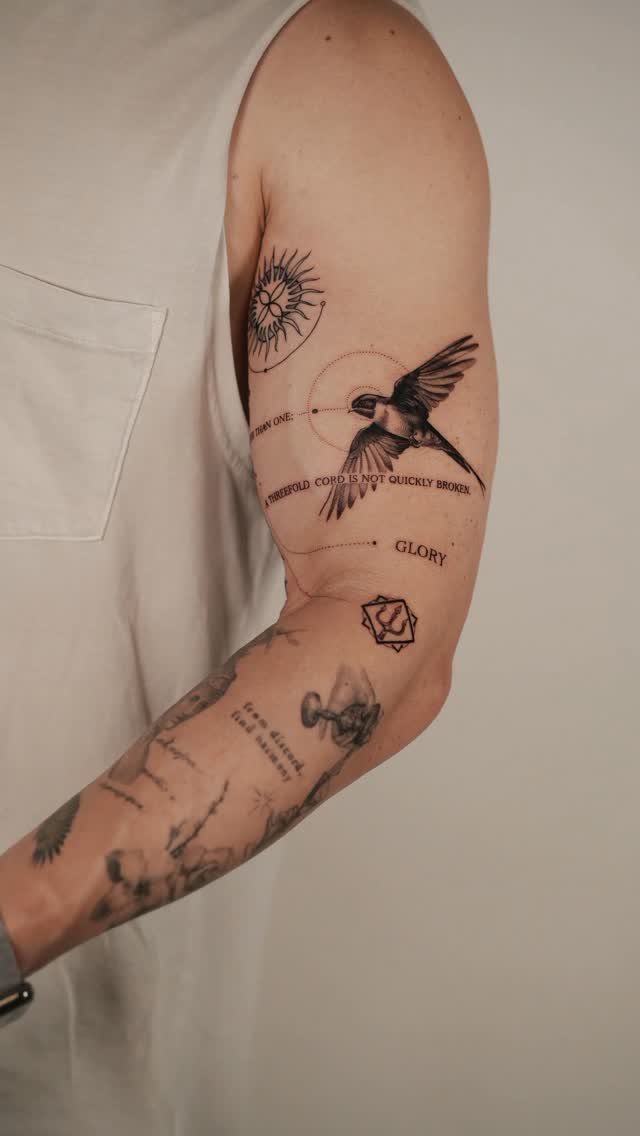
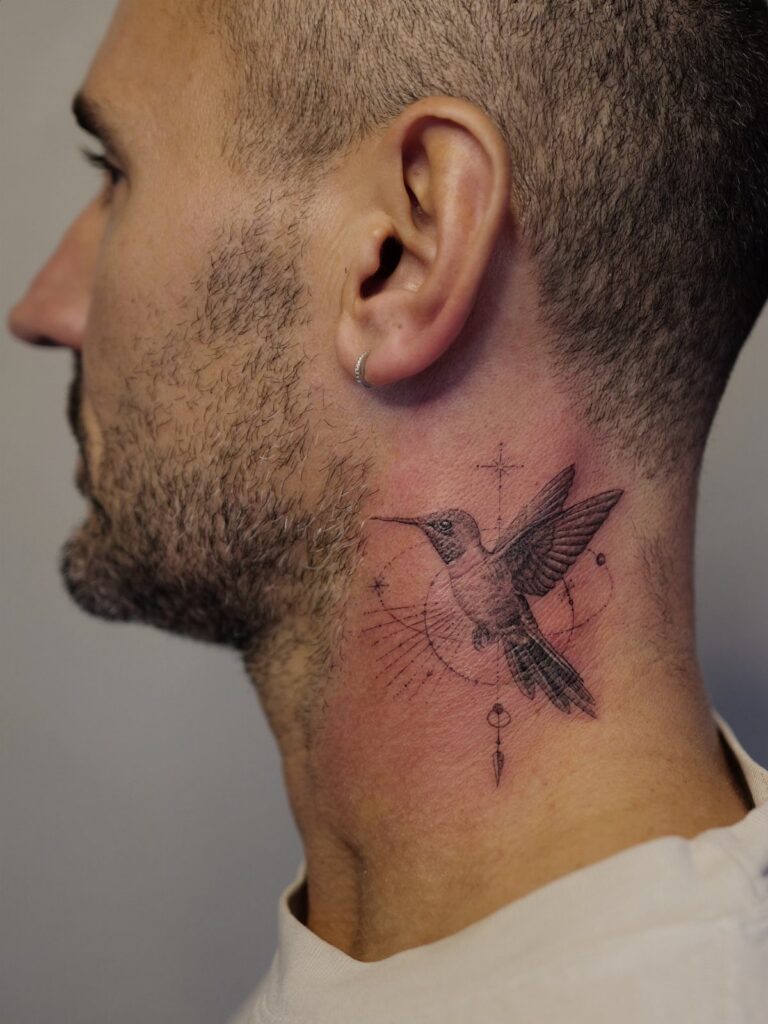
A hummingbird framed by geometric circles, lines or polygons turns the organic shape into something architectural. The contrast between the soft curves of the bird and the hard angles of the geometry gives the piece structure.
This style suits guys who already have geometric work or want a tattoo that reads more graphic than naturalistic. The shapes can anchor text, dates or coordinates around the bird without crowding it.
Upper arm or forearm makes the geometry readable. A piece this size with clean linework takes time to finish right.
3. Realistic Hummingbird Tattoo
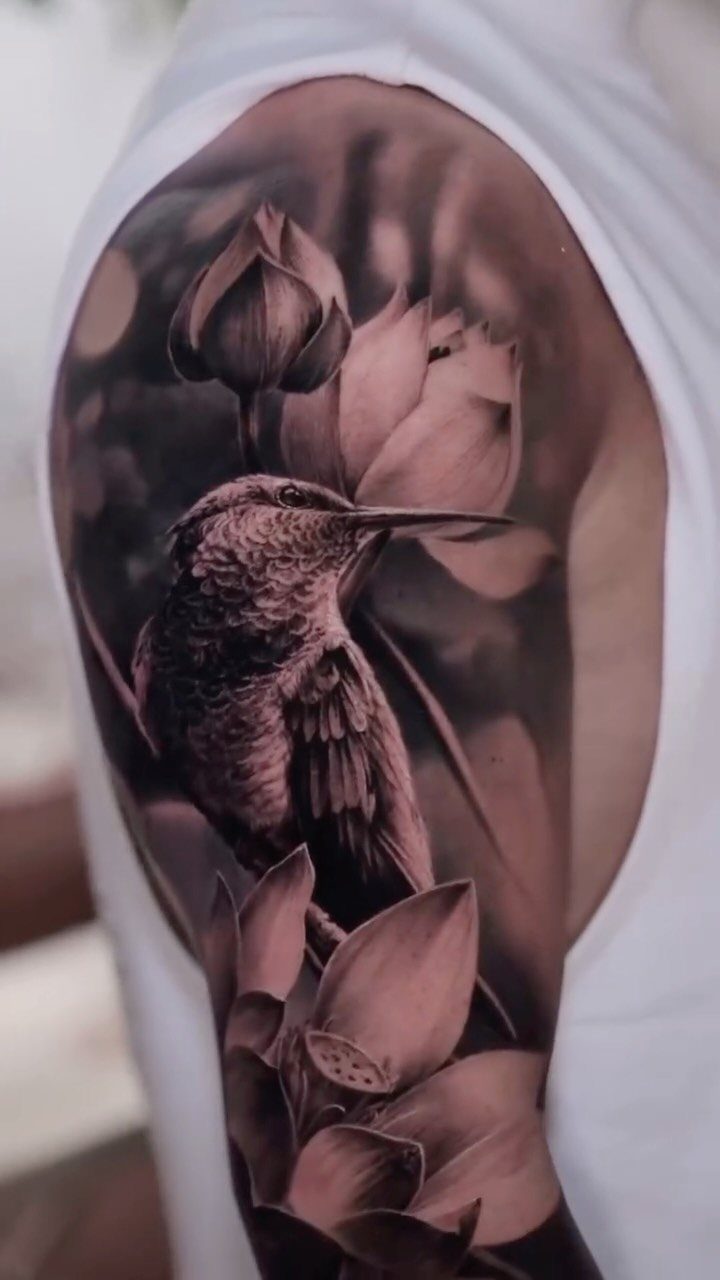
A realistic hummingbird captures every feather barb, the iridescent throat patch and the way light hits the wings mid-hover. Paired with lotus flowers, the composition balances the bird’s energy with the flower’s stillness.
This demands an artist who specializes in realism. Black and grey realism like this holds detail better than color over time, especially on the upper arm where skin stretches less.
The shading needs to be soft enough to look lifelike but strong enough to last.
4. Fine-line Hummingbird Tattoo
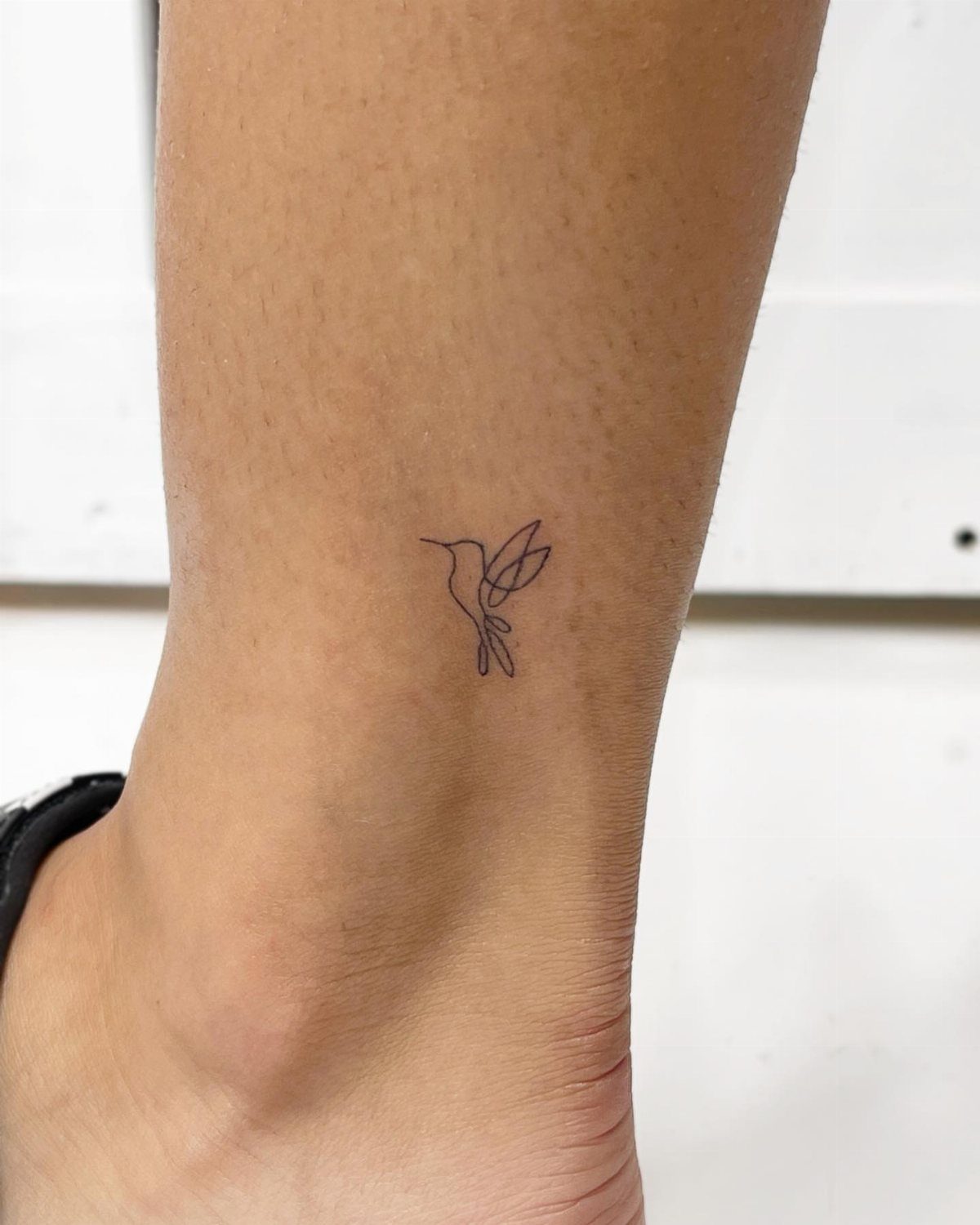
Fine-line hummingbirds strip the design down to its skeleton: just the outline and a few key details, no shading or fill. The result reads delicate but still masculine when placed on areas like the ankle or wrist.
This style suits guys who want something visible but not dominant. The thin lines mean the tattoo won’t spread or blur as much as bold linework, but it also fades faster if the artist goes too light.
Size it large enough that the detail holds.
5. Hummingbird with Flowers
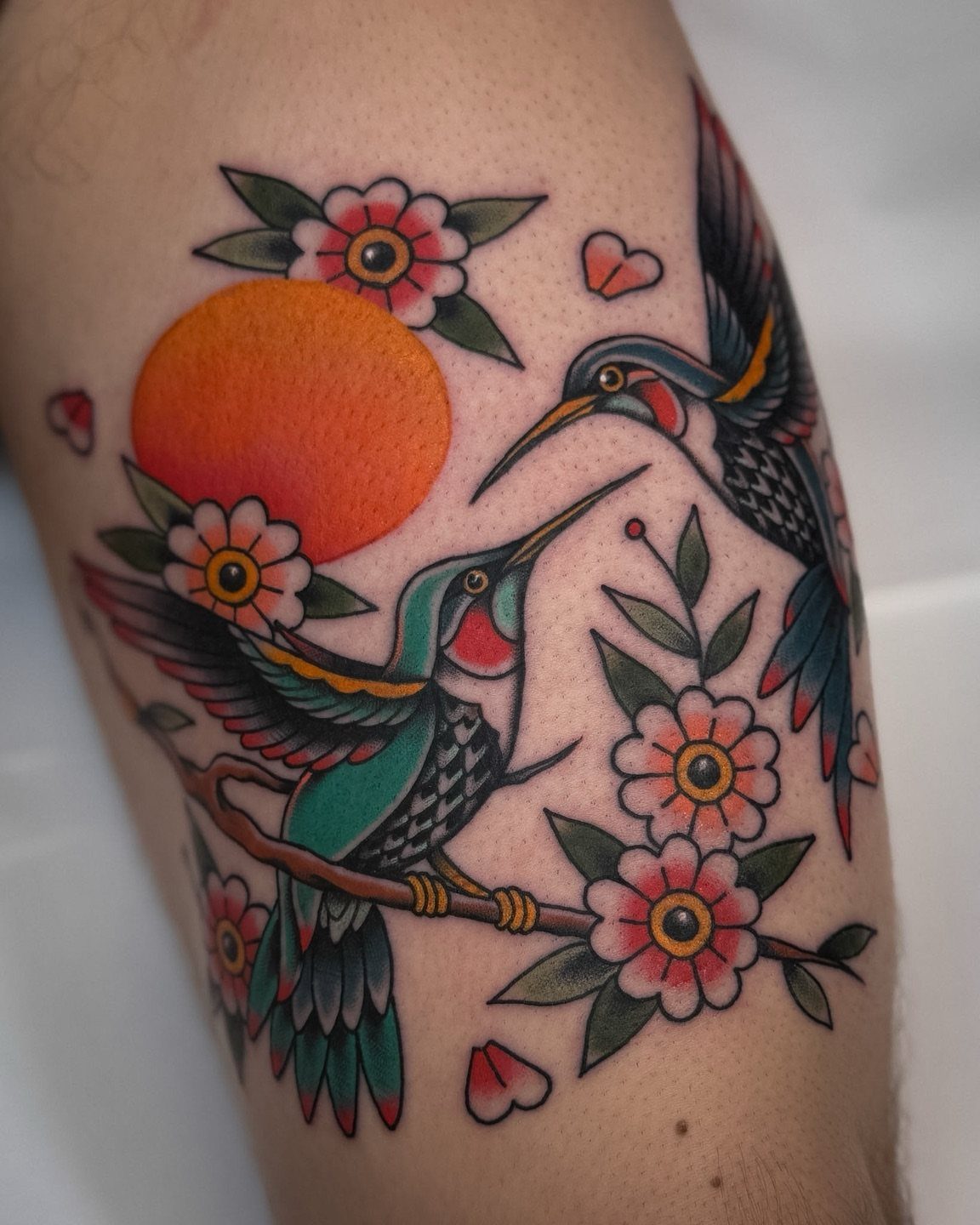
Pairing a hummingbird with flowers gives the piece color and context. In traditional style, the bird and blooms get bold outlines, saturated color and a slight compositional flatness that reads well from a distance.
Flowers like roses, hibiscus or peonies balance the bird’s movement with something stationary. The sun or background elements fill negative space without cluttering the foreground.
Traditional work ages well because the thick lines and high contrast stay strong for decades.
6. Two Hummingbirds Facing Each Other
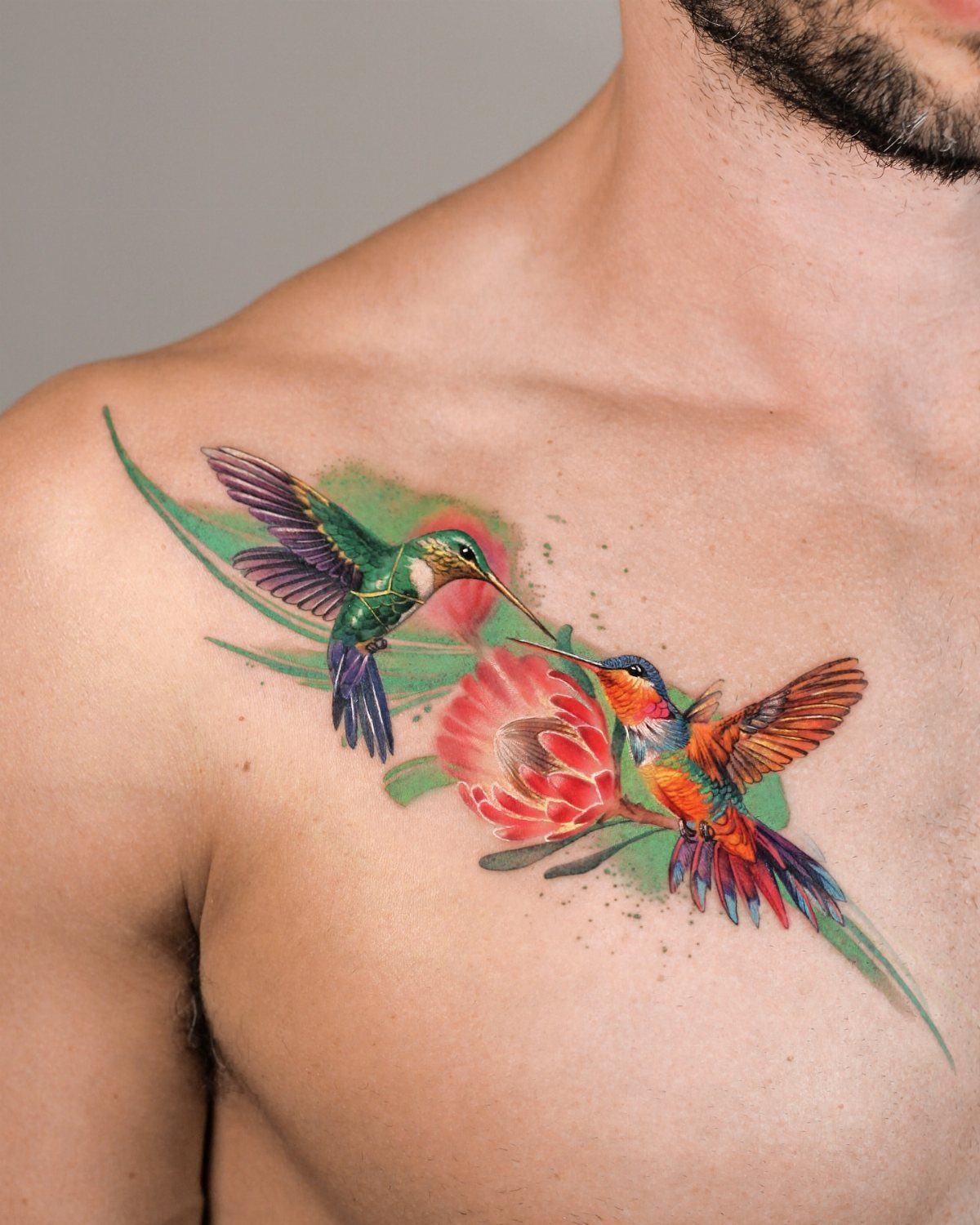
2 hummingbirds facing each other, wings nearly touching, create symmetry and suggest a bond: partnership, duality or balance. Centering them around a flower or focal point on the chest ties the composition together.
Chest placement lets the birds mirror your body’s natural symmetry. The sternum gives a vertical axis, and the pectorals frame the design on both sides.
Color makes the birds distinct from each other.
7. Colorful Hummingbird Tattoo
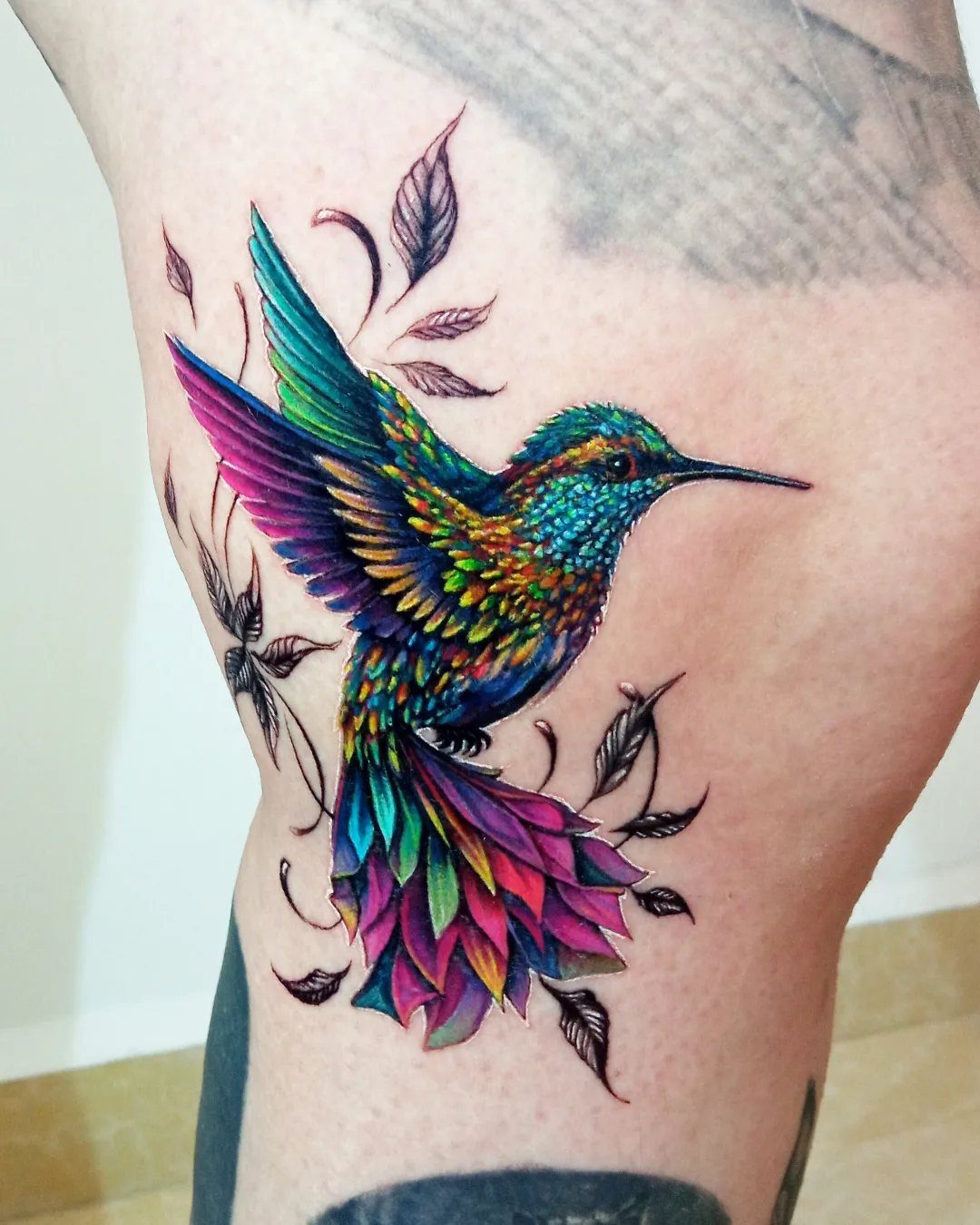
Color makes a hummingbird read as alive: blue and green across the body, pink or purple on the throat, blending into each other the way iridescence actually looks.
On the thigh, there’s room to let the wings spread wide without cramping the composition.
Color fades faster than black ink, especially on areas that see sun or friction. Saturated color fades faster than black, so plan on touching it up to keep it this bright.
The thigh placement keeps it personal. You choose when someone sees it.
8. Hummingbird with Geometric Background
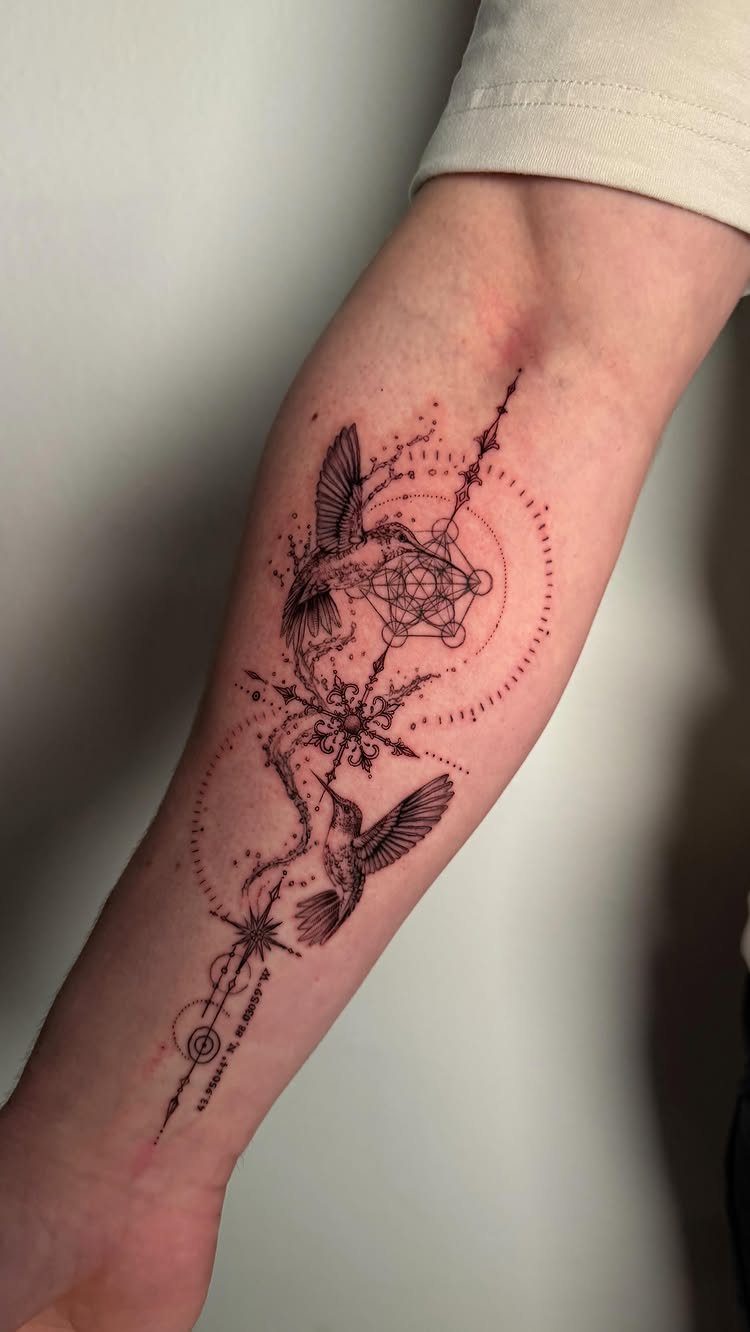
Dots, circles and coordinate lines behind 2 hummingbirds turn the organic shapes into part of a larger system. The geometry frames the birds without boxing them in, and coordinates or other data can sit inside the structure.
Forearm placement makes the whole composition readable at a glance. Flat muscle underneath keeps the linework from distorting as you move.
The dots and lines age better than fine shading.
9. Two Hummingbirds with a Date
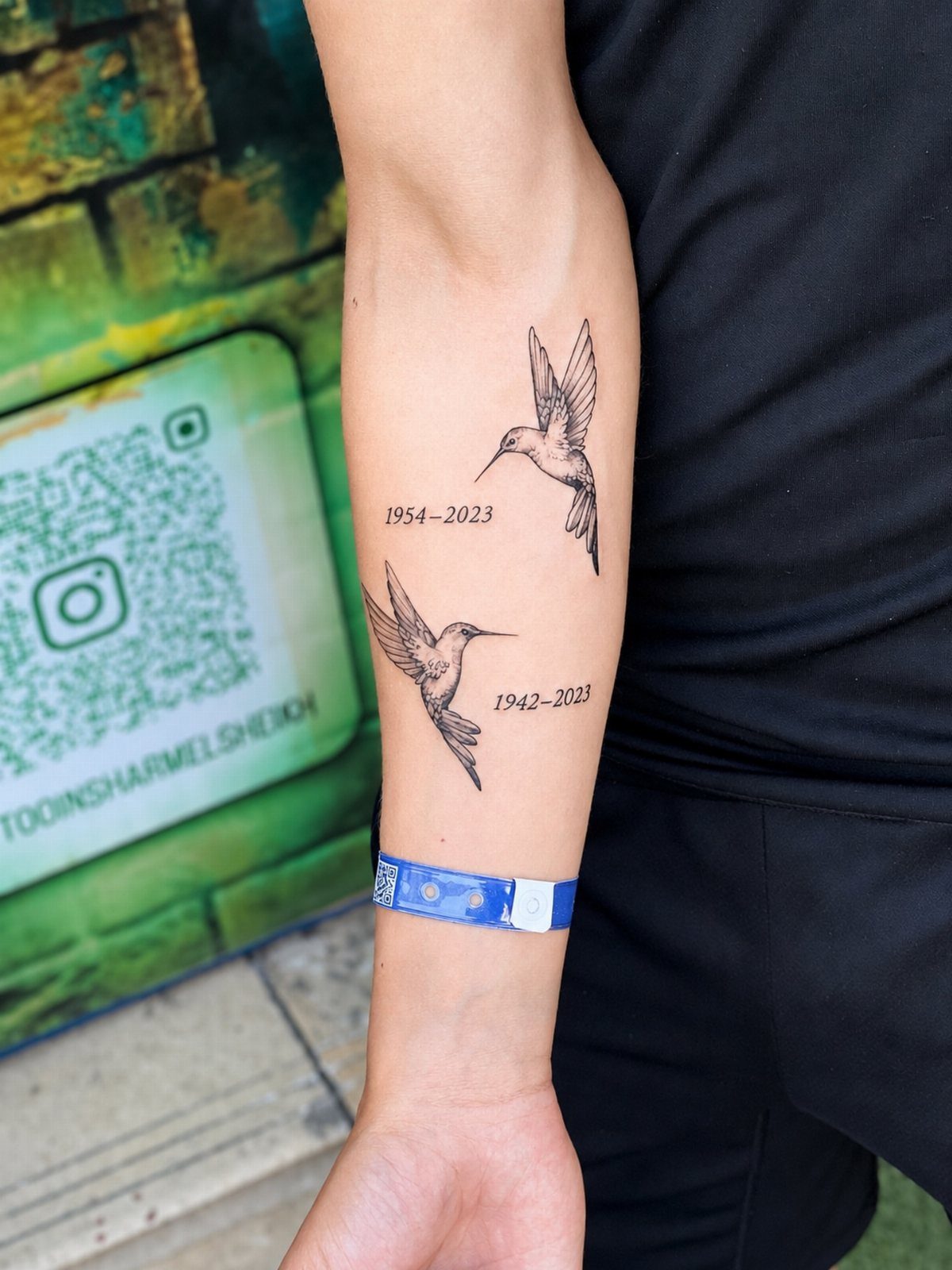
2 hummingbirds flanking a pair of dates mark a memorial or tribute. The dates make the meaning clear without needing text to explain it, and the symmetry gives the piece balance.
The forearm shows it to you every day. Black ink stays readable longer than color for something this personal.
A piece this direct doesn’t need extra decoration.
10. Traditional Hummingbird Tattoo
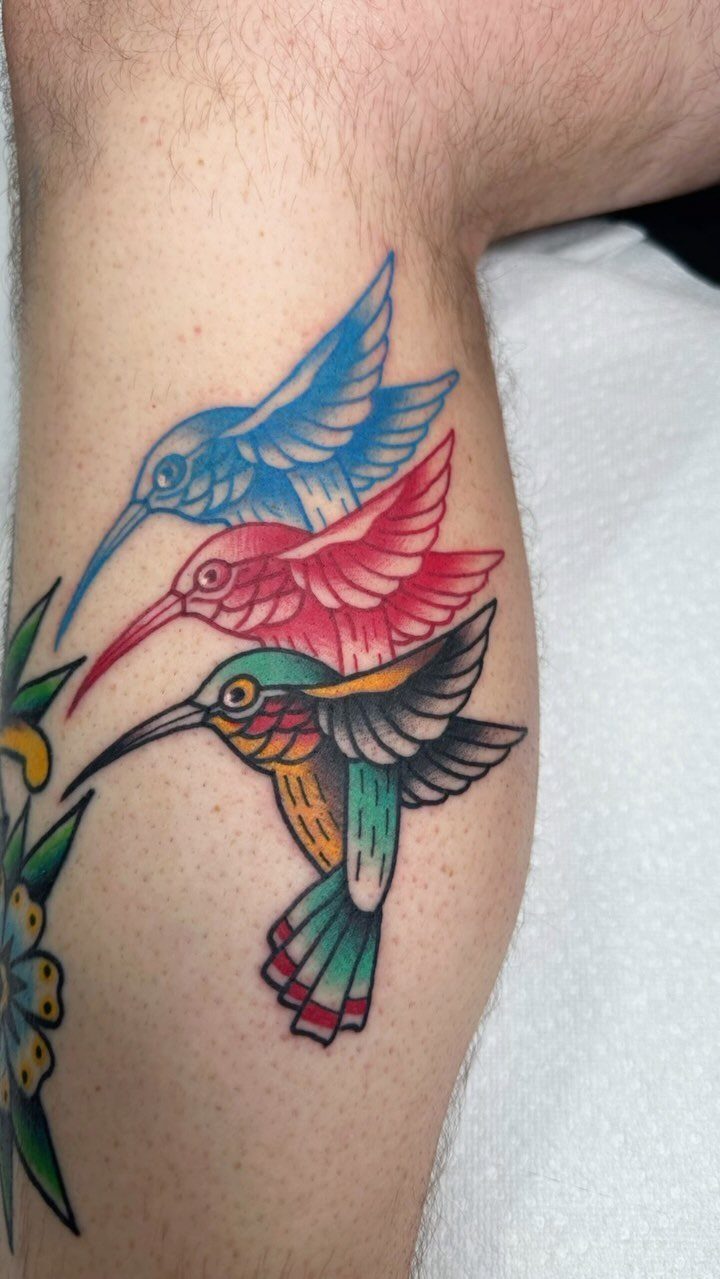
3 hummingbirds in traditional style, each a different color, stacked or grouped on the lower leg. Bold black outlines and saturated fill, no gradients or soft shading.
Traditional work reads well from across the room and holds its shape for decades. The thick lines resist spreading, and the high contrast between outline and color stays strong even as the ink ages.
Lower leg placement works because the design wraps around the calf without needing the birds to distort. Color choice is personal, pick what matters to you.
Placement Suggestions
The forearm works for designs you want to see yourself. Outer forearm suits horizontal birds in flight.
Chest placement centers symmetrical compositions. The chest keeps larger pieces more private than the arm.
Upper arm and shoulder handle bold work well.
Lower leg and thigh offer room for color or multi-bird designs.
The calf wraps around curved muscle, so traditional outlines stay crisp longer than fine shading. The thigh keeps larger color work out of constant sun exposure.
Symbolism of Hummingbird Tattoos
A hummingbird moves differently than other birds.
It hovers, reverses, holds perfectly still in midair while feeding. That control over its own motion is why the bird reads as resilience: the ability to hold your position when everything around you is moving.
The throat patch on most species flashes color only when light hits it at the right angle.
One second it’s visible, the next it’s gone. That shift between presence and absence ties the bird to joy that shows up in moments rather than sitting constant in the background.
Flight without landing suggests freedom, but it’s freedom that takes work. A hummingbird’s wings beat fast enough to blur, and its heart rate runs higher than almost any other vertebrate.
The bird doesn’t coast. That effort makes it read less as escape and more as persistence.
Color Choices
Blue reads cooler, green warmer. Layering both into the same bird mimics the way iridescence shifts as the bird moves.
Red and pink show up on species like the Ruby-throated or Anna’s hummingbird.
In traditional tattoos, red pairs with bold black outlines and sits flat without gradients. In realism, pink blends into purple or orange to mimic the metallic sheen of feathers catching light.
Yellow anchors flowers in compositions where the bird and bloom need to read as separate elements. Yellow petals or centers pull the eye without competing with the bird’s body color.
Black ink holds better over time than saturated color.
Frequently Asked Questions
What is the most masculine tattoo?
Bold designs with strong contrast read masculine: black ink hummingbirds with deep shading, geometric frameworks, or traditional outlines with saturated color.
Upper arm, chest and shoulder placements handle larger work, and thick linework or high-contrast shading holds its shape over decades without softening.
What is the popular bird tattoo?
Hummingbirds rank among the most requested bird tattoos because they balance movement with detail and carry meaning without needing text.
Fine-line versions work on smaller placements like the ankle, while traditional or realistic styles suit larger areas like the arm or chest where color and shading stay readable.